Wednesday, January 22, 2020

Local Teacher's Second World War service

In 1959, the Education Department of Victoria published War Service Record, 1939-1945 which has a list of Teachers, College lecturers and Departmental Officers who enlisted in the Second World War - 1,775 men and women in total. I have found the staff who were connected to schools in the Casey Cardinia region and they are listed here. I have come across one other who enlisted but for some reason is not in the book, so he is also included.

The list is alphabetical by surname, then has the name and number of any local schools they were teaching at before enlistment, their date of birth and a short summary of their service from the book. This service information sometimes differs from that in the Nominal Roll. The dates of birth come from the World War Two Nominal Roll http://www.ww2roll.gov.au/ Some of the entries in the book had photographs and I have included them here.

Here are the abbreviations used regarding the different services -
A.I.F. - Australian Imperial Force 
A.M.F.  - Australian Military Forces
C.M.F. - Civilian Military Forces
R.A.A.F. - Royal Australian Air Force
R.A.N. - Royal Australian Navy
R.A.N.R. - Royal Australian Naval Reserves
W.A.A.A.F. - Women's Auxiliary Australian Air Force.
There is a useful section on the Australian War Memorial website called Understanding Military Structure that explains all these services - https://www.awm.gov.au/learn/understanding-military-structure

Anderson, John Cunningham.  Bunyip, No. 2229.  Born December 28, 1922. Enlisted January 31, 1942 in the R.A.A.F.  Served in England, North Africa, Italy, Palestine and Egypt and took part in night bombing operations in Europe. Discharged January 31, 1946.


John Cunningham Anderson
War Service Record, 1939-1945 (Education Department Victoria, 1959)

Anderson, Maurice Kelvin.   Garfield North, No. 3849, where he was Head Teacher.  Born April 17, 1912. Enlisted December 31, 1941 in the R.A.A.F. Served with his squadron of Beaufort aircraft in New Guinea and Torres Strait. Discharged on medical grounds April 3, 1945.


Maurice Kelvin Anderson
War Service Record, 1939-1945 (Education Department Victoria, 1959)

Bull, Raywood Alfred.  Cranbourne, No. 2068. Born January 10, 1922.  Member of the C.M.F. from January 14, 1942 and joined the A.I.F on September 7 that year. Served in New Guinea and New Britain, then returned to Australia and worked as an instructor and was discharged on August 22, 1946.


Raywood Alfred Bull
War Service Record, 1939-1945 (Education Department Victoria, 1959)

Chapple, Alison Derrick.  Beaconsfield Upper, No. 2560, where he was Head Teacher. He had also been a student teacher at Berwick, No. 40 before his teacher training.  Born June 21, 1908. Enlisted in the A.I.F. on March 28, 1941. Attached to the 13th Australian Armoured  Regiment, 1st Australian Ordnance Vehicle Park in Australia. Discharged December 18, 1945.

Child, Phillip John.   Koo Wee Rup, No. 2629.  Born May 24, 1923. Enlisted on March 25, 1942 in the R.A.N.R. Discharged February 1, 1946.

Cox, Stuart Edward.  Pearcedale, No. 2961. Born  May 4, 1924. Enlisted in the A.M.F. on June 16, 1942 and later transferred to the A.I.F. Served in Australia and was discharged  February 21, 1946.

Dodd, Basil Alcuin.  Rythdale, No. 4231, where he was Head Teacher. He had also been a student teacher at Officer, No. 2742 and Pakenham, No. 1359, before his teacher training.   Born March 13, 1913. Enlisted in the A.I.F. on February 2, 1942. Served in Australia and New Guinea. Discharged December 12, 1945.


Basil Alcuin Dodd
War Service Record, 1939-1945 (Education Department Victoria, 1959)

Donald, Alexander Louis.  Koo Wee Rup, No. 2629.  Born July 7, 1905.  Enlisted December 6, 1939 in the A.I.F.  Served in the Middle East. Discharged January 25, 1943.


Alexander Louis Donald
War Service Record, 1939-1945 (Education Department Victoria, 1959)

Doyle, Allen Andrew.  Caldermeade, No. 4271, where he was Head Teacher.  Born March 24, 1916. Enlisted in the A.M. F. January 13, 1942 and later transferred to the R.A.A.F. Served in Australia, Bouganville and New Britain. Discharged August 31, 1945.

Fyffe, John Raymond.  Heath Hill, No. 3225, where he was Head Teacher. He had also been a student teacher at Emerald, No. 3381.  Born May 25, 1910. Enlisted in the A.M. F. in November 1941.  He served in the 13th Armoured Regiment in Australia and was discharged May 21, 1943.


John Raymond Fyffe
War Service Record, 1939-1945 (Education Department Victoria, 1959)

Graham, Douglas John.  Tynong North, No. 4464. Born September 19, 1919. Enlisted in the A.M.F. on February 5, 1941. He served in the Middle East and the commando forces in New Guinea and the South Pacific. Discharged on October 13, 1945.

Horsfall, Henry Graham.   Tonimbuk, No. 3363, where he was Head Teacher.  Born September 14, 1913. Enlisted in the A,I.F., on July 11, 1940. He served with the 4th Australian General Hospital in the Middle East. Mr Horsfall was one of the 'Rats' of Tobruk. On his return to Australia he became part of the Army Topographical Survey Company. Discharged October 11, 1945. Mr Horsfall was a teacher at Pakenham Consolidated School, when I was there in the 1960s.


Henry Graham Horsfall
War Service Record, 1939-1945 (Education Department Victoria, 1959)

Hunter, Nada.   Narre Warren East. No. 3719.  Born April 11, 1918. Enlisted in the W.A.A.A.F. on June 8, 1942. Stationed at the R.A.A.F. station in Tocumwal, then undertook a course in Radio filter work and photographic interpretation and later attached to Central Intelligence in Brisbane. Discharged December 6, 1945.


 Nada Hunter
War Service Record, 1939-1945 (Education Department Victoria, 1959)

Janicke, Peter Francis Stewart.  Longwarry, No. 2505.  Born June 6, 1924. Enlisted in the R.A.A.F.  on July 10, 1942 and served in New Guinea and the Philippines. Discharged September 4, 1945.

Koochew, Walter John Henry.  Island Road, No. 3952, and had also been a student teacher at Bunyip, No. 2229.   Born January 7, 1914. Enlisted on June 12, 1942 in the R.A.A.F., with the Meteorological section. Discharged October 2, 1945.

Laugier,  Jean Biene Pierre.  Lyndhurst South, No. 1222.  Born March 20, 1902. Enlisted in the A.I.F., on May 20 1940. He saw service in the Middle East and as an instructor with the Northern Territory Force Training School. Discharged March 7, 1944. Mr Laugier also served in the First World War where he was awarded the Military Medal. He enlisted in April 1916 and had his age as 18 years old, which means he was born in 1898. If he was really born in 1902 then he enlisted in the Great War at the age of 14 or else he took four years off his age to enlist in the Second World War, which I believe is the case.


Jean Biene Pierre Laugier
War Service Record, 1939-1945 (Education Department Victoria, 1959)

Mackenzie, Kenneth George.  Catani, No. 4151, where he was Head Teacher. Born July 4, 1904. Enlisted in the A.I.F. on November 13, 1939 and after training arrived in Palestine in May 1940, then Egypt in the September and took part in the Western Desert campaign. He returned to Australia for medical reasons and was appointed as a staff officer to the Chief of the General Staff, then to the 2/7 Australian  Cavalry Commando  Regiment and various other roles until he was discharged February 22, 1946.

McFadyen, Norman.   Dalmore, No. 4002.  Born January 10, 1905. According to the Dandenong Journal, Norman left for military training in October 1939, then returned  a few weeks later. However, according to the Nominal Roll,  Norman enlisted in the A.I.F. on March 17, 1941 in the 52nd Battalion and also enlisted on July 19, 1942. There is no discharge date and he is not listed in the War Service Record, 1939-1945  book.  Did he enlist three times? I do not know, neither do I know why he is not in the book.
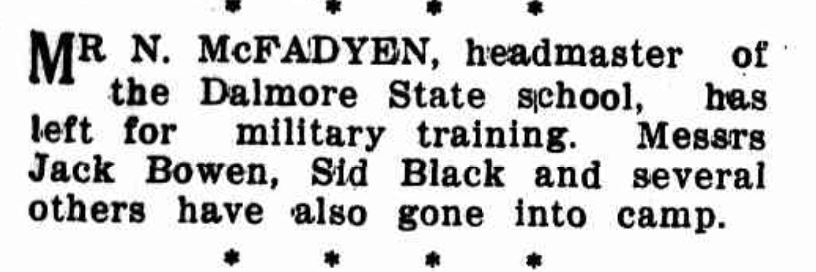

Norman McFadyen of Dalmore State School, leaves for military service.
Dandenong Journal  October 11, 1939


Norman McFadyen returns to Dalmore State School.
Dandenong Journal October 25, 1939  http://nla.gov.au/nla.news-article201308255


McGill, Frederick William.  Narre Warren East, No. 3719, where he was Head Teacher. Born January 21, 1913. Enlisted in the R.A.N. on November 4, 1940,  he spent the war years as an instructor at various locations. Discharged October 9, 1945.

McPhee, Ronald Alexander.  The Gurdies, No. 2224, where he was Head Teacher.   Born April 26, 1911. Enlisted in the A.I.F. on January 13, 1942. He served in the 7th and 3rd Australian Radio maintenance sections and was discharged November 2, 1945.


Ronald Alexander McPhee
War Service Record, 1939-1945 (Education Department Victoria, 1959)

Morgan, James C. H.  Cardinia, No. 3689. Can't find him in Nominal Rolls. Enlisted in the R.A.A.F. on October 13, 1940. Undertook training in Canada from March 1941 and was then posted to the United  Kingdom where he served as a bombing leader with Bomber Command. He was demobilized  on March 21, 1946.

Nilan, Michael Allen Kerins.  Dewhurst, No. 4522, where he was Head Teacher.  Born April 1, 1913. Enlisted in the A.M.F. on January 12, 1942 and served in New Guinea. He was discharged February 13, 1946.


Michael Allen Kerins Niland
War Service Record, 1939-1945 (Education Department Victoria, 1959)

Phillips, Allan Joseph.  Toomuc Valley, No. 3034.  Born February 2, 1903. Enlisted on January 7, 1942 in the A.I.F. He served in New Guinea and Australia and was discharged on medical grounds on March 28, 1945.


Allan Joseph Phillips
War Service Record, 1939-1945 (Education Department Victoria, 1959)

Reed, Sydney John. Army Road, Pakenham, No. 3847, where he was Head Teacher. Born October 4, 1914. Enlisted in A.I.F. on July 1, 1940. Served in Northern Australia, New Guinea and Bougainville. Discharged February 4, 1946.

Revell, John.  Cardinia, No. 3689.  Born January 25, 1915. Enlisted January 13, 1942 in the A.I.F. Served in the Intelligence Branch in New Guinea and Bouganville. Discharged March 27, 1946.

Romanes, John.  Yallock Village, No. 3420, where he was Head Teacher.   Born February 18, 1912. Enlisted in the R.A.A.F. on June 23, 1941. Attached to the 1st Cavalry Division, U.S. Army. Discharged October 16, 1945.


John Romanes
War Service Record, 1939-1945 (Education Department Victoria, 1959)

Sheldon, Clarence George.   Tynong North, No. 4464, where he was Head Teacher. He was also a student teacher at Longwarry, No. 2505. Born October 10, 1910. Enlisted in the A.M.F. on June 23, 1942 and discharged a few months later on August 31, 1942.


Clarence George Sheldon
War Service Record, 1939-1945 (Education Department Victoria, 1959)

St Ellen, Joseph James.  Labertouche, No. 2471, where he was Head Teacher. Born November 3, 1912. Enlisted October 29, 1942, in the A.I.F., even though the Education Department War Service book said he had undertaken training in 1941. Served in New Guinea and Bouganville and took part in the organization of rehabilitation training for members of the  Australian forces after the surrender of Japan.  Discharged January 18, 1946.


Joseph James St Ellen
War Service Record, 1939-1945 (Education Department Victoria, 1959)

Friday, January 17, 2020

Crimean War and Indian Mutiny veterans in Casey Cardinia region

I thought it would be interesting to find out what historic connections there were between the Casey Cardinia region and some of the pre-Great War conflicts, specifically the Crimean War. However, I discovered that one Crimean veteran also fought in the Indian Mutiny, as it was traditionally known.  We will start of with a short history of both conflicts from the Australian War Memorial website.

The Crimean War (1853 to 1856) was fought between Imperial Russia on one side and an alliance of France, the United Kingdom, the Kingdom of Sardinia, and the Ottoman Empire on the other. Most of the conflict took place on the Crimean Peninsula, with additional actions occurring in western Turkey, and the Baltic Sea region. (Australian War Memorial website, see here)

The Indian Mutiny - The Indian Rebellion of 1857 began as a mutiny of sepoys of British East India Company's army on the 10th of May 1857, in the town of Meerut, and soon erupted into other mutinies and civilian rebellions largely in the upper Gangetic plain and central India, with the major hostilities confined to the region of present-day Uttar Pradesh, Uttarakhand, northern Madhya Pradesh or Saugor and Nerbudda Territories, Delhi, and Gurgaon. The rebellion posed a considerable threat to British power in that region, and it was contained only with the fall of Gwalior on 20 June 1858. The rebellion is also known as India's First War of Independence, the Great Rebellion, the Indian Mutiny, the Revolt of 1857, and the Sepoy Mutiny. (Australian War Memorial website, see here)

I knew we had some Crimean veterans who had come to Australia and lived locally as there is this paragraph in the book Early Days of Berwick - Two Crimean War Veterans, Mr Drummond and Mr Adams, resided in High Street, Berwick. These two old gentlemen wearing their Crimean War medals, could often be observed sitting in the Boulevard, enjoying the sunshine. It was said that Mrs Drummond was contemporary with and associated with Florence Nightingale, nursing at the Crimea. 

I can find no information on Mr Adams, but a report in the South Bourke and Mornington Journal of August 10, 1911 said that Tom Drummond celebrated his golden wedding anniversary on Friday evening and Private Tom wears a couple of Crimean medals of which he is justly proud (see article here) So, now we know Mr Drummond's first name and according to the Electoral Roll, his wife was called Mary.  The Victorian Births, Deaths and Marriages Index tells us that Tom died in 1915 at Berwick, that he was aged 86 and his mother's name was Mary and his father's name was Thomas. His obituary in the Berwick Shire News of  June 23, 1915 said that he came to Adelaide in 1875 and eight years later moved to Victoria where he lived at Toora and Mirboo North and he came to Berwick about four years ago.  Tom was attached to the Coldstream Guards and was in the trenches at the taking of Sebastapool and the battle of Alma. He was also in other minor engagements, and was awarded the Crimean war medals issued by the English and Turkish Governments, which he greatly treasured (Berwick Shire News June 23, 1915, see here) I am not sure when Mary passed away - there is a Mary Anne Drummond who died in 1927 in Cheltenham, aged 89 (parents listed as Michael Seabright and Elizabeth Tobin). This is possibly her. It is quite interesting that Mrs Drummond nursed with Florence Nightingale, I will do some more research on her (Mrs  Drummond) one day.

I found this in Punch magazine of May 14, 1914 and I feel the article must be about Tom and Mary Drummond - An interesting presentation was made to Lady Stanley during her visit to Beaconsfield last week. This was an old Crimean veteran, as far as is known, the only surviving one in this part of the world. His wife, an elderly lady, who was also present the same afternoon, came in for much attention. She was one of Florence Nightingale's nurses, and pursued her work of healing through the horrors of the Crimean War also. The old gentleman is eighty-five, and his wife is seventy-five. The old lady was very worried because her husband had been presented to Lady Stanley whilst she had not, and "e'll be crowing over me, too, and I've got something interesting to tell Her Ladyship." Later in the afternoon the second presentation was duly made, and Lady Stanley was very interested to hear that her grandmother was also one of the volunteer nurses who went out with Florence Nightingale. When the guests departed the old couple were left happily hand in hand comparing notes over the events of the afternoon, both looking well and happy, in spite of the fact that the old lady had been operated on only six weeks ago. (Punch, May 14 1914, see here)


Death notice of William Fist, Crimean veteran
The Argus February 16, 1921 http://nla.gov.au/nla.news-article1736766

Another Crimean veteran who lived in the area was Color-Sergeant William Fist who died February 14, 1921 at the age of 80. He was also a veteran of the Indian Mutiny. William Frederick Fist is listed in the 1919 Electoral roll at 4 Grattan Street, Prahran, with his wife Fanny Maria Fist (nee Croxford) whom he married in 1912, so I am not quite sure of the connection to Lyndhurst, but it is listed in the death notice and the short obituary that appeared in the Frankston and Somerville Standard (see below) refers to him as an old Lyndhurst identity, and who had taken part in the Seige of Lucknow.


Obituary of William Fist
Frankston and Somerville Standard, February 25, 1921  http://nla.gov.au/nla.news-article75948196

From various newspaper reports we can build  a picture of some of William's life. In April 1875, William was brought before the Emerald Hill Court by his wife Elizabeth for maintenance. The report said that the marriage of the pair took place in India in 1860, and in consequence of the insobriety of Mrs. Fist, a separation took place some time since. The defendant, who held a commission in the 16th Lancers in India, and was now filling the occupation of coachman at Toorak. (The Age April 15, 1875) The result of the court case was that Mrs Fist was granted 7 shillings and six pence per week. Mrs Fist was back in Court in August 1889, claiming the William had not paid maintenance since October 1886 and that she was thus owed £52.

Two years later he was back in Court on a perjury charge. William had given evidence at an Inquest at the City Morgue that the deceased woman, Mary Anne Keilly, who was the subject of the Inquest,  was his wife, when in fact they were not married but had been living together for years and she was known by the neighbours as Mrs Fist. His Honor said that in committing the crime of perjury the accused did not appear to have been actuated by any sordid motive. But the circumstance did not justify the prisoner in perjuring himself. His Honor believed that he swore what was untrue to save the character of the woman with whom he had been living, and for the sake of the character of her children. (The Herald July 27, 1891, see here)

In 1909 the Weekly Times had some photographs of Naval and Military Veterans taken at the Victoria Barracks, and William Fist was in one of them.


 Veterans of the Crimean and Indian Mutiny Wars - William Fist is seated on the right.
Weekly Times November 20, 1909.  http://nla.gov.au/nla.news-article221824966

The only other Crimean War connection I can find was that of Charles James Jago, who died February 1, 1914 at the age of 77. He had been Mayor of Richmond and then left Richmond and retired to his handsome country residence at Springvale. Mr Jago was the Shire President of Dandenong, so just outside the Casey Cardinia region. You can read his obituary in the Dandenong Advertiser of February 5, 1914. It had this to say about his experience in the Crimean War -   At the age of 16 he was engaged as a bugler in the Crimean war, and was engaged right through the campaign, with all its hardships and privations, and later took a prominent part in the siege of Sebastopol. (Dandenong Advertiser, February 5, 1914, see here)


Death notice of Crimean War veteran, Charles Jago.
The Leader February 7, 1914.  http://nla.gov.au/nla.news-article89316164


Place names
The battles and personalities of the Crimean War were a source of place and street names  - a prime example can be seen in the suburb of St Kilda which has a Crimea, Alma, Inkerman and Redan Streets and is near the suburb of Balaclava. The towns of St Arnaud and Sebastapol also have  a Crimean War connection. Locally there are three streets in Cranbourne with a Crimean War connection -
Codrington - Sir William John Codrington (1804 to 1884) was Commander in Chief of the British Forces in the Crimean War from 1853 to 1856.
Clarendon - George William Frederick Villiers, 4th Earl of Clarendon (1800 to 1870) was Lord Lieutenant of Ireland from 1847 to 1852 and the British Foreign Secretary on three occasions from 1853 to 1870. He negotiated a favourable outcome for Britain at the end of the Crimean War in 1856 at the Congress of Paris Peace talks. The Crimean War, which was a war between Britain, France, Turkey and Sardinia against Russia took place largely on the Crimean Peninsula in Russia.
Lyons - Admiral Sir Edmund Lyons (1790 to 1858), Ist Baronet Lyons, commanded the Black Sea fleet during the Crimean War.

I also believe that Pakenham was named after Lieutenant-Colonel Edward William Pakenham (1819 -1854) who was killed at Inkerman during the Crimean War. This has been disputed, but I stand by my research. You can read more about the naming of Pakenham, here.

Lucknow, in East Gippsland, is the only place name I know connected to the Indian Mutiny.

I have created a list of articles on Trove, on these three Crimean War veterans, you can access it here. All the articles referred to here are on the list.

Wednesday, January 1, 2020

Rowville Prisoner of War camp - tragic shooting

In December 1944, a camp was opened in Rowville to house Italian Prisoners of War. It was under the supervision of the Murchison camp and initially housed 100 inmates. The camp was located on the south west corner of Stud and Wellington Road, when Rowville was still very much a country town. It was very low security and the men worked on the neighbouring farms, the engineers depot at the Oakleigh rail yards or the salvage depot at Fisherman's Bend. In June 1945, Rowville became a relocation camp for prisoners who were to be relocated to other areas.

As you might imagine, the prisoners often formed close relationships with the locals, including some romantic attachments. One of these men was Rodolfi Bartoli, who worked on a farm owned by the Gearon family and he and Nora Gearon became attracted to each other. Sadly, I cannot tell you that this relationship had a  happy ending, as it ended in tragedy.  Rodolfi was shot dead on March 20, 1946 by the commandant of the camp, Captain Waterston. Was it cold blooded murder or warning shot which was fired that had a deadly result?


Darren Arnott, has written a fascinating book about the Rowville camp and the tragic shooting. The book,  No Regard for the Truth: Friendship and Kindness. Tragedy and Injustice. Rowvilles's Italian Prisoners of War  has many photographs, transcripts of the official inquiries which took place after the event, lovely letters written to Nora from Rodolfi and letters written between Nora Rodolfi's family in Italy.

An interesting and little known part of our local and military history, this book is  a great read. You can borrow it from the Library, click here, or Darren has links on his website to purchase either  a print or electronic copy, https://darrenarnott.com/

Thursday, December 19, 2019

Shire of Cranbourne certificate presented to Edwin Spencer Johnson

This certificate is from the Koo Wee Rup Swamp Historical Society collection and was awarded to Edwin Spencer Johnson by the Shire of Cranbourne, in appreciation of your voluntary enlistment for active service overseas. It is dated march 27, 1943 and was signed by Shire President, Cr Matthew Bennett, M.L.A; Cr Leslie James Cochrane, M.L.A and Shire Secretary Allan Frank Buchanan.


Edwin Johnson's Shire of Cranbourne certifcate
Koo Wee Rup Swamp Historical society collection

The certificate was presented at a function at the Koo Wee Rup Memorial Hall on Saturday, March 27, 1943 and it was reported on in the Koo Wee Rup Sun of  April the 1st. The dance and presentation night was held under the auspices of the Koo wee Rup Citizens' Send-off and Welcome Home Committee. 250 people were present to farewell the 16 local boys who enlisted - only four of whom were present - Ken Child, Wallie Ellett, Gordon Hobson and Keith Barnes. Cr Cochrane said that the Committee had farewelled 93 servicemen and each man (or their family) were given £2 and the Cranbourne Shire Certificate shown here. The twelve men who could not be present were listed as J. O'Brien, H. Jacob, Ted Johnson, J. Davey, K. McInnes, C. Loveday, L. Colvin, L. Seddon, B.L. Broadbent, A. Burton, Colin Burton and G. Cuff.

Here's some information about Ted Johnson, the man whose certificate we have -
Johnson, Edwin Spencer (SN VX117828 Australian Army) Ted was born in Dandenong on August 29, 1914 and was living in Koo Wee Rup when he enlisted. He was discharged Janaury 11, 1946. On July 15, 1944, Ted married Gladys Warren, of Upper Yannathan, at St Johns Church of England in Lang Lang. Gladys wore a graceful frock of white chantilly lace, with an ivory tuille veil. There is a lovely report of their wedding in the Dandenong Journal of  August 2, 1944, read it here. The report also tells us that Ted Johnson was the eldest son of Mr & Mrs W. Johnson of Charles Street in Koo Wee Rup. Ted and Gladys are listed in the 1954 Electoral Roll in Lang Lang, his occupation was  a butcher. Ted died on August 23, 1990  and Gladys on July 28, 1997 and they are both buried at the Lang Lang Cemetery.

Here is some brief biographical information  of the other men who are listed in the Koo Wee Rup Sun article. The information is from the World War Two Nominal Rolls http://www.ww2roll.gov.au/ and  includes their Service numbers (SN)

Barnes, Keith Henry  (SN 119759 Royal Australian Air Force). Born in Swan Hill, lived in Koo Wee Rup. Discharged March 18, 1946.

Broadbent, Benjamin Lane ( SN VX112302 Australian Army)  Born in Northcote, lived in Koo Wee Rup. Discharged May 10, 1946. Ben Broadbent was well known in Koo Wee Rup as the owner of Broadbent's Drapery store.

Burton, Allan Edward  (SN VX123516 Australian Army).   Born and lived in Koo Wee Rup. Discharged September 24, 1946.

Burton, Colin Stewart (SN VX113988 Australian Army) Born and lived in Koo Wee Rup. Discharged December 15, 1943.

Child, Kenneth Samuel (SN PM5468 Royal Australian Navy) Born and lived in Koo Wee Rup. Discharged April 12, 1946.

Colvin, Leonard Michael (SN VX122263 Australian Army). Born and lived in Koo Wee Rup. Discharged December 19, 1945.

Cuff, Gordon George (SN VX110054 Australian Army). Born in Lismore in NSW, lived at Koo Wee Rup. Discharged June 2, 1948.

Davey, John Arthur  (SN VX117309  Australian Army) Born in Dandenong, lived in Koo Wee Rup. Discharged June 7, 1946.

Ellett, Walter Lyell (SN PM5217  Royal Australian Navy) Born and lived in Koo Wee Rup. Discharged February 14, 1946.

Hobson, Gordon James (SN VX67536 Australian Army) Born in Bunyip, lived in Rythdale. Discharged January 8, 1944.

Jacob, Harold Allen (SN PM5297  Royal Australian Navy)  I believe this is the right man - he was born in Murrayville and he doesn't have  a place of residence listed, however his next of kin is listed as W. Jacob and there is a William Alexander and Anne Olive Jacob in the Electoral Roll at Koo Wee Rup in 1942, so I believe I have the right man. Harold was discharged June 3, 1946. The family are listed in Tynong North in the 1949 Electoral Rolls.

Loveday, Cuthbert Lyall  (SN VX112913 Australian Army)  Born and lived in Koo Wee Rup. Discharged October 31, 1945.

McInnes, Keith Gordon  (SN 120614  Royal Australian Air Force)  Born in Rushworth, lived in Koo Wee Rup. Discharged April 11, 1945. 

O'Brien, J Not sure who this is. The Koo Wee Rup Sun article said that he joined the Royal Australian Navy, but I can't find a J. O'Brien with a Koo Wee Rup connection.

Seddon, Charles Leonard  (SN VX106720 Australian Army)  Born in Stanley and lived in Koo Wee Rup. Discharged January 14, 1946.

The men who signed the certificate were - 
Bennett, Matthew (1862 - 1951) Owned a  dairy farm  at Catani. He was a Cranbourne Shire Councillor from 1925 until 1951. He was a member of the Legislative Assembly for Gippsland West from 1929 until 1950 for the Country party and was succeeded Les Cochrane.

Cochrane, Leslie James  (1894 - 1972) Cranbourne Shire Councillor from 1930 - 1964, Shire President 1935/1936, 1946, 1949/1950 and 1957/1958. He was a member of the Legislative Assembly for Gippsland West from 1950 to 1970. I have written about Cr Cochrane, here.

Buchanan, Allan Frank.  Cranbourne Shire Secretary from 1935 until 1950. In October 1950 he took leave of absence due to ill health and retired in April 1951. You can read about his retirement in the Dandenong Journal, here.

Saturday, December 14, 2019

Men from the Berwick Show Committee enlist

This is an interesting article about the Berwick Show Committee - seven of the men enlisted to serve in the Second World War and the article also lists the Committee members who served in the First World War. The Berwick Agricultural & Horticultural Society, to give the Show Committee its formal name, was established in 1856 and they held their first show in the form of a ploughing match in 1857 at Holly Green, Thomas Walton's farm at Narre Warren. You can read about the 1857 and 1858 ploughing matches, here.

Dandenong Journal November 15, 1939

We will have a look at the men in more detail. For information on the World War Two men, you can access the Nominal rolls, here http://www.ww2roll.gov.au/  The World War Two records are in the process of being digitised by the National Archives of Australia, so you may be lucky and find a fully digitsied record, here www.naa.gov.au The Archive series number is B883, so that will help you locate the records. The World War One men have their Service Numbers (SN) listed and you can see their full record on the National Archives of Australia, website.

The newspaper article is dated November 15, 1939 and implies that the men enlisted at that time, even though they (apart from David Knox) all enlisted much later according to the Nominal Rolls, in fact, all in July 1942 and they all have more than one service number, so it seems there is something about this that I don't understand. I believe the digitising of the National Archive records will be completed in September 2020 and they will provide more information.

Anderson, J. W - This maybe John Wilson Anderson, son of Leslie Wilson  and Isabella Henderson Anderson of Girvan, Wilson Street, Berwick. He was born in 1918 in Warnambool, and the family are listed in the 1942 Electoral Rolls at Berwick. However the only John Wilson Anderson who enlisted was born in 1912, also by coincidence in Warnambool - so J.W. Anderson's identity is unconfirmed at the moment.

Gamble, William Crawford  (VX 102742 / VX 23433) William  lived at  Hazeldene, Berwick. He was a farmer, born April 20, 1916. He enlisted on July 7, 1942 and was discharged April 24, 1946 and he  returned to farming at Berwick after the war.

Gardiner, John Morris (VX89492 / V23862) John was born February 26, 1916 and was a dairy farmer from Glenbarr, Berwick. He enlisted on August 27, 1942 according to the Nominal Rolls, but December 16, 1938 according to his record at the National Archives. His application form includes a medical examination, and it was conducted by long-term Berwick doctor, Percy Langmore.  John was discharged on December 7, 1945 and he returned to his farm on Buchanan's Road in Berwick. 

Knox, David William Robert Lieutenant  (VX 174) (listed  in the report as Know) David was born December 4, 1916  and his parents were Sir Robert and Lady Knox of Greenknowe, St George's Road in Toorak. In February 1939 David was engaged to Miss Peggy Mollard, you can read an account of their engagement party, here and see a photo of the lovely couple, here.  David enlisted on October 26, 1939, and his occupation was 'merchant and agent.' Sadly, his engagement to Peggy did not last and in December 1941 he announced his engagement to Eirene Rose Angliss and they were married in January 1942. David was discharged March 3, 1944.  I presume the Knox family had a farm in the Berwick region and that is why he was involved with the Show Committee. After the war, David is listed in the Electoral roll as a farmer at Nagambie. 

Lloyd, John Charles.  John lived at Brechin at Narre Warren, now the site of the Fountain Gate shopping centre, you can read about John and Brechin, here.  John's uncle, Charles Lloyd, had purchased the property, then called Holly Green,  in 1924, from the Webb family. Sidney Webb had purchased Holly Green from Thomas Walton, and it was as we said where the first 'Berwick Show' was held in 1857.  John, born October 21, 1906, enlisted on July 26, 1942 and was discharged May 9, 1944. His service numbers were VX104306 and V42081. 


John Lloyd (1906 - 1984)

Moran, Laurence Alexander (VX 102747, V23861, V23863)  Laurence was born December 31, 1917, in Berwick. He enlisted on July 7, 1942. Laurence was discharged February 13, 1944 and he returned to farming at Narre Warren.

Wilson, George Pritchard Harvey  (VX89093 / V23857) George enlisted on July 20, 1942 and was discharged August 16, 1944. He was born on March 10, 1918 to George and Maria (nee Pritchard) Wilson. George was the grandson of James Wilson (1833-1910) and great nephew of William Wilson (1830 - 1907) early Berwick pioneers. It was William Wilson who started the Berwick Quarry, now Berwick Botanic Park. You can read about the Wilson family and the Quarry, here. 

The article also lists the Show Committee men who served in the First World War. 

Beaumont, Norman Edward.   Norman was born October 1895, had an operation to fit himself for active service, but did not pass the medical, so he took himself off to England to offer his services to the Empire and was employed at the Ministry of Munitions as as trainee chemist. He wrote to the Pakenham Gazette in May 1917 outlining his role, you can read it here. Norman Beaumont is a co-author of Early Days of Berwick. He is also a grandson of Ann Wilson (1827-1909, Mrs James Buchanan), the sister of William and James Wilson, mentioned above.

Cooper, Robert William (SN 199)  Robert enlisted at the age of 28 on September 14, 1914, his occupation was a farrier. He Returned to Australia December 9, 1919. Robert is listed in Electoral Rolls at Berwick from 1931.   

Gamble, William.  William served in the Boer War in the First Victorian Mounted Infantry Company. He was the father of William Cooper, listed above, William, snr, had been Principal of the Dookie Agricultural College and they came to Berwick in 1922. I found this out from Mrs Gamble's obituary, which was in the Dandenong Journal in January 1944, you can read it here.  

Gardiner, John James (SN 1651) John served in the Boer War and the First World War. I have written about John and his three brothers and two nephews who served in the Great War, here. John and his wife, Moya, did not have children, so I don't know if he is connected to John Morris Gardiner, listed above.

Greaves, Charles Forrester (SN 13156) Charles enlisted on July 10, 1915 aged 24.  Charles Returned to Australia  May 6, 1919.
Greaves, Sydney Alexander (SN 6523) Lieutenant Greaves enlisted at the age of 23 on July 16, 1915. He Returned to Australia  May 29, 1919. 
Charles and Sydney were the sons of of Edwin and Margaret (nee Forrester) Greaves of The Springs, Berwick. Edwin's brother, William, owned Picnic Park at Lyndhurst. The brothers are listed on the Cranbourne Presbyterian Church Honor Roll, see here. 

Rae, George Frederick (SN 5071) George enlisted on January 20, 1916 at the age of  23 and he Returned to Australia March 25, 1919. George was the son of Frederick William and Annie (nee Troup) Rae.  George's grandfather, George (1830-1899) opened a store in Narre Warren North (then just called Narre Warren) in the late 1860s. George was a Berwick Shire Councillor and was also involved in the Dandenong Agricultural & Pastoral Society, read about this here. 

Ryan, Rupert  Colonel  (1884 - 1952).  Colonel Ryan was the brother of Lady Casey and they inherited Edrington  in Berwick from their aunt, Winifred Chirnside in 1934, read about the Caseys and Edrington, here.  Colonel Ryan had a distinguished military career and after the War he was an arms salesman for Vickers Ltd and was also involved in intelligence-gathering (he was a spy!) In 1935 he returned to Australia and had a Romney Marsh sheep stud at Edrington. He was also a politician and held the seat of Flinders. This biographical information comes from his Australian Dictionary of Biography entry, written by Diane Langmore, read it here.

Sturken, John Ferdinand (SN 75) John was 21 when he enlisted on March 19, 1915.  He Returned to Australia October 31, 1915 and was discharged on medical grounds (neurasthenia)  in March 1916. John also enlisted to serve in World War Two in March 1942 and was discharged in the November. John married Euphemia 'Effie' Wilson in 1923. Effie was the granddaughter of  Ann Buchanan (nee Wilson) who we mentioned before and thus the first cousin of Norman Beaumont. Effie was also the granddaughter of William Wilson (1830-1907) as her mother, Annie Buchanan, had married her first cousin William Wilson jun (1860-1938). People did that in those days, married their first cousins, it's still legal to do so, but appears to be a rare thing now. You can read John's obituary in the Dandenong Journal of February 3, 1943, here. 

Thewlis, James Sydney (SN 609)  James enlisted on November 22, 1916 at the age of 20 and he Returned to Australia April 5, 1919.  He was a farmer at Pakenham and also a Shire of Berwick Councillor for many years. Thewlis Road in Pakenham is named after the family.

Thursday, November 7, 2019

Armistice Day

November 11 is the day we commemorate the Armistice, or the end of World War One. It is also called Remembrance Day, for obvious reasons, when we remember those that died in the Great War and other conflicts.

Here are some World War One statistics from the Australian War Memorial website. In 1914, Australia had a population of about 4.9 million people - 416,809 enlisted - mainly men, but the figure includes 2,861 nurses. In fact, 38.7% of the male population aged between 18 and 44 enlisted. 336, 931 embarked for service overseas and of these 60,000 were killed and 156,000 wounded, gassed, or taken prisoner. You can see what a massive impact the War had on the population and the figures don’t count the number of returned soldiers who died prematurely from their injuries - both physical and psychological - and one estimate from the Australian War Memorial is that between 1919 and 1933 38,000 returned soldiers died.

In 1918,  the announcement of the end of the War was on a Monday and the newspapers had reports on how local communities celebrated the end of the War. The language is a bit more nationalistic and jingoistic, than what you will see in the mainstream media these days. 


Alex Dunlop of  Koo Wee Rup. Alex was only 18 when he enlisted on May 8, 1915 and he survived the War, saw the Armistice declared and Returned to Australia March 31, 1919. His Service Number was 2811. 
Image: Australian War Memorial


Koo Wee Rup -  from Koo Wee Rup Sun, November 13, 1918.
News was received here on Monday night.  It was accepted with reserve by many, who remembered former fiascos, and waited for official intelligence. Fog detonators were exploded on the line, and there was some cheering, but many people resolved, to wait till morning before getting unduly excited. Then, when the morning papers came through, it was seen that the long war was over at last, and the Huns' fangs had been drawn.

A little after ten o'clock the hall doors were thrown open, and the school children, marshalled by Mr Eason, head teacher, marched into the building, where a programme of patriotic airs was rendered, with songs by Miss Mickle, Mr E.J. Lupson and Sergeant Finck. Messrs Eason and Hopkins made suitable speeches. Mrs Townson presided at the piano. The National Anthem was sung with great fervour. ‘The Marseillaise’, and ‘Rule Britannia,’ ‘Anzacs Every One,’ ‘Soldiers of the King,’ etc. Cheers were given lustily, and a collection was taken up to give the school children a picnic during the afternoon, Mrs J. A. Mickle kindly offering the use of a paddock. A couple of returned soldiers were present, and these got an ovation. The afternoon was spent, pleasantly, with a really capital sports programme, about £3 being collected.

In the evening a dance was given, by Mr and Mrs M'Namara in honor of the victory at which there was a very large attendance. The utmost happiness was in everybody's face, and all enjoyed themselves thoroughly. Excellent music was furnished by a band from Tooradin - Miss King, (piano), E. King (cornet), and J. Glasheen (violin). Songs were rendered by Mrs Donald. Miss Jessie Coates, Messrs Lupson, Donald, and Pepper. Cr E. Simpson Hill made a speech, in which he referred to the doings of our boys at the front, and gave instances of their heroism, which were loudly applauded. 

An excellent supper was provided. Considering that the social was not arranged until mid-day and that it was a postal holiday, the goods having to be ordered from Melbourne, it seemed an impossible performance to get these sent on the 1.15 p.m. train, to arrive in time for the evening's festivities. Yet it was done, reflecting great credit on Dance's, the Melbourne caterer, and Mrs M'Namara. The McNamara’s were the owners of the Royal Hotel.


This is Robert Henry, from Yallock. Robert enlisted on July 8, 1915 at the age of 19. He Returned to Australia March 2, 1919, so he also lived to see the Armistice declared. His Service Number is 344.
Image: Australian War Memorial.


Lang Lang -  Koo Wee Rup Sun, November 13, 1918
When the news came of the signing of the armistice by Germany at 8.45 p.m. there was an expression of over-whelming joy amongst the townspeople, who soon turned up from bed and fireside. In the midst of all the jubilation there was a certain amount of sober seriousness, and also of deep sympathy for the mourners of loved ones.

It wasn't long before a town band made its appearance, and Mr E. Cougle rode round, breaking the news at front doors. Everybody resorted to the hall, where patriotic airs were sung after ‘Oh, God, our Help in Ages Past’ and ‘Praise God, from Whom all Blessings Flow.’ Rev. N. Danne, Constable Cole, Mr E. Wiseman. Mr  E. Cougle, and others made short speeches, punctuated by the band, on the platform. Everybody went home at 11.30 p.m. with light hearts and prepared to make a day of it on Tuesday in the Show Grounds, where all sorts of sports were indulged in.

Clyde  (Koo Wee Rup Sun, November 20, 1918
Great excitement was caused locally by the news that Germany had signed the armistice. The news was received here on the Monday night. Fireworks, rattling of tins, ringing of bells, etc. hailed the glorious news. On Tuesday morning the school children marched up and down the station, singing patriotic songs, to the accompaniment of the tin can band. On the Tuesday evening the celebrations were continued at the local school, which was crowded. Addresses were given by Cr. Hardy, the chairman of the School committee, Mr C. Croskell, and Mr M. Forrest, after which a bonfire, built earlier in the day, was lighted, and the various kinds of fireworks were distributed amongst the children, who imagined they were shooting imaginary Germans. After the handing round of refreshments, the singing of ‘Auld Lang Syne’ and the National Anthem brought, the most memorable day in the history of Clyde to a close.

Bunyip and Garfield
The Bunyip & Garfield Express of November 15, 1918 had a report on the end of the War, it was headlined Peace at Last, Germany Surrenders. It then had an understandably emotional report about the ‘Mad Dog of Europe’ being beaten and brought to his knees but the joy of the announcement was tempered by this statement The price of victory has been dearly won, as many thousands of our brave men have had to pay the supreme sacrifice in the struggle for liberty and the triumph of right over might. 

Garfield    Bunyip & Garfield Express November 22, 1918
There were celebrations on the day of the announcement of the end of the War, which was on a Monday, as we said,  and the next day the Garfield Children paraded the streets with 50 kerosene tins, 2 drums, whistles and bells. They played in front of each shop and £3 was collected for a school flag. The next day, Tuesday, a meeting was held in Garfield and they decided to hold a monster picnic on Peace Day, to be followed by a bonfire and camp fire concert. 

Peace Day was celebrated on Wednesday, November 20, 1918. The Garfield Picnic commenced at 11.00am by the saluting of the flag.  A procession marched to the recreation ground the National flag came first, carried by two returned soldiers, followed by an effigy of the Kaiser on horseback and under guard. This was followed by a field gun, manned by an up to date crew and a machine gun in charge of boy scouts.

Preminent [sic] in the procession was an aeroplane, pilot and observer. A pretty picture was a decorated cart and seated therein was the Queen of Peace (Miss O. Dawes). Practically all the children and most of the adults were in fancy dress. These were most novel and artistic and reflected credit on the proceedings.

The children were put through the various drill evolutions by Mr Hill, and the word ‘Peace’ was skilfully formed, each letter being taken by a child. The effigy of the Kaiser was hanged and left swinging all day. The ladies supplied dinner, and a program of events was run off. The events included various foot races, with Mrs Heath winning the married ladies’ race.

In the evening a concert was held in Barker’s paddock. It was followed by a display of fireworks and a bonfire. The paper concluded that the promoters are to be congratulated on the success of the function.

Bunyip    Bunyip & Garfield Espress November 22, 1918
Similar celebrations were held in Bunyip at the Show grounds.  The paper reported Not even the most sanguine could have anticipated the warm-hearted spontaneous demonstration of a thankful community, which even at this distance, has felt the grip and menace of a mighty war that has shaken the earth on its very foundations for the past four years. Many of those who assembled have not had a light heart since the war began, for someone near and dear to them had cast their chance of life into that whirlpool of death that has taken so many of our bravest and best. But now it is over and are boys are coming home, and their people rejoiced.

Friday, November 1, 2019

Soldiers on the Nyora and District Honor Roll

The Koo Wee Rup Sun of July 24, 1918  had a report on the unveiling of the Nyora and District Honor Roll.  You can see the article on Trove, here. You can read a short history of the town of Nyora, here.  Many of the men listed here had a  connection to the Victorian Railways, not surprising as Nyora was a railway junction - the line to Wonthaggi, which opened May 9, 1910 started at Nyora, which was  a stop on the Great Southern Line.

What follows is information on the soldiers on the Nyora Honor Roll. I have included their Service Number (SN) so you can look up their full record on the National Archives of Australia, www.naa.gov.au

Berry, James George (SN 3354) James was 34 years old when he enlisted on June 8, 1917. He was Killed in Action  in France on September 27, 1918.
Berry, Robert Ernest (SN 10323) Robert was 25 when he enlisted on September 13, 1915. He Returned to Australia February 9, 1919.
Robert and James were the sons of Mary Moffat Berry, of Elgrove farm, Nyora. Their father, James, was deceased at time of the boy's enlistments.

Brown, Frederick Gordon (SN 5970)  There is a Frederick Gordon Brown, railway employee listed in the 1914 Electoral Roll at Nyora. There is a Frederick Gordon Brown who enlisted on March 30, 1916 at the age of 27. He was a shunter in the Railways, so I assume he is the same man.  His next of kin was his father, Charles, of Castlemaine. Frederick was wounded in action - gunshot wound, right arm - and Returned to Australia January 20, 1918 for a medical discharge

Champion, Henry Howard  (SN 457) Henry enlisted on  September 26, 1916. He was a 27 year old farm labourer. He was born in Wales, his next of kin was his father, Henry, of Cardiff, in Wales. His address was listed as Nyora. The Electoral Roll of 1916 has his address as Devon Meadows, Cranbourne. That makes him an early  resident of the area as the first land sales took place there in late 1913, read more of this, here. Henry Returned to Australia August 1, 1919.

Chessell, Albert William (SN 3372). Albert enlisted on April 2, 1917 at the age of 28. He was a labourer and his next of kin was his sister, Mrs Mable Cozens, of Nyora. Albert Returned to Australia March 25, 1919.

Cochrane, Harry Stanley (SN 5762) Harry was 19 when he enlisted on March 13, 1916. He was a farmer and he was Killed in Action in France, July 4, 1918, although the Nominal Rolls state that he Returned to Australia May 29, 1919, but sadly, this is incorrect.
Cochrane,  William David (SN 5761) William enlisted on the same day as his brother and he was 20 years old and also a farmer. He was wounded in action on three occasions and Returned to Australia November 8, 1918.
The boys both had their mother, Mrs Jessie Cochrane, of Musk Park, Poowong North, as their next of kin.

Conroy, John Patrick (SN 1123 / 2146)  I am not one hundred per cent sure this is the right J. Conroy, but he is the best fit I can find. John was a railway repairer, his next of kin was his sister, Johanna Conroy of Cranbourne. He is listed in the 1914 Electoral Roll at Kernot, which was three stops down the railway line from Nyora on the Nyora to Wonthaggi line. John enlisted at the age of 32 on September 28, 1914;   he was wounded at Gallipoli and returned to Australia and then re-embarked in April 1916 and was Killed in Action in France September 26, 1917.

Glover, Abraham Samuel (SN 1916)  Abraham was a 21 year old farmer when he enlisted on April 3, 1916. He Returned to Australia July 1, 1919.
Glover, Roderick Thomas  (SN 4199A) Roderick enlisted on November 25, 1915 at the age of 24 and he was also a farmer. Roderick married Florence Ada McWilliams when he was in England in February 1917. He Returned to Australia July 3, 1919.
Abraham and Roderick were the sons of Thomas and Hetty Elizabeth (nee Harvey) Glover, of Nyora. Thomas was the son of Abraham and Ann (nee Lee) Glover. Three of Thomas' nephews also served - Robert and George Glover and Abraham Patullo, you can read about these three boys on my Heath Hill post, here.

Gordon, Bertrand Denman (SN 5982)  Bertrand was  a porter in the Victorian Railways and he enlisted on September 2, 1916 at the age of 30. Less than a year later, on May 3 1917 he was Killed in Action in France. His address on the Embarkation Roll was Nyora.  Bertram's father, Thomas, of Majorca was his next of kin.

Hansen, Arnold Alfred  (SN 5458)  Arnold enlisted on April 5, 1916 at the age of 21. He was a farmer, and he lived at Nyora with his wife Florence Victoria Hortop Hansen. Arnold Returned to Australia July 4 1919. Arnold applied for a Soldier Settlement farm, you can read his file here, on the Battle to Farm website, however he was not successful as the Board did not consider it suitable for the purposes of Soldier Settlement. The farm Arnold applied for was owned by Mr Hortop, so presumably this was his father-in-law, or some relation to his wife, as Hortop was her second middle name.

Hills R
Hills T. F
My best guess for these two are brothers, Robert and Thomas Frederick Hill.  Robert was born in Lillimur, between Kaniva and Serviceton, so very close to the South Australian border and Thomas was born in Murtoa. Their parents were George and Mary (nee Jackson) Hill and they were living at Hallam or Hallam's Road as it was called then, when the boys enlisted. Another brother, David, also enlisted, you can read about him, here on my Hallam soldiers post.
Hill, Robert (SN 1591) Robert was a 19 year old farmer when he enlisted on August 2, 1915. Less than a year later on July 20 1916 he was Killed in Action in France.
Hill, Thomas Frederick (SN 4516) Thomas enlisted on September 6, 1915 at the age of 23. He was a Police Constable. He was wounded in action, gun shot wound right arm. He Returned to Australia March 13, 1918 and was discharged on medical grounds in the June. What is their connection to Nyora? I do not know, I may have the wrong people, but I can't find any Hills who enlisted with an obvious connection to Nyora.  If you have any more information, I would love to know.

Horsburgh, Albert (SN 1931)  Albert enlisted  on April 3, 1916. He was a 22 year old farmer. Albert was wounded in action on three occasions and a gun shot wound to his right arm resulted in it being amputated. Albert Returned to Australia July 31, 1918.
Horsburgh, George  (SN 1932)  George enlisted on the same day as Albert, he was also  a farmer and was 25 years old. George Returned to Australia December 12, 1918. George was a granted a Soldier Settlement Farm, you can read his file here,  on the Battle to Farm website.
Horsburgh,  James  (SN  675) James enlisted on August 22, 1914, he was a 22 year old carpenter. James Returned to Australia October 14, 1918. James also served in World War Two in March 1942 in the 23rd Battalion Volunteer Defence Corps.
Horsburgh, Robert  (SN  1933A) Robert enlisted on the same day as Albert and George, he was a 29 year old farmer. Robert was Killed in Action in Belgium, October 1, 1917.
The boys were the sons of Robert and Margaret (nee Watt) Horsburgh of Nyora.


Lang Lang Guardian October 31, 1917

Humphries,  George  (SN 1081)  George was nearly 36 years old when he enlisted on January 4, 1915. He was a roads and bridges contractor, from Nyora, and his sister, Sarah Wildes, of Yannathan his next of kin. George Returned to Australia May 12, 1918 and was discharged on medical grounds - 'chronic rheumatism'

Johnson, Leslie Robert (SN 2935) I presume this is the right L.R Johnson - there is a Leslie Robert Johnson on the Electoral Roll in 1916 at Nyora, his occupation is rabbit trapper and there was a Leslie Robert Johnson who enlisted on January 31, 1916, he was 22 and his occupation was a driver. His next of kin was his mother, Mary, of Fitzroy. Leslie Returned to Australia June 2, 1919.

Laidlow, R  I am not sure who this is. The only Laidlow I can find who enlisted was born in Sydney and enlisted in Perth, so I do not believe he is our man. The surname is more likely to be Laidlaw. I have two possibilities - Reuben Campbell Gordon Laidlaw (SN 13959) who enlisted at the age of 25 on July 13, 1915. His next of kin was his mother, Mary, of Ballan. Reuben was awarded the Military Medal and Returned to Australia May 11, 1919. His occupation was Railway Signalman, so he was possibly based at Nyora. The other possibility is Rodney Goulburn Laidlaw (SN 2037), he was a blacksmith, he enlisted at the age of  28 on May 24, 1917. He Returned to Australia May 6, 1919. His next of kin was his father, Robert of Cranbourne. His address in the 1914 Electoral Roll was Bass  - so clearly neither Cranbourne nor Bass are next door to Nyora, they are however not a long way from Nyora either, so it is possibly him. If you can identify this man, I would love to hear from you.

Littledike, Henry Hensler Neville (SN 3092)  Henry enlisted on November 6, 1916 at the age of 29. Henry was born in Nyora.  He was a bacon curer, his next of kin was his mother, Abigail, of Greensborough. Henry Returned to Australia January 14, 1919.

Moulton, Louis Leeds (SN 2744) Louis enlisted at Korumburra on July 12, 1915. He was a 29 year old carpenter. His next of kin was his mother, Charlotte, of Port Macquarie in NSW. Louis died of wounds July 26, 1916, he had received a gunshot wound which caused a  compound fracture in the left femur.

Noonan, Richard Hugh (SN 5990)  Richard was a leading shunter with the Victorian Railways when he enlisted on September 2,  1916. He was living at Nyora and his next of kin was his father, Richard, of Moriac. Richard Returned to Australia January 30, 1918 and was discharged on medical grounds in the April of the same year.

Payne,  Richard Stanley (SN 1691)  Richard enlisted on July 24, 1915, he was 26 years old and his next of kin was his wife, Lilian May, of Nyora, she later moved to Bait Street, St Kilda. Richard Stanley Payne is listed in the Electoral Roll at Nyora in 1914, 1916 and 1917. His occupation is baker, there is also a Lilian May Payne on the same roll. Richard's enlistment papers says that he is a blacksmith, so that does not tally with his Electoral roll occupation, so possibly one of them is a mistake. Richard was discharged on medical grounds on June 16, 1916 suffering from rheumatism. In the 1925 Electoral roll Richard and Lilian were living in Waverley Road in Malvern and his occupation was baker, so I would say that was the correct calling.

Poole, Ernest James (SN 2512a)
Poole, Harry  (SN 2423)
Ernest and Harry both enlisted on June 5, 1916. They were both born in Clyde, Ernest was 27 when he enlisted and Harry was 22. They were both farmers. Their next of kin was their father, Harry, of Poowong, and their mother was Elizabeth, nee Jennings. Sadly, both boys were Killed in Action - Ernest on September 15, 1917 and Harry on October 21, 1917.


A letter from Elizabeth Poole asking for 'the plaque' for her '2 boys', Ernest and Harry, poignantly signed 'Their mother'. 
National Archives of Australia www.naa.gov.au 
First Australian Imperial Force Personnel Dossiers, 1914-1920

Rowe, Clive Terril (SN 2246)
Rowe, Vernon Wasley (SN 12814)
Clive and Vernon were the sons of Alfred Rowe, the Station Master at  Nyora, he was transferred to Cressy in November 1916, having arrived at Nyora from Morwell in October 1915.  Clive was 18 when enlisted, on March 17,  1916 and he was a draper. Vernon was 19, when he enlisted on January 25, 1916, and he was a grocer. Clive Returned to Australia March 28,  1919 and Vernon September 22, 1919.

Stewart, Frederick Richard (SN 5468)   The Great Southern Advocate, a Korumburra paper, had a list of  'Volunteers from the Shire' in their March 2, 1916 issue (see here) and it listed a Frederick Stewart of Nyora.  As it appears that he enlisted in early 1916 and his initials were F.R. Stewart according to the Honor Board report, the the most likely man I can find is Frederick Richard Stewart , and as he enlisted in Leongatha on February 22, 1916, I believe this is correct. Frederick was 22 years old when he enlisted, and he was a baker. I wonder if he worked with Richard Payne, listed above, who was also a baker? His next of kin was his mother, May Merriman of Kew. Frederick Returned to Australia September 6, 1919.

Stewart, Norman James Campbell (SN 517)  Norman enlisted on April 28, 1915 at Wonthaggi, his occupation was listed as miner and he was 21.  His next of kin was his mother, Mary, of Nyora. Her address later changed to Boort Railway Station; her husband William was the Station Master at  Nyora from around 1913 to 1915. Norman Returned to Australia January 14, 1919.

Stewart, W.  William and Mary Stewart (see above) had  another son, William, born in 1890 at Toolamba (east of Tatura, north of Murchison)  he was listed in the 1913 Electoral Roll at Nyora, occupation clerk. I believe this is the W. Stewart listed on the Honor Roll, but can't work out who he is exactly and can't find  a record at the National Archives that matches that information. Which may mean I am wrong, so if you know who this person is, I would love to hear from you.

Uren, Edgar Albert (SN 672) Edgar was a  fireman with the Victorian Railways and he was 24 when he enlisted on January 24, 1917. His next of kin was his father, Thomas, of Melbourne and he Returned to Australia July 7, 1919. What was the connection to Nyora? Edgar was listed in the 1918 Electoral Roll at Nyora, so I presume he was living there when he enlisted.

Wuchatsch,  Benjamin George (SN 504) Benjamin enlisted on October 5, 1914. He was a 22 year old labourer. Benjamin was awarded the Military Medal. He Returned to Australia July 10, 1919.
Wuchatsch, Frederick Joseph (SN 1174/1208)  Frederick enlisted on September 21, 1914 at the age of 24. He Returned to Australia September 24, 1918. Frederick's initial application is missing and  a replacement form lists him as Francis Joseph, however the Embarkation and Nominal Roll list his name as Frederick.
Wuchatsch, Raymond Royal (SN 39) Raymond enlisted on March 22, 1915. He was a 24 year old grazier. He Returned to Australia April 8, 1919. Raymond made two applications for a  Soldier Settlement Farm, you can read the applications here and here, on the Battle to Farm website.
The brothers were the sons of August Wuchatsch, of Bena, and his wife, Sarah, whose surname is listed in the Indexes to the Victorian Births, Deaths and Marriages as Grundil, Grendel, Grundel, Greedel and Gruendel, so I presume one of these is the correct spelling.


The obituary of August Wuchatsch, the father of Benjamin, Frederick and Raymond.
Great Southern Advocate, May 3 1917