Showing posts with label Cranbourne. Show all posts

Wednesday, January 19, 2022

The Lyons of Cranbourne

During the war years, Cranbourne like many other small towns across Australia, rallied behind the soldiers fighting overseas. Communities offered their support at the time in many different ways. In Cranbourne, the Patriotic Association held weekly dances in the Shire Hall to raise money for supplies and parcels to send overseas and funded many welcome-home events and monuments after the war. A branch of the Red Cross was established in Cranbourne towards the beginning of World War One and remained extremely active throughout the First and Second World Wars (1). As a community, Cranbourne lost many fathers, sons, and brothers to the First World War, but maintained a strong fundraising effort throughout.

As with all wars, the First World War devastated many families. One family I came across while researching soldiers from Cranbourne was the Lyons family. Their experience can give an insight into the experience of many families on the home front during war time.

Patrick Lyons married Louisa Henderson (records for Louisa appear under Louise also) in 1892 (2) and the pair went on to have 11 children over the next 24 years; Patrick was approximately 29 when they married; Louise/Louisa was only 17.  Their family consisted of John (1892), Patrick Edward (1894), Leslie William (1895), Charles (1896), Harold (1900), Percy (1902), Mary Eileen Isabel (1904), Gordon (1906), Stanley Noel (1909) Thomas Bertram (1911) and Eric Michael (1916) (birth records in footnotes).

John and Leslie enlisted for World War I in 1915. Patrick and Charles followed shortly and enlisted in 1916. Thus, by the end of 1916, just under half of the Lyons family had gone off to war.


Leslie’s enlistment record (3).


Patrick’s enlistment record (4).


John’s enlistment record (5).

Charles’ enlistment record – he was the youngest out of the boys to enlist, only 18 and 2 months at the time (6).

It can certainly be assumed that having four children leave for war would be devastating for a family, no matter the size. The Lyons family though, had suffered another great loss while their children were enlisting.

In late 1915, Patrick Lyons, Louisa’s husband and the children’s father died suddenly. He had been involved in an accident on Cranbourne Road, where he had fallen out of the back of a wagon. Patrick was travelling with his son (who we can assume was Harold, because of the age of the child mentioned in the article) and another man. He had insisted the pair go home without him and he would follow, but the following morning he was found dead. It was determined he had died from suffocation during an alcoholic coma, at the age of 52. Patrick was buried at the Cranbourne cemetery, where his gravestone is shared with his son Percy who died in 1927 (7).
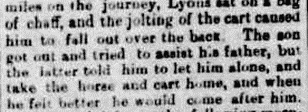


The article recalls that Harold tried to assist his father once he had fallen (8).

This event left Louisa Lyons a widow at the age of 40. She was now the single mother to 11 children, 4 of whom were overseas, with 7 children at home under the age of 15. Sadly, within the next three years, two of four of the boys fighting overseas would be killed in service. In September of 1917, Patrick died of wounds sustained (9), and in October of 1918, Leslie was killed in action (10).

  Leslie’s death mentioned in an article in the Dandenong Advertiser and Cranbourne, Berwick and Oakleigh Advertiser (11).

News of Leslie’s death arrived relatively quickly to Australia, with a notice being printed in a paper published on October 31st of 1918. We do not know when news of Patrick’s death reached the family, except for the mention in this article of the death of Leslie’s ‘eldest brother’. The name written is Richard, but I believe it to be a misprint (we know Leslie and Patrick are related, and that this is the same Leslie Lyons, because of the death and birth date mentioned). So, it can be assumed that the Lyons family knew of both boys' deaths late 1918. It is entirely probable that the family went months without hearing news of Patrick’s death, as was quite commonplace.

This left the Lyons’ in a somber position by the end of World War I. They had lost three family members; two to the war, one to an accident. Presumably John and Charles both returned home after the war (below is an excerpt of John’s death notice, printed in 1972 – this lists all members of the Lyons family and was very useful in identifying further family members).


John’s death notice, listing the Lyons family (12).


Digging further into the Lyon’s family history from here, I found that three of the younger boys, Harold, Stanley and Thomas then enlisted in World War II (13). Records also suggests that perhaps the only daughter in the family, Mary, also served in the Second World War. There is a record of a Mary Elizth Isabel Lyons marrying a Harry Evans in 1923 (14). I believe this may have been the same Mary, as in 1923, Mary Lyons would have been 19 years old; a normal age for marriage at the time. If indeed this is the same Mary, she likely served as a nurse. None of these children are listed on the Australian War Memorial’s roll of honour, so it might be assumed that they all survived their service.

Exploring the Lyons family history gives an insight into just how difficult wartime was for most families. The home front continued on as it always had, regardless of the war, and so too did the tragic accidents that had likely been occurring for years. Patrick’s death left Louisa Lyons a widowed, single mother of 11 children, seven (perhaps eight) of whom fought during the World Wars, two of whom lost their lives fighting for Australia. Undoubtedly the experience of the Lyon’s family would be incredibly similar to those of many other families from this period.


Useful Databases When Researching Military Family History:

Australian War Memorial Roll of Honour.

Both Patrick and Leslie are listed on the Australian War memorial Roll of Honour, which commemorates soldiers who lost their lives in service of Australia. The database can be accessed here).

The Roll of Honour can provide family historians with further information about their ancestor's involvement in war, including service and death details. The Australian War Memorial has digitised many circulars (documents which were required to be filled for qualification to the roll of honour, often filled by next of kin), which provide a great deal of extra detail.


Patrick’s circular reveals that he served as a Private in the Australian Infantry Force, 59th battalion, and died of wounds in Polygon Woods, Belgium, at the age of 23 and 8 months. It lists Louisa Lyons at an address in Longwarry East and includes details of Leslie’s service (15).


Leslie’s circular reveals similar information. He served as a Sergeant in the 24th Australian Infantry Battalion and was killed in action at Montbrehain, Picardie, France, at the age of 23 (16).


The Australian War Memorial Roll of Honour webpages also detail which panel of the Commemorative Area the soldier’s name is listed, and times at which their name will be projected onto the exterior of the Hall of Memory.

Find a Grave.
Another great resource for family historians is the Find a Grave database (access here). The database is very useful in finding both military and civilian gravestones.


Leslie’s grave at Calvaire Cemetery in Montbrehain, Picardie, France (17).


Patrick’s grave at Lijssenthoek Military Cemetery in Lijssenthoek, Flanders, Belgium (18).

Author: Kate Davis - Casey Cardinia Libraries

Footnotes

1- City of Casey & Casey Cardinia Libraries, ‘Cranbourne: a town with history’, City of Casey, n.d., p. 7.2, https://www.casey.vic.gov.au/sites/default/files-public/user-files/City%20%26%20Council/About%20Casey/military.pdf

2- The Victorian Registry of Births, Deaths and Marriages, ‘Louisa Henderson in Victoria, Australia, Marriage Index, 1837-1950', Marriage Records, The Victorian Registry of Births, Deaths and Marriages, Melbourne, Victoria, Australia, 2018, Ancestry.com [database], reference number 3182, https://search.ancestrylibrary.com.au/cgi-bin/sse.dll?dbid=61649&h=2075382&indiv=try&o_vc=Record:OtherRecord&rhSource=1778

3- National Archives of Australia, ‘Leslie William Lyons in Australia, World War I Service Records, 1914-1920', B2455, First Australian Imperial Force Personnel Dossiers, 1914-1920, National Archives of Australia, Canberra, Australian Capital Territory, Australia, 2015, Ancestry.com [database], https://search.ancestrylibrary.com.au/cgi-bin/sse.dll?_phsrc=Hnm2&_phstart=successSource&usePUBJs=true&indiv=1&dbid=60864&gsfn=leslie%20william&gsln=lyons&cp=0&msbpn__ftp=cranbourne,%20victoria,%20australia&msbpn=94493&new=1&rank=1&uidh=ry4&redir=false&gss=angs-d&pcat=39&fh=0&h=342463&recoff=&ml_rpos=1&queryId=5b93b738121b6202beab6fa0378bae18

4- National Archives of Australia, ‘Patrick Edward Lyons in Australia, World War I Service Records, 1914-1920', B2455, First Australian Imperial Force Personnel Dossiers, 1914-1920, National Archives of Australia, Canberra, Australian Capital Territory, Australia, 2015, Ancestry.com [database], https://search.ancestrylibrary.com.au/cgi-bin/sse.dll?_phsrc=yBT3&_phstart=successSource&usePUBJs=true&indiv=1&dbid=60864&gsfn=patrick&gsln=lyons&cp=0&msbpn__ftp=cranbourne,%20victoria,%20australia&msbpn=94493&new=1&rank=1&uidh=ry4&redir=false&msT=1&gss=angs-d&pcat=39&fh=0&h=347012&recoff=&ml_rpos=1&queryId=1e6656ed434571b2848144ab7b78380a

5- National Archives of Australia, ‘John Lyons in Australia, World War I Service Records, 1914-1920', B2455, First Australian Imperial Force Personnel Dossiers, 1914-1920, National Archives of Australia, Canberra, Australian Capital Territory, Australia, 2015, Ancestry.com [database], https://search.ancestrylibrary.com.au/cgi-bin/sse.dll?indiv=1&dbid=60864&h=340926&tid=&pid=&queryId=a9ff9d76ffcb54ba3bf4e019a889cdab&usePUB=true&_phsrc=CGP10&_phstart=successSource

6- National Archives of Australia, ‘Charles Lyons in Australia, World War I Service Records, 1914-1920', B2455, First Australian Imperial Force Personnel Dossiers, 1914-1920, National Archives of Australia, Canberra, Australian Capital Territory, Australia, 2015, Ancestry.com [database], https://search.ancestrylibrary.com.au/cgi-bin/sse.dll?indiv=1&dbid=60864&h=343367&tid=&pid=&queryId=8040e977f8dc9c7b8172e54fb4a11947&usePUB=true&_phsrc=yrP3&_phstart=successSource

7- Find a Grave, ‘Patrick Lyons (1863-17 June 1915)’, Find a Grave [database], Memorial ID 66810886, 2011, https://www.findagrave.com/memorial/66810886/patrick-lyons  

8- South Bourke and Mornington Journal, ‘Fatal Accident at Cranbourne’, South Bourke and Mornington Journal (Richmond, Vic.: 1877 - 1920; 1926 - 1927) 24 June 1915, p. 3,  http://nla.gov.au/nla.news-article66187933

9- Australian War Memorial, ‘Roll of Honour Patrick Edward Lyons’, AWM145 Roll of Honour cards, 1914-1918 War, Army [webpage], 2022, https://www.awm.gov.au/collection/R1638375

10- Australian War Memorial, ‘Roll of Honour Leslie William Lyons’, AWM145 Roll of Honour cards, 1914-1918 War, Army [webpage], 2022, https://www.awm.gov.au/collection/R1637576

11- Dandenong Advertiser and Cranbourne, Berwick and Oakleigh Advocate, ‘Cranbourne’, (1918, October 31). Dandenong Advertiser and Cranbourne, Berwick and Oakleigh Advocate (Vic.: 1914 - 1918), 31 October 1918, p. 2, http://nla.gov.au/nla.news-article88816917

12- The Age, ‘John Lyons in Australia, Newspaper Vital Notices, 1831-2001', Fairfax Media, Pyrmont, New South Wales, Australia, 2015, Ancestry.com [database], https://search.ancestrylibrary.com.au/cgi-bin/sse.dll?dbid=9091&h=1800659906&indiv=try&o_vc=Record:OtherRecord&rhSource=60864

13- National Archives of Australia, ‘Harold Lyons in the Australia, World War II Military Service Records, 1939-1945', B884, Citizen Military Forces Personnel Dossiers, 1939-1947, National Archives of Australia, Canberra, Australia, 2016, Ancestry.com [database], https://search.ancestrylibrary.com.au/cgi-bin/sse.dll?dbid=61172&h=1506510&indiv=try&o_vc=Record:OtherRecord&rhSource=1778

National Archives of Australia, ‘Stanley Noel Lyons in the Australia, World War II Military Service Records, 1939-1945', B883, Second Australian Imperial Force Personnel Dossiers, 1939-1947, National Archives of Australia, Canberra, Australia, 2016, Ancestry.com [database], https://search.ancestrylibrary.com.au/cgi-bin/sse.dll?dbid=61172&h=1743295&indiv=try&o_vc=Record:OtherRecord&rhSource=1778

National Archives of Australia, ‘Thomas Bertram Lyons in the Australia, World War II Second Imperial Forces and Citizen Military Forces Service Records, 1939-1947', B883, Second Australian Imperial Force Personnel Dossiers, 1939-1947, National Archives of Australia, Canberra, Australia, 2020, Ancestry.com [database], https://www.ancestrylibrary.com.au/discoveryui-content/view/4253:61987?_phsrc=KTk1&_phstart=successSource&gsfn=thomas+bertram&gsln=lyons&ml_rpos=1&queryId=a98ffe9dc6a783c6df20b6b84a00e5c3

14- The Victorian Registry of Births, Deaths and Marriages, ‘Mary Elizth Isabel Lyons in Victoria, Australia, Marriage Index, 1837-1950', Marriage Records, The Victorian Registry of Births, Deaths and Marriages, Melbourne, Victoria, Australia, 2018, Ancestry.com, reference number 2648, https://search.ancestrylibrary.com.au/cgi-bin/sse.dll?dbid=61649&h=274083&indiv=try&o_vc=Record:OtherRecord&rhSource=61172

15- Australian War Memorial, ‘No. 3149. Private. LYONS. Patrick Edward.’, AWM 131 Roll of Honour Circular [document], n.d.,https://s3-ap-southeast-2.amazonaws.com/awm-media/collection/RCDIG1068879/document/5578343.PDF

16- Australian War Memorial, ‘No. 665. Sergeant. LYONS. Leslie William.’, AWM 131 Roll of Honour Circular [database], n.d., https://s3-ap-southeast-2.amazonaws.com/awm-media/collection/RCDIG1068879/document/5578340.PDF

17- Find a Grave, ‘Sgt Leslie William Lyons’, Find a Grave [website], Memorial ID 56137696, 2010, https://www.findagrave.com/memorial/56137696/leslie-william-lyons

18-

Find a Grave, ‘Private Patrick Edward Lyons’, Find a Grave [website], Memorial ID 12071361, 2005, https://www.findagrave.com/memorial/12071361/patrick-edward-lyons

Lyons Family Birth Records:

Edwardian Index, ‘Gordon Lyons in Australia, Birth Index, 1788-1922', Edwardian Index. Victoria. 1902-1913, 2010, Ancestry.com [database], reference number 9948,https://search.ancestrylibrary.com.au/cgi-bin/sse.dll?indiv=1&dbid=1778&h=269854&tid=&pid=&queryId=0662e48dbc85ae98a49d4eae30a14f1c&usePUB=true&_phsrc=yrP15&_phstart=successSource

Edwardian Index, ‘Mary Eileen Isabel Lyons in Australia, Birth Index, 1788-1922', Edwardian Index. Victoria. 1902-1913, 2010, Ancestry.com [database], reference number 9605, https://search.ancestrylibrary.com.au/cgi-bin/sse.dll?indiv=1&dbid=1778&h=271505&tid=&pid=&queryId=97f522034da8e898634371b8ade709ca&usePUB=true&_phsrc=yrP6&_phstart=successSource

Edwardian Index, ‘Percy Lyons in Victoria, Australia, Birth Index, 1788-1922', Edwardian Index. Victoria, 1902-191., 2010, Ancestry.com [database], reference number 9746, https://search.ancestrylibrary.com.au/cgi-bin/sse.dll?indiv=1&dbid=1778&h=271941&tid=&pid=&queryId=87448b8914bc36211bde8aabcb8bbb30&usePUB=true&_phsrc=CGP4&_phstart=successSource

Edwardian Index, ‘Stanley Noel Lyons in Australia, Birth Index, 1788-1922', Edwardian Index. Victoria. 1902-1913, 2010, Ancestry.com [database], reference number 18394, https://search.ancestrylibrary.com.au/cgi-bin/sse.dll?indiv=1&dbid=1778&h=272319&tid=&pid=&queryId=042a94bc1947c8cd30826c2539a62695&usePUB=true&_phsrc=yrP17&_phstart=successSource

Federation Index, ‘Jno Lyons in Australia, Birth Index, 1788-1922', Federation Index. Victoria. 1889-1901, 2010, Ancestry.com [database], reference number 31724, https://search.ancestrylibrary.com.au/cgi-bin/sse.dll?indiv=1&dbid=1778&h=1828242&tid=&pid=&queryId=60f04b7eaee212ba00de9eb7c257b0ec&usePUB=true&_phsrc=yrP2&_phstart=successSource

The Victorian Registry of Births, Deaths, and Marriages, ‘Eric Michael Lyons in Victoria, Australia, Birth Index, 1837-1917', Birth Records, The Victorian Registry of Births, Deaths and Marriages, Melbourne, Victoria, Australia, 2018, Ancestry.com [database], reference number 28732,https://search.ancestrylibrary.com.au/cgi-bin/sse.dll?indiv=1&dbid=61648&h=316568&tid=&pid=&queryId=820991cb644476b4dbefb84fcd7841a0&usePUB=true&_phsrc=yBT2&_phstart=successSource

The Victorian Registry of Births, Deaths, and Marriages, ‘Leslie William Lyons in Victoria, Australia, Birth Index, 1837-1917', Birth Records, The Victorian Registry of Births, Deaths and Marriages, Melbourne, Victoria, Australia, 2018, Ancestry.com [database], reference number 30262,  https://search.ancestrylibrary.com.au/cgi-bin/sse.dll?indiv=1&dbid=61648&h=162734&tid=&pid=&queryId=aac81e12ddd36ea044460e0848e6638f&usePUB=true&_phsrc=CGP1&_phstart=successSource

The Victorian Registry of Births, Deaths, and Marriages, ‘Louisa Henderson in Victoria, Australia, Birth Index, 1837-1917', Birth Records, The Victorian Registry of Births, Deaths, and Marriages, Melbourne, Victoria, Australia, 2018, Ancestry.com [database], reference number 145, https://search.ancestrylibrary.com.au/cgi-bin/sse.dll?dbid=61648&h=1496741&indiv=try&o_vc=Record:OtherRecord&rhSource=1778

The Victorian Registry of Births, Deaths, and Marriages, ‘Patk Edward Lyons in Victoria, Australia, Birth Index, 1837-1917', Birth Records, The Victorian Registry of Births, Deaths and Marriages, Melbourne, Victoria, Australia, 2018, Ancestry.com [database], reference number 2597, https://search.ancestrylibrary.com.au/cgi-bin/sse.dll?dbid=61648&h=109853&indiv=try&o_vc=Record:OtherRecord&rhSource=1778

Saturday, July 17, 2021

Wounded Soldiers visit Dandenong, Berwick and Cranbourne

In 1915 the Motorists' Wounded Soldiers' Association was formed. The Secretary wrote  a letter to The Argus, published on August 10, outlining the rationale of the Association - The care of returned wounded soldiers is now our duty, but what about their pleasures? There is much pathetic reading in the accounts of their condition as brought under our notice by the papers and it is wonderful the fine spirit they show under such conditions. Undoubtedly we should help to keep that spirit alive, and not let their return be the usual "nine days' wonder." As a motorist I would suggest that we place our cars at the disposal of the wounded soldiers as much as possible and to this end would appeal to all motorists willing to do so to write in and state how many Saturdays or Sundays they are prepared to give up each month (1).  The Secretary of the Association was W.M. Pearson of 468 Collins Street.  

The President of the Automobile Club of Victoria, Dr Weigall had just the day before publicly announced in The Argus, that the motorists of Melbourne desired to give the returned wounded soldiers the use of their touring cars whenever possible (2).  On August 11, the Secretary of the Automobile Club of Victoria in response to the Motorists' Wounded Soldiers Association letter had his own letter published in The Argus saying that as it has a complete list of car owners and a properly organised clerical staff trained and accustomed to the control of concerted motoring movements it would not serve the best interests, and be a pity for another body to step in and cause arrangements to clash. Furthermore, as the Automobile Club of Victoria is closely in touch with the military authorities at the present time regarding various matters, it would be much the wiser course were the arrangements to be left solely in our hands (3).  

By the beginning of September 1915, the Motorists' Wounded Soldiers' Association, was renamed to the Committee for the Motor Transport and Recreation of Invalid Soldiers (4) and they were working in co-operation with the Automobile Club of Victoria (5). They also helped transport wounded soldiers along with  providing the day trips and this work was sanctioned and approved by the Defence department, and heartily endorsed by the medical authorities, and the soldiers themselves highly appreciate the committee's work (6). 

Early trips were organised to Frankston, Lilydale, Ferntree Gully and other locations in the Dandenong Ranges (7). As a matter of interest in August 1915 the Australian Patriots' League  also provided day trips for wounded soldiers (8).

The earliest reference I can find to the wounded soldiers visiting this area was on Saturday, September 4, 1915 a party of 100 soldiers (9) visited Dandenong and were treated to a reception at the Town Hall and then afternoon tea at the Showgrounds where the ladies of the committee had not been idle, and there was a bountiful supply of tea and coffee, hot meat pies, rolls, buns, cakes, and also cigars and cigarettes (10) and where a  hockey match between the ladies of the Dandenong team and one from Melbourne was set in progress, and this was viewed with interest by the large attendance who lined the arena, and filled the grand-stand (11).

Between 30 and 40 wounded soldiers had arrived earlier on the day at Berwick and were entertained .....by the members of the Berwick Red Cross Society at lunch. They were motored from Melbourne and welcomed by Mrs Pearson, president of the Red Cross Society. After dinner a pleasant hour or two was spent in conversation with the residents, and Mr Pearson returned thanks for the kindness and hospitality, which was responded to by Mr W. Wilson (12). They then joined their comrades at Dandenong for the festivities. 


Dandenong Town Hall where 100 wounded soldiers were received on September 4, 1915.
This is a later photo of the Town Hall and the Post Office, taken in the 1950s, but would have been much the same as when the soldiers saw it.
State Library of Victoria Image H2011.171/5i

Another trip to Berwick was held in May 1916 - On Saturday last the Berwick Tennis Club entertained between 30 and 40 returned wounded soldiers in the tennis court. The arrangements were well carried out by a bevy of ladies, and the visitors were regaled with a dainty afternoon tea. Mr W. G. a'Beckett received them with an appropriate speech of welcome, followed by Mr Buck, who spoke on behalf of the car owners, and Sergt. Mullen, of the 8th L.H., replied for the soldiers. The gallant soldier became garrulous and spoilt an otherwise good talk by stretching it out too long. The boys thoroughly enjoyed the trip, and returned to the city laden with flowers and good things (13).

On Sunday, February 27, 1916 soldiers visited Cranbourne. There was a comprehensive report in the South Bourke & Mornington Journal (14) worth repeating in full to give some idea of the logistics involved in hosting such an event - 
The reception and entertainment of a party of between 60 and 70 wounded soldiers, on Sunday afternoon last, was in every way a thoroughly successful function, and the management of all details in connection with the event signified the possession of much organising ability on the part of Mr and Mrs Campbell, who undertook all arrangements with respect to the reception. With innumerable valuable assistants, both indoor and outdoor, everything went on in an orderly and pleasant manner, and an extremely enjoyable afternoon was spent by all. Amongst the assemblage were Crs Brunt, Callanan, Hardy, Lloyd, and Wilson.

The shire hall was set out with five long tables, artistically adorned with beautiful pot plants, flowers and groaning under burdens of lovely eatables of quality equal to the temptation of the most critical. The tables were managed by the following ladies:-No. 1,. Mrs Nash and Misses Nash and Rennie; No.2, Mrs Savage, Mrs E. Waller, Mrs J. Savage and Miss Greening; No. 3, Miss H. Nurse, Mrs Nash, Mrs Skews, Miss Keogh; No 4, Mesdames White, A. E. Brunt, Halliburton and Robinson ; No. 5, Misses C. Nurse, Lecky, Wilson, and Mrs Thomson, who, with quite a bevy of young ladies, attended to the wants of their brave guests and their friends in a most charming manner.

Between 3 and 4 o'clock the guests began to arrive in private motor cars, which had been kindly placed at the convenience of that estimable body - The Committee of the Motor Transport and Recreation for Invalid Soldiers - who have done so much for the wounded men by giving them pleasant outings on Saturday and Sunday afternoons. The cars of Mrs Sinclair, Dr Stanley, and Messrs Short, Buck and Robinson, with a large char-a-banc were used in the conveyance of the men on Sunday. On arrival an enthusiastic reception was given the visitors by a gathering of fully 400 people.

Cr J. B. Wilson, on behalf of the local Red Cross committee, invited the visitors to afternoon tea in the hall,  and in heartily welcoming them to Cranbourne, spoke of the glorious deeds performed by the Australians, and stated that no effort on the part of the people was too great in honor of the men who had played such an immense part in making history for our country and supporting the just cause of the British nation. God Save the King was sung most heartily, and Grace having been spoken by the Rev E. C. Thompson, Vicar of Cranbourne, the guests entered upon the enjoyment of the repast provided. 

During the afternoon Mr J. H. White took the opportunity of offering the thanks of the Cranbourne residents to the members of the Motor Transport Company for their kindness in giving the people a chance of entertaining a party of men who had nobly done their duty, and trusted that this would not be the last occasion upon which Cranbourne residents would be privileged to assist the convalescents during the progress of recovery. Mr R.L Laidlaw supported the statements of Mr White, and expressed the view that the valiant actions of the Australian soldiers had shown the world that our land could produce men capable of upholding the sacred cause of freedom as those of any country in the world, and that it was impossible to too highly honor the brave men who had so freely offered their lives to perpetuate the privileges we now enjoy under the invincible sway of the Union Jack.

Private Franklin Murray, secretary of the Returned Soldiers' Association, thanked Cranbourne people for their hospitality, which had not been excelled by any of the centres the wounded soldiers had visited. It was pleasing to the men to know that their efforts had the sympathy of the people. He stated that fully 75 per cent of the returned soldiers were eager to recover and once more take a hand in the fray, and show that deeds equal to those achieved in the past were easily possible. Much enthusiasm was shown by the assemblage. The representatives of the Motor Car Transport Committee praised the efforts advanced for their comfort, and said that another visit would probably be arranged in the near future.

After the guests had left the hall, the ladies engaged in ministering to the wants of the large gathering, and the supply of good things was more than ample to meet the requirements of all. About 5.30 the cars started on the homeward journey, laden with cases of fruit, cakes and tomatoes, contributed by local donors, amidst cheers from the crowd assembled. The Red Cross Committee desire to thank all who assisted in making the function a success (South Bourke & Mornington Journal, March 2, 1916, see here)


Cranbourne Shire Hall where 60 - 70 wounded soldiers were hosted on February 27, 1916.
This photo is from 1942.

The only other local account I could find was in November 1915 when the townsfolk of Lang Lang had invited the soldiers for  a visit, however this offer lapsed when  A meeting of the committee was called for Saturday afternoon, but owing to the smallness of attendance and the fact that the undertaking of catering for about a hundred soldiers is no light task, the meeting was postponed to a future occasion (15) I thought I might have found some accounts of soldiers visiting Emerald, Cockatoo or Gembrook, because there were articles on visits to other scenic spots in the Dandenongs such as Warrandyte, Belgrave and what were then the country towns of Bayswater and Boronia, however, I could not find any. It may have been due to the state of the roads or perhaps because the communities were too small to be able to host large numbers of people. 

Trove List - I have created a short list of articles on trips to the local area by wounded soldiers, you can access it here.

Footnotes
(1) The Argus, August 10, 1915, see here.
(2) The Argus, August 9, 1915, see here.
(3) The Argus, August 11, 1915, see here.
(4) The Age, September 2, 1915, see here.
(5) The Argus, August 30, 1915, see here.
(6) The Age, September 17, 1915, see here.
(7) See my Trove list, referred to above.
(8) The Argus, August 17, 1915, see here.
(9) Dandenong Advertiser, September 9, 1915, see here. There is another good account of the visit to Dandenong in the South Bourke & Mornington Journal of September 9, 1915 here.
(10) Dandenong Advertiser, September 9, 1915, see here.
(11) Dandenong Advertiser, September 9, 1915, see here.
(12) South Bourke & Mornington Journal, September 9, 1915, see here.
(13) South Bourke & Mornington Journal, May 11, 1916, see here.
(14) South Bourke & Mornington Journal, March 2, 1916, see here.
(15) Lang Lang Guardian, November 17, 1915, see here.

Tuesday, November 8, 2016

Celebrating the Armistice in the Cranbourne Shire in 1918

We are looking at how people in the area celebrated the end of the Great War.  In this post we will see how the children in the Shire of Cranbourne celebrated the momentous day.  To see how the Nar Nar Goon community celebrated Armistice Day, click here. To see how the people of Emerald celebrated, click here.

There was a full report in the South Bourke and Mornington Journal of December 5, 1918 on the 'great day for juveniles' held to celebrate the signing of the Armistice.   The article is from Trove and you can read the full article here, but I have transcribed it below. It must have been an amazing experience for the children, many of whom would hardly have remembered  the time before Australia was at War and most of whom would have had  a soldier in their extended family.


South Bourke and Mornington Journal December 5, 1918


PEACE CELEBRATIONS.
At Cranbourne
A Great Day for the Juveniles.

To celebrate the signing of the armistice,and the consequent cessation of hostilities between the Allies and their foes, the President of the Cranbourne Shire Council (Cr D. M. McGregor) decided to give a picnic to all the children in the shire on Wednesday, November 27. For this purpose the Shire was divided into three sections, centres being established at Cranbourne, Kooweerup and Lang Lang. The following schools attended at the Cranbourne centre :- Cardinia, Currum Downs, Clyde North, Cranbourne, Devon Meadows, Lyndhurst, Lyndhurst South, Pearcedale and Tooradin; a few children from Clyde were also present.

At 11 a.m. the young folk assembled at the Shire hall, and were lined up in fours to take part in the procession, which was headed by the Langwarrian Military band. The march was down Sladen street, along Codrington and Childers streets and up High street back to the Shire hall. This was well carried out, and the teachers were complimented on the fine display made. 

On returning to the Shire hall the children formed three sides of a hollow square round the Union Jack, which was flying from the recently erected flag-pole. The flag was saluted, the declaration made, and cheers given for our King, our Empire, our Commonwealth, and our own soldier boys. All present solemnly bowed their heads in silent remembrance of the lads who can never come back to us - our honored dead.

The Shire President then gave a short address, briefly stating the reasons for the rejoicings. He then introduced Chaplain Captain Gates, who gave a very interesting address on many phases of the war. The National Anthem and ‘Our Splendid Men’ were sung by the whole assemblage, the band leading the singing.

The children were then marched to the picnic-ground, where they were arranged in rows of fifties. A handsome medallion, bearing the inscription, ‘Shire of Cranbourne. Signing of Armistice, Nov. 11, 1918’ was handed to each child. 

Dinner was served, the good things provided were of first-class quality, and the local caterers, Messrs J. Taylor and J.Thorpe, were complimented, on all sides for the excellent viands supplied. 

After dinner, games and sports were indulged in during the afternoon. Races of all kinds for boys and girls were spiritedly contested and the judges, Messrs Callanan and McKenzie, had their work cut out to separate the winners from the rest. The sports were managed by representatives of the various school committees and teachers, with Mr J. H. White as starter. It was unanimously agreed that the kiddies had had a great afternoon.

Shortly after 4 o'clock all again wended their way to the picnic ground, where tea was  heartily partaken of. After enjoying a splendid meal each child was presented with a bag of sweets. Before dispersing ringing cheers were given for President McGregor for his kindly thoughtfulness in giving the children such an enjoyable time.  The President, in a few words, gracefully acknowledged the compliment. 

The merry-go-round was a great source of pleasure, not only to the juveniles, but also to ‘the children of a larger growth’, many elderly folk seeming to enjoy a ride as much as the little ones. 

The Langwarrin Military band played some very fine selections during the day, and added greatly to the enjoyment of the gathering. 

The picnic was a great success in every way. All the arrangements for the festivities were made by the local committee, of which Mr J. H. White was chairman and Mr D. A. Schulze, hon. secretary. The organization for the day was highly praised. All the details had been carefully planned beforehand, consequently everything worked with the most smoothness. The ladies of the town and district again proved themselves to be willing and efficient workers.

President McGregor was delighted with the success of the day's rejoicing, and no doubt feels exceedingly grateful to all, who in any way, helped to make the event what it truly was - a red letter day in the history of Cranbourne.

In this post we looked at Armistice celebrations in the Cranbourne Shire. To see how Nar Nar Goon celebrated the Armistice, click here. To see how Emerald celebrated the end of the Great War, click here.

Thursday, January 7, 2016

Cranbourne Presbyterian Church Honour Roll

The Cranbourne Presbyterian Church Honour Roll is housed at the Fishermans Cottage Museum at Tooradin. The Museum is operated by the Cranbourne Shire Historical Society. It's a beautiful board, in a Gothic ecclesiastical style.  What follows is a list of soldiers on the Honour Board,  their fate (i.e. when they Returned to Australia after active service or when they were Killed in Action) and their Service Number (SN) so you can look up their full service record on the National Archives website (www.naa.gov.au)


Baker, Alexander George  (SN 1782) Alexander enlisted on June 11, 1915 at the age of 22. He was a farmer and his next of kin was his father, Mr J. W Baker of Lyndhurst. Alexander was awarded the Military Medal in 1917. He Returned to Australia April 8,  1919

The T. Bell listed on the Honour Roll is either Thomas Bell (SN 340) or Thomas Bell (SN 3773) They are both Presbyterian.
Bell, Thomas  (SN 340)  Thomas was one month off 25 years of age when he enlisted on January 18, 1915. His next of kin was his father, J. Bell of Cranbourne and his occupation was farm labourer. Thomas Returned to Australia January 2, 1919.
Bell, Thomas Stanley (SN 3773)  Thomas enlisted on August 12, 1915 aged 23. His next of kin was his mother, Mary Ann Bell of St Germains, Clyde. Thomas Returned to Australia October 18, 1917 and was discharged on medical grounds on January 21, 1918. In June 1917 he had been wounded - 'Gun shot wound chest penetrating' was the description of the wound.

Bethune, Rupert Charles (SN 3672) Rupert enlisted at the age of 26 on July 24, 1915. His next of kin was his mother, Mrs Annie Meade of Cranbourne.  Rupert was Killed in Action in France on July 19, 1916.

Bethune, William Charles (SN 3262) William was a 20 year old grocer when he enlisted on June 30, 1917, his next of kin was his mother, Mrs Susie Bethune, of Cranbourne. William Returned to Australia on July 23, 1919.

Brunt, Robert Harold  (SN 26769) Robert is the son of  William Brunt and  Mary Jane (nee Espie), who lived at Spring Villa, where the Settlement Hotel is now located. William was a Cranbourne Shire Councillor from 1904 to 1923. Robert enlisted on February 26, 1916 aged 27 and Returned to Australia on May 31, 1919. Brunt Street in Cranbourne is named for the family.

Cameron, Alexander Gordon (SN 1688) Alexander enlisted on June 28, 1915 at the age of 23. His next of kin was his mother, Mary Ann Cameron of Heatherleigh in Cranbourne. Alexander Returned to Australia May 15, 1919. Alexander's father was Ewen (1860 to 1903) and his mother Mary Ann (1859 to 1947)  was also a Cameron and she was the daughter of early Cranbourne pioneer, Alexander Cameron ( 1814 to 1881) who took up the Mayune run in 1851 and purchased the pre-emptive right of the property which he re-named Mayfield; he was also a member of the Cranbourne Road Board from 1863 until 1867. Cameron Street in Cranbourne is named for the family.

Daws, James  (SN 3809)  James was 18 years old when he enlisted on July 16, 1915. He was an engine driver and his next of kin was his father, Abraham Daws, of Codringtton Street, Cranbourne. James was Killed in Action in France on May 3, 1917.

Greaves, Charles Forrester (SN 13156) Charles enlisted on July 10, 1915 aged 24.  Charles Returned to Australia  May 6, 1919.
Greaves, Sydney Alexander (SN 6523) Lieutenant Greaves enlisted at the age of 23 on July 16, 1915. He Returned to Australia  May 29, 1919. 
Charles and Sydney were the sons of of Edwin and Margaret (nee Forrester) Greaves of The Springs, Berwick. Edwin's brother, William, owned Picnic Park at Lyndhurst.

Hallyburton, Adam Benjamin  (SN 391) Adam enlisted at the age of 21 on February 3, 1915. He was Killed in Action in France on July 27, 1918. His next of kin was his father, W.B Hallyburton of Cranbourne. 

Hill, Leslie Victor (SN 64207) Leslie first enlisted on November 27, 1917 - claimed he  was 18 and his next of kin was his father, Leslie of Nilma, this was,of course, all lies. His father sent  a stern letter asking how it is that the military authorities have taken him in as he was not only underage but didn't have his parent's permission. He was discharged on March 14, 1918 because  he was underage, but then he re-enlisted less than two moths later, on May 1.  This time he truthfully said that his father was Samuel Hill of Tooradin Park in Tooradin. He was sent overseas to Egypt, where he arrived in October 1918 and he Returned to Australia on July 3, 1919.

Innes, Peter  (SN 1757)  Listed as Innis on the Honour Board. Peter was 33 when he enlisted on January 5, 1915. He was killed at Gallipoli four months later on August 6, 1915. His next of kin was his brother, William, of Hicksborough. Peter was a resident of Cranbourne when he enlisted and his death was reported in the 'Patriotic News' section of the South Bourke and Mornington Journal


Report on the death of Peter Innes.
South Bourke and Mornington Journal September 23, 1915


Kennedy, Alexander Stewart  (SN 2131) Alexander enlisted at the age of 31 on March 2, 1916. His occupations were listed as 'farmer and general smith'. His next of kin was his wife, Helen Quinn Kennedy. His enlistment papers say that he had spent 5 years with the Tooradin Rifle Club. Alexander Returned to Australia January 24, 1919.

Kirkham, Malcolm (SN 913)  Malcolm was 29, and a farmer from Lyndhurst, when he enlisted on June 8, 1915. His next of kin was his mother, Margaret. Lieutenant Kirkham was Killed in Action in France on September 2, 1918.

This is an article about the deaths of Malcolm Kirkham and William Lecky. 
This is the link to the original article on Trove, which may be easier to read http://nla.gov.au/nla.news-article66194848
South Bourke and Mornington Journal  October 10, 1918.


Laidlaw, Rodney Goulburn (SN 2037) Rodney was a black smith and enlisted  on April 18, 1917 at the age of 28. His next of kin was his father, Robert, of Cranbourne,  He Returned to Australia on May 6, 1919. Interestingly, Rodney was born in Tatura which is in the Goulburn Valley and also part  of the old Shire of Rodney, which presumably influenced his parents when they were naming him.

Lecky, James Alexander (SN 19922)  James enlisted on February 25, 1916 at the age of 25. He died of 'wounds  received in action' in France on November 14, 1918. The wound was a gun shot wound to the chest, which he sustained on October 25 1918.  
Lecky, William Mervyn  (SN 6612) William enlisted on June 15, 1915 aged 20. He was killed in Action in France on September 1, 1918.
James and William were the sons of James Lecky of Cardinia Park in Officer. James (1841 to 1939) was a Cranbourne Shire Councillor from 1876 until 1905.  Their grandfather, also James (1802 to 1884) had taken up the Gin Gin Bean Run (later named Cardinia Park) at Officer in 1846 and he was a member of the Cranbourne Road Board and the Cranbourne Shire from 1860 until 1881.  Lecky Road in Officer/Pakenham  is named for the family.

McLellan, Donald (SN 2207) Donald was 19 when he enlisted on February 28, 1916. He was born at Lyndhurst and his next of kin was his father, Alexander of Ferndale, Cranbourne. Alexander Returned to Australia on June 10, 1919.

Morris, Philip Samuel (SN 1509) Philip enlisted at the age of 34 on September 6, 1918. He served in Rabaul in New Guinea and then was seconded to the Department of Agriculture over there and Returned to Australia on January 28 1920 and was discharged on medical grounds (post-malarial debility) on March 7, 1920.  His next of kin on enlistment was his wife, Minnie, and his address was Ellamatta, Cranbourne and his occupation was orchardist. 

Pitcher, Claude  William Leonard (SN 2552)  Claude enlisted on February 26, 1916, aged 21. He was a farmer and his next of kin was his father, John, of Cranbourne,  He Returned to Australia July 31, 1918 after being wounded including sustaining a gun shot wound to his right shoulder, and discharged on October 14, 1918.

Read, George Alfred  (SN 1636) George enlisted at the age of 21 on November 10, 1916. His next of kin at the time was his father, William, of Myrtle Cottage, Cranbourne.  He Returned to Australia on December 21, 1919.

Reeves, Albert Reginald (SN 629) I believe that this is Albert Reginald Reeves as he is the only A.R Reeves I can find who enlisted. Albert was farm labourer, so could have worked on a local farm, but I can't find  a specific local connection.  He enlisted on July 20, 1915 at the age of one month off 23 years of age. He was born in Essex in England and his next of kin was his father, who also lived in Essex. Albert Returned to Australia on April 19, 1919.

Ryland, Arthur Anderson (SN 2553) Arthur enlisted at the age of 21 on March 23, 1916. His next of kin was his mother, Amelia Ryland of Clyde; his father Alfred having already died.  He stayed in France after the War ended and was attached to the Australian Base Depot and on September 29, 1919 he married Marie Jeanne Hureaux at the Town Hall in Argenteuil, in France.   He Returned to Australia on February 2, 1920. What happened to Marie? Did she come to Australia? In the 1925 Electoral Roll Arthur is listed at Duff Street Cranbourne with the interesting occupation, Picture Showman. Also at the address is his mother, Amelia, and  Hilda Alice Ryland, his sister, who was a dressmaker. In the 1930s Arthur was President of the Cranbourne Football Club, on the Recreation Reserve Committee and President of the Cranbourne Band Committee and gave his sister Ruth 'away' at her marriage to Thomas Facey, amongst other things. So we know all this, but I can't tell you what happened to Marie.


This is the original Cranbourne Presbyterian Church, built in 1860 and served the Cranbourne Community until the exisiting Church was built in 1953.


Stark, John (SN 4311) John enlisted on July 20, 1915 at the age of 20, he was a Railway employee. His next of kin was his father, William, of Cranbourne, even though in  a letter William wrote in August 1917, he has his address listed as Devon Meadows, Cranbourne.  John was Killed in Action in France on August 18, 1916.

Strong, Frederick William (SN 29790) Frederick enlisted on March 23, 1916. He was 27 and  a farmer. Frederick Returned to Australia  May 31, 1919.
Strong, Albert Victor  (SN 29789) Albert was 24 when he enlisted on the same day as his brother, Frederick. He Returned to Australia on February 7, 1919. 
Frederick and Albert were both born in Portarlington and were the sons  of William Strong of Ercildoune, Cranbourne.

Taylor, William George (SN 1740) He is listed as G. Taylor on the Honour Board.  William was 24, had been born in Lyndhurst and  enlisted on February 17, 1916. He was the son of Richard Thomas Taylor whose address was Post Office Lyndhurst   William Returned to Australia January 8, 1919.   

Thomas, Hedley Howard (SN 4611) Hedley enlisted on September 3, 1915. He was Killed in Action in France, on July 10, 1918. He was the son of George Thomas of Clyde. His enlistment papers said that he was Methodist, but this may have been a mistake, or he may have just been very ecumenical.