Showing posts with label Brothers who enlisted. Show all posts

Wednesday, September 29, 2021

The Campigli Brothers

The Herald of November 23, 1916 (see here) published an article on Donald Campigli and his Distinguished Conduct Medal, which was presented to him on Wednesday, November 22 1916 by the Governor General, Sir Ronald Munro Ferguson. Donald has a local connection because he was born in 1896 whilst his father was stationed at the Bunyip Railway Station.

His father, James, was the Station Master at Bunyip from February 1901 to May 1904 but the family had been in Bunyip for around five years before he received this appointment.  As with many families where the father was employed by the Victorian Railways, they moved frequently.  This is a quick look at the birth years and birth registration places of the children of James and Catherine (nee Murray) Campigli, who were married in 1887  - Marion Helena - 1888, Williamstown; Mary Ann - 1889 Frankston; George Murray - 1890 Inglewood; Louis - 1893 Cranbourne, died aged seven months; Francis Louis - 1894 Rocky Lead (now Rocklyn); Donald Hugh - 1896 Bunyip South; John Murray - 1898,  Bunyip South; Christine Louise - 1900, Bunyip South; William Robert Gordon - 1903, Heywood; Sydney McIntosh - 1904, Port Albert. 

This is the report from The Herald

PRIVATE CAMPIGLI, D.C.M. HOW THE MEDAL WAS WON.
WATER FOR THE WOUNDED.

Private Donald H. Campigli, D.C M, who Sir Ronald Munro Ferguson, the Governor-General, presented with his medal at South Melbourne yesterday, was one of those who with the 8th (Victorian) Battalion, took part in the famous landing in Gallipoli on April 25, 1915. He was a member of B Company and his story of how he won the medal is, briefly as follows:—

"We were occupying Shrapnel Gully and were getting into the Turks hot and strong. They we're doing the same to us. We were in a recently used trench, from which we had driven the Turks. Some of our killed and wounded were in front and we heard the men cry for water. I did not know at the time who they were. Some of the boys said they would go out but our commanding officer, Captain L. R. Hartland (afterwards killed in action) gave orders that no man should leave the trenches because it would mean further loss of life. I was not satisfied, and asked him if I could go. He said 'No.' "He turned away, and while he was doing something a few yards away, I jumped over the parapet, and went out I got hold of one of the men, who was not seriously wounded. I don't know who he was - he belonged to some other battalion. I brought him back into the trench where he was fixed up. Then I went out a second time, and a fellow asked me for a drink of water. I gave him my bottle. He was shot through the back and could not move. I got him on my back and brought him within five or six yards of the trench, where he was shot a second time. He was a man of 13st. or more, and I found him no light burden. I was taking him further to the rear when he was again shot and this time the wound was fatal."

Private Campigli afterwards took part in the gallant charge of the 2nd Brigade under Brigadier-General J. W. McCay, at Cape Helles and celebrated his 19th birthday while in the Gallipoli trenches. His brothers,  George and Frank, are now on active service in Europe.

The father of the three soldiers is a relieving station master living at Williamstown. For some years he was resident of Scarsdale where Donald went to the school so lovingly honored by the Scarsdale Old Boys. His portrait, handsomely framed, looks down from the wall on the younger generation of scholars, an ever-present incentive to the faithful accomplishment of lessons nobly learned. It was given to the school by Mr W. H. Rogers, of Nar Nar Goon, an enthusiastic member of the Old Boys' Association.

The article mentions the fact that his two brothers, George and Frank, were serving and a fourth brother, John, enlisted after this article was published. This is a brief summary of their war service. 

Campigli, Donald Hugh (SN 7460)  Donald  enlisted on December 11, 1914 at the age of 19, and served in Gallipoli where he was awarded the Distinguished Conduct Medal, was later at Dardenelles, and was discharged February 1916 but then rejoined  on July 16, 1917 and Returned to Australia April 1920.   On his second enlistment he was  one of the 'Sportsmen's Thousand' a 1917 campaign to encourage sportsmen to join the AIF. Donald is listed on the Bunyip Methodist Church Honour Board (see here).  Donald married Doris Isabella Taylor in 1921 and they had two sons Donald and Keith. Young Donald served in the RAAF in World War Two.  Donald died December 21, 1952, aged 56.


Death notice of Donald Campigni
The Argus December 22, 1952  http://nla.gov.au/nla.news-article23198038

Campigli, John Murray (SN 3930). John, known as Jack, was a 22 year old Clerk with the Railways when he enlisted on December 8, 1917. He Died of Disease - pneumonia and malaria - in Palestine on November 21, 1918. 


The Campigli family were living in Williamstown when Donald, Frank and George enlisted, so because they had that Williamstown connection Jack is listed on their Honour Board which hangs in the Williamstown Town Hall. The Honor Board commemorates the 256 men from Williamstown, Newport and Spotswood who did not return. 
The Honour Board photos are reproduced on the 
Sons of Williamstown: a Labour of Love website. 
It is a beautiful  website


Death notice of John Murray Campigli

Campigli, Francis Louis (SN 3634) Frank was 21 years old and a Clerk, when he enlisted on July 13, 1915. He Returned to Australia October 6, 1919. Frank married Jessie May Adsett in 1922.  They lived in the Camberwell area after their marriage and had a daughter, Margaret. Frank died October 28, 1976, aged 82. He was cremated at Springvale Crematorium. Jessie moved to Sydney after Frank's death and passed away March 20, 1978,


Death notice of Frank's wife, Jessie May.
Sydney Morning Herald, March 22, 1978

Campigli, George Murray (SN 237). George enlisted on August 20, 1914 at the age of 24, He was a Clerk with the Victorian Railways. He was discharged from the A.I.F on July 11, 1916 and joined the Imperial Army or British Expeditionary Forces. George rose to the rank of Lieutenant-Colonel and received the Military Cross.  After the War he remained in Palestine to organise their railways on a commercial basis. He married Edna May Phillips, the daughter of William Henry Phillips, who also stayed in Palestine after the War and worked with the railways. The marriage took place at Port Said on December 20, 1922. Read a report in the Northam Advertiser, here. You can read the obituary of W.H. Phillips in the  Northam Advertiser  here. The article, below, tells us that George and Edna had five children. Their son, Bruce Campigli, was Killed in Action on July 11, 1944 at the age of 18. He was in the Royal Navy on the H.M.S. Pembroke. 


This article tells us about George's career after the War.

There was an interesting interview with George Campigli published in the Perth Listening Post on February 24, 1933. He talked about his War experience and gave an overview of the  economy and infrastructure of Palestine. Read it here and here. George died in Camberwell on August 23, 1951, aged 61. He is buried at Burwood Cemetery with his wife, Edna.


Death notice of George Campigli.

Thursday, February 4, 2021

The McDonald Brothers of Yannathan

As part of our series, Brothers who enlisted, we look at the four McDonald brothers of Yannathan, who enlisted. They were the sons of Charles Stuart McDonald and Margaret Matheson who had married in 1876 and had fourteen children (that I can trace) - Donald Alexander (1877 - 1945), Charles Stuart Black (1879 - 1957), Lachlan John (1881 - 1918), Ann Euphemia (1883 - 1960), Violet Ida Helen (1883 - ?), Norman Victor (1885 - 1968), Neil Lamont (1886 - 1917), Lionel Munro Matheson (1888 - 1963), Malcolm McLean (1890 - 1890, died aged one month), Eliza (1891 -1891, died at 2 days old), Hector Rodney (1892 - 1952), Hugh Carr (1895 - 1971) and Duncan McLean (1897 - 1963).

The births were registered at Mooroopna, but the children were born at Ardmona. The family moved to Yannathan sometime after Duncan was born but before November 1901 when Charles placed the following advertisement for the sale of a stripper and winnower in good working for order


Charles McDonald's advertisement
Euroa Advertiser November 1, 1901 https://trove.nla.gov.au/newspaper/article/65537988

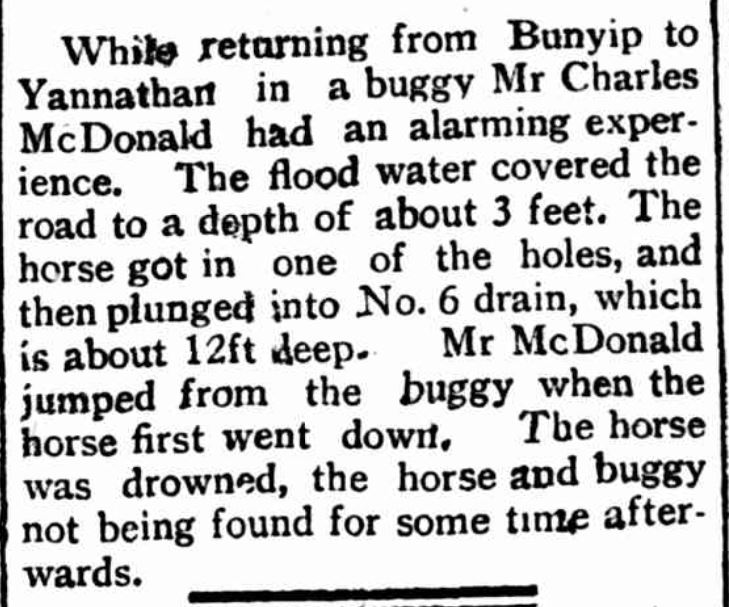
Charles died in 1919, aged 69 and Margaret died in 1925 aged 73. The only other thing I could find out about Charles was that he had an unfortunate incident due to one of the many floods on the Koo Wee Rup Swamp, this one was in 1915, when three feet of water covered the road. The No. 6 drain, the location of the incident, runs besides the Bayles-Modella Road.


Mr McDonald's unfortunate incident
Lang Lang Guardian, November 17, 1915 https://trove.nla.gov.au/newspaper/article/119513134

Here are the details of the four McDonald boys, of whom two sadly died whilst serving their country. I have included their service number (SN) so you can look at their full record on the National Archives website, www.naa.gov.au.

McDonald, Lachlan John. Lachlan enlisted in the Royal Flying Corp and was killed in a flying accident on January 19, 1918. The Dookie and Katamatite Recorder of February 14, 1918 had the following tribute to Lachlan.

Our Heroes.
Died, in the service of his country, Lachlan J. McDonald, horticulturist, attached to the staff of the Dookie Agricultural College, and well known to residents of this and surrounding districts. The late Mr McDonald ("Mac" to all his numerous friends) spent his early days in the Mooroopna district, and received special training at the orchard and school of horticulture of Mr John West, of Ardmona. Further experience was gained at the well-known Nobelius Nurseries at Gembrook, and lands-scape gardening on station homesteads in the Western district contributed its share towards putting a finish on an education which was to be used, at a later period, in imparting a first-class knowledge of horticultural work to the numerous students who came under his care.
During the years of his connection with the College, Mr McDonald contributed a great number of articles on subjects connected with his work to various agricultural journals and papers, and was a splendid lecturer and teacher. He was an enthusiast in all matters pertaining to his particular branch, and had the faculty of being able to enthuse others. Mr McDonald joined the College staff in
1907, and left for England in October 1915, where he received a commission as Lieutenant in the Royal Flying Corps, became Instructor in Aviation, and, as the result of an accident when flying, met his death at Stockbridge, Hants, England, on the 19th January of this year.
A good public-spirited citizen, and one whose loss will be regretted by all classes in the community. We offer his relatives our heartfelt sympathy. "Vale!"
Dookie and Katamatite Recorder of February 14, 1918 (see here

McDonald, Norman Victor (SN 934) Norman enlisted on February 8, 1916, same day as his brother, Neil. He was a 31 year old labourer. Norman Returned to Australia July 4, 1919. Norman was  granted a Soldier Settlement farm at Catani, read his file on the Battle to Farm website, here. He married Florence Mary Jackson in 1925 and he lived the rest of his life in Catani and after his death, on October 18, 1968, he was cremated at Springvale Necropolis.


Norman McDonald was involved with the R.S.L.
Dandenong Journal, June 20, 1945 http://nla.gov.au/nla.news-article214331846

McDonald,  Neil Lamont (SN 2060) Neil was a 29 year old labourer when he enlisted on February 8, 1916, the same day as Norman, His father was his next of kin, but this was later changed to his wife Matilda (nee McFarlane), whom he married between his enlistment and his embarkation. Her address was listed as Modella, Longwarry.  Lance Corporal McDonald Died of Wounds on May 14, 1917 received whilst fighting in France.


Marriage notice of Neil McDonald to Matilda McFarlane, which took place on March 4, 1916.
The Age April 10, 1916 http://nla.gov.au/nla.news-article155075807

McDonald, Hector Rodney (SN 3425) Hector enlisted on January 1, 1917. He  was 25 year old farmer and his father was his next of kin. Hector Returned to Australia July 24, 1919. Hector was also granted a Soldier Settlement farm at Catani, read his file on the Battle to Farm website, here. Hector was listed  in the Electoral rolls at Catani, until his death, which took place on February 10, 1952, when he was aged 60.


Hector's death notice 1952

Sunday, September 15, 2019

Phillip, Rupert and Robert Gay of Lang Lang

As part of our series of Brothers who enlisted, this post will look at the Gay brothers of Lang Lang. The three brothers - Phillip, Rupert and Robert - all enlisted and all returned. They were the sons of Robert and Alice Elizabeth (nee Bray) Gay of Lang Lang. Robert and Alice farmed at their property, Noorong, at Lang Lang and they had nine children - Phillip (born 1891), Rupert (1893), Susan (1895), Robert (1897),  Arthur (1899), Alice (known as Dot, 1902), Marjorie (1904), Sam (1908) and Gus (1910) and Keith (1912). I believe the family arrived  at Lang Lang in 1905 as the boys and their sister, Susan, are listed in the school roll for that year. The School roll is published in the book, Protector's Plains: history of Lang Lang Primary School, No. 2899 and district, compiled by Barbara Coghlan in 1988. Robert Gay died in February 1939 at the age of 79 and Alice died in June 1951 at the age of 84. They are both buried at the New Cheltenham Cemetery.


Alice Gay's death notice
The Argus, June 18, 1951   http://nla.gov.au/nla.news-article23060725

Here are the details of the War Service of the brothers. I have included their Service number (SN), so you can look up their full record on the National Archives, www.naa.gov.au

Gay, John Phillip McCandlish (SN 1474) Phillip as he was known,  was 23 when he enlisted on July 31, 1915. He was a farm labourer, his next of kin was his mother, Alice, and he Returned to Australia April 12, 1919.

Gay, Rupert Alfred   (SN 1479)  Rupert was in the 1st ANZAC Cyclist Corp, and he enlisted on August 14, 1915 at the age of 21. He was labourer and his next of kin was his father, Robert. Rupert Returned to Australia June 12, 1919.

Gay, Robert  (SN 5356)  Robert enlisted on April 10, 1916 at the age of 18. His next of kin was his father, Robert, and his occupation was farm labourer. Robert Returned to Australia October 8, 1919. Robert was granted a soldier settler farm, you can read his file, here, on the Battle to Farm website.


A farewell was held at the Lang Lang Hall on August 30, 1915 to say goodbye to some of the local boys who had joined up - including Rupert Gay.
Lang Lang Guardian September 1, 1915.   http://nla.gov.au/nla.news-article119512821


This very nationalistic and patriotic poem, written by Robert Gay, was published in the Lang Lang Guardian, June 14, 1916. I don't know if it was Robert Gay, the father or Robert Gay, the son. I suspect  it was the father,  as Robert Junior was only 18 in 1916.

Tuesday, August 27, 2019

The Gardiner brothers of Berwick and their nephews, the Sibert boys

Four brothers from the Gardiner family of Berwick served in the Great War. They all returned, however, two grandsons, who also served in the War did not return. The Gardiner boys were the sons of  James and Mary (nee Church) Gardiner, who had married in 1870. They lived in Brisbane Street.  Mary was the daughter of Isaac Church, she died in 1920, aged  71, and according to her obituary she had been a resident of Berwick for 53 years, hence since 1867. James died in 1923 at the age of 77, and his obituary said that he had been a resident of Berwick for 60 years, thus since 1863.


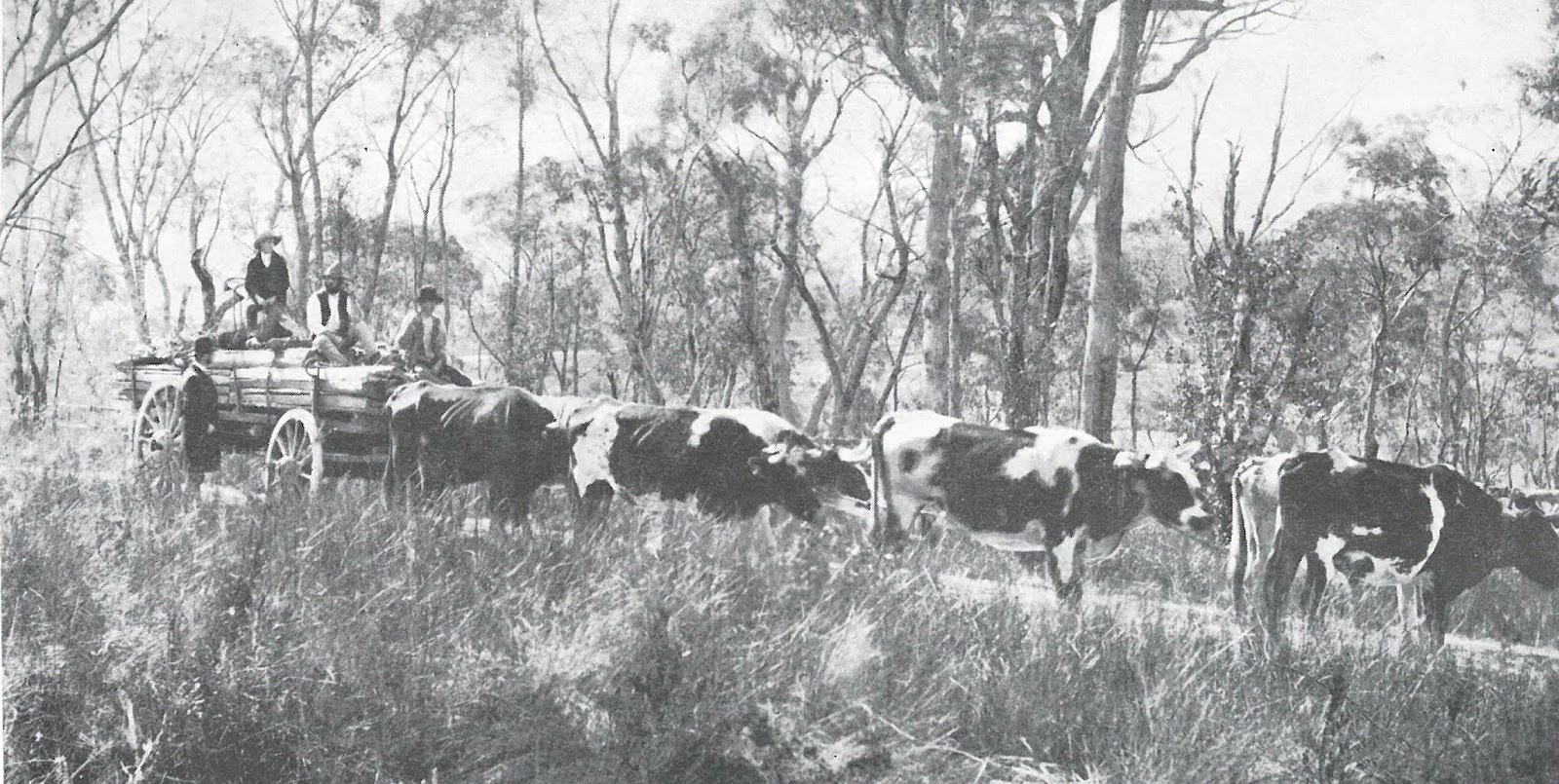
Brisbane Street, Berwick, c. 1880
This is a great photo - seated on the wagon is John Gardiner, who served in the Boer War and the Great War; his father James Gardiner;  E. Sibert, who I assume is Edward Sibert, the husband of Amelia Gardiner. Standing is G. Church, who is probably Mary Gardiner's brother.

The couple had the following children, all born in Berwick -
  1. John James (1870, married Matilda Ann McCann in 1903 and died 1946) 
  2. Amelia Jane (1872, married Justin Edward Sibert in 1890, died 1941 in Western Australia) It was Amelia's two sons, Frederick and Edward, who died in the War. 
  3. Isaac Henry (1874 - 1875)
  4. Mary Anna (1876,  married Francis Henry Montgomery Marsh in NZ in 1902, died 1962 in Queensland)
  5. George Peter (1878 - 1968, never married)
  6. Walter Israel (1880 - 1881)
  7. Joseph Arthur (1882, married Martha Elizabeth Glenn in 1908, died 1924)
  8. Albert Charles (1884, married Ruth Sherriff in 1909, died 1961)
  9. Clyde (born and died 1886)
  10. Alexander (born and died 1886)
  11. Ernest Edward (1887, married Daisy Campbell in 1925, died 1967)
  12. Emily Edith (1890 - 1970, never married)
  13. Clarence Eustace (1892, married Margaret Fogarty in 1918, died 1965)

Berwick Shire News May 10, 1916

Here are the details of war service of the Gardiner Boys. I have included their Service number (SN), so you can look up their full record on the National Archives, www.naa.gov.au

Gardiner, John James (SN 1651) John enlisted at the age of 44 on May 11, 1916.  His occupation was Civil Engineer and Surveyor and his next of kin was his wife, Mary Ann, of Berwick. Mary is called Matilda and Moya in some sources. John Returned to Australia August 24, 1918. John had also served in the Boer War, he was part  of the 2nd Tasmanian Imperial Bushmen and was Mentioned in Commander-in-Chief's Despatches on April 2, 1901. John  was a Shire Engineer in New South Wales and Queensland and after his retirement in 1935 he returned to Berwick and was elected as a Shire of Berwick Councillor. You can read his obituary in the Dandenong Journal of January 9, 1946, here.

Gardiner, George Peter (SN 4401)  George enlisted on January 5, 1916. He was 37 years old, his occupation was Slaughterman and his address was Cockatoo Creek, a previous name for Cockatoo. George's next of kin was his father, James, and he Returned to Australia April 10, 1919.

Gardiner, Ernest Edward (SN 48) Ernest enlisted on August 22, 1914 at the age of 27. He was a farmer and he enlisted in New South Wales. He was reported as being 'dangerously ill'  and invalided to Australia July 31, 1915 and medically discharged June 6, 1916. Ernest is incorrectly listed on the Embarkation Roll as Gardener.

Gardiner, Clarence Eustace (SN 4707) Clarence enlisted on August 7, 1915. He was a 23 year old fireman, working for the Victorian Railways. His father was his next of kin.  Clarence was Wounded in Action  - gun shot wound left ankle and compound fracture right thigh. Clarence was discharged on medical grounds on April 9, 1918.

Sadly, for James and Mary Gardiner, even though their four sons survived, two of their grandsons did not, Frederick and Edward, who were the sons of Amelia Gardiner and her husband, Justin Sibert, did not return.

Sibert, Frederick John  (SN 3482) Frederick was born in Berwick and  living in Blackbutt in Queensland when he enlisted at the age of 22 on October 18, 1916. He was a timber-getter. His next of kin was his mother, Amelia, of Yarloop in Western Australia. Frederick Died of Wounds received whilst fighting in France, on October 10, 1917.

Sibert, Edward Justin (SN 4551, listed in NAA as 4557) Edward was born in Collie in Western Australia and was 18 when he enlisted on March 1, 1916. His mother was his next of kin. Edward was Killed in Action, sometime between November 3 and November 6, 1916.


Edward's death notice in the West Australian of April 27, 1917


The report on Edward Sibert's death in the Pakenham Gazette - it is transcribed, below.
Pakenham Gazette May 11, 1917 http://nla.gov.au/nla.news-article92152744

News has been received of the death of Private Sibert, an old Berwick school boy, and grandson of Mr and Mrs Jas. Gardiner. He was 18 years of age, enlisted from Western Australia, and sailed for the Front early last year. He was killed in France on 5th Nov. last when charging across " No Man's Land," when the Australians took Baupaume. He has a brother still in the fighting line, and also three uncles -Sergeant C. Gardiner, Sergeant major J. Gardiner and Private George Gardiner. Another uncle - Sergeant E. E. Gardiner who is now with us, took part in the memorable landing at Gallipolli and was severely wounded. Trooper Arthur Gardiner was at the South African war, where his brother, now sergeant-major, was twice mentioned in despatches by Lord Roberts. (Pakenham Gazette May 11, 1917)


The report on Frederick's death in the Pakenham Gazette
Pakenham Gazette  December 7, 1917  https://trove.nla.gov.au/newspaper/article/92152769

Friday, July 19, 2019

The Fisher family of Bunyip - eight sons and a grandson fight for Australia

I came across this article in The Herald with the headline - Footscray Family Produces Nine Men for Ranks. As it turns out four of the sons were born in Bunyip and some of the children also went to school in Bunyip. These men were the family of John and Annie (nee Whelan) Fisher. They were the parents of twelve children born between 1881 and 1898, the ten boys listed below and two daughters, Theresa and Catherine. The family had their story written up in The Herald of May 27, 1916 (see it here) It is transcribed below, in italics. Eight of their sons enlisted in the A.I.F, one son had poor eye sight so was not accepted.  Their eldest son, had enlisted in a Scottish Regiment years before and had been killed, but his son, John,  had enlisted in Melbourne to fight along side his eight uncles. I have added their Service Number (SN) so you can look up their full record on the National Archives, www.naa.gov.au


The article has a photos of all the Fisher boys, and this photo of their mother, Annie, who deserves a medal for giving birth to twelve children and having the heart break of three of her sons dying due to fighting for their country.


A remarkable record of enlistments is claimed by the family of the late Mr. John Fisher, formerly of Bunyip, Gippsland, and Mrs. Fisher, of 2 Newell street, Footscray. Eight of their sons enlisted and a ninth has been rejected.

The eldest son, John, was a lieutenant in the Scottish Regiment, but was killed many years ago, leaving a son, who is now at the front.

Staff sergeant - major, Edward Fisher, the eldest son, is now in the Broadmeadows camp. He was born Kangaroo Flat, Bendigo, and later attended school at Bunyip, Gippsland. He was a member of the Fourth Contingent in the South African War, under Colonel Kelly, and gained a Distinguished Conduct Medal. His wife and children live at Essendon. Edward (SN 6765)  Returned to Australia July 24, 1919.


Edward, went to school at Bunyip.
The Herald May 27, 1916

Lieutenant Walter Fisher was the next son, and he is now at Broadmeadows camp. He was formerly a color-sergeant in the 5th Australian Infantry Regiment, and won the battalion badge for shooting and the company's badge five yearn in succession. His is the only name on the merit-hoard of the company. He enlisted as a private on September 24, 1914, in the 7th Battalion, and was promoted lieutenant at Gallipoli. He commanded the battalion in the battle of Lone Pine. In the first landing he was wounded in the arm, leg and side, but returned to the firing line after four weeks' absence. At Lone Pine he was again wounded in the right arm, the bone being partly shattered. He was buried at Steel's Post, Gallipoli, in July, 1915 through the bursting of a high explosive shell, and it took 20 minutes to dig him out. In the following week he had a similar experience. He was invalided home  on August 20, being discharged as unfit, for further, service. His wife and five children live at Frankston. Walter was born at Kangaroo Flat, he Returned to Australia March 20, 1916.

Sgt James Joseph Fisher is now in Wandsworth Hospital, London, having been wounded in Galllpoli in the Lone Pine attack. He is married, 30 years of age, and his wife and five children live at Sunshine. James (SN 1621) was born in South Melbourne and Returned to Australia in August 1916 and discharged on medical grounds in March 1917 and died June 29, 1919.

Sgt.-Major Terence Rufus Fisher, 38, is married, and has a wife and four children. He is an engineer, and lived in Milton street, West Melbourne. He is in camp, being a member of the Pioneer Battalion. Terence (SN 1502) was born in Bunyip. He Returned to Australia June 12, 1919.

Mr Robert Fisher, 36, married, of Footscray, has made five efforts to enlist, but has failed to pass the sight test. He is the only living boy in the family that has not enlisted.


Martin, was born at Bunyip and Killed in Action at Lone Pine
The Herald May 27, 1916


Cpl. Martin J. Fisher, 24, single, was killed at Lone Pine. He was shot through the thigh on the day of the landing, and returned to the firing line five weeks later. He was a first-class shot and was selected as one of five battalion snipers. He was a member of the Coburg Harriers, and lived at Sunshine where he worked as a carpenter.  Martin (SN 439) was born in Bunyip.

Armourer-Stg George Fisher, 22, of  Sunshine, has a wife and two children. George (SN 63) was born in Bunyip. He Returned to Australia June 12, 1919.


Eli, Cecil and their nephew John Fisher.
The Herald May 27, 1916


Driver Eli Fisher, 20, single, is now at Broadmeadows, in the Pioneer Battalion. Eli (SN 12) was born in Melbourne. He Returned to Australia June 12, 1919.

Private Cecil Fisher, 18, is in camp at Broadmeadows. Cecil (SN 2742A) was born in North Melbourne. He was awarded the Miltary Medal and  Returned to Australia December 18, 1918.

Pte. John Fisher, 18, of the 8th Battalion, is the son of Lieutenant John Fisher.  John (SN 3754) was born in Brunswick, and he Returned to Australia April 12, 1919.

Monday, June 4, 2018

The Dawes Brothers of Iona

In our series of Brothers who Enlisted are the Dawes' brothers of Iona - Albert, Clifford, Gladstone, Victor and Walter  - the sons of Alfred and Elizabeth Dawes. Or were they the sons of Alfred and Elizabeth? First of all we will look at their enlistment details, then I have done some research into their family tree.

Dawes, Albert (SN 736)   Albert was a 24 year old carpenter when he enlisted on October 20, 1914. His next of kin was listed as 'Father and Mother' Kirwan's Post Office, via Garfield and as 'Mr Dawes' on the Embarkation Roll.  He sustained a bullet wound in the left wrist and Returned to Australia on February 9, 1916 for a medical discharge. Albert was a Soldier Settler - you can read his file on the Battle to Farm website here.

Dawes, Clifford Gordon  (SN 5086) Clifford was an 18 year old farmer when he enlisted on January 26, 1916. His next of kin was his father, Alfred, of Iona. He Returned to Australia on July 21, 1917 for a medical discharge - 'Gun shot wounds  multiple' was the reason. Clifford is listed on the Bunyip War Memorial.

Dawes, Gladstone (SN 4178) Gladstone enlisted on July 20 1915 aged 18. His next of kin was his mother, Mrs A. Dawes of Iona, and his father was listed as Alfred Dawes, Senior. Gladstone was Killed in Action in France on June 17, 1918.

Dawes, Victor (SN 3080) Victor enlisted on July 20, 1915 aged 21 and his next of kin was his mother, Mrs Elizabeth Dawes of Garfield. He Returned to Australia on July 3, 1919.

Dawes,  Walter (SN 4093) Walter enlisted on January 10, 1916. He was a 22 year old carpenter and his next of kin was his father, Albert. Albert's address was Kirwan's Post Office, via Garfield. Walter Returned to Australia June 4, 1919.


Gladstone Morgan Dawes, standing.  
Photo possibly taken in Egypt. The  two seated soldiers are said to be Gladstone's cousins perhaps  Raymond Oswald Dawes (SN 430) and Edmond Withers Dawes (SN 2368)

Alfred and Elizabeth (nee Morgan) Dawes are listed in the Electoral Roll in 1914 at Iona. Were these boys brothers? According to the Indexes to the Victoria Births, Deaths and Marriages - Albert was born with the surname Morgan  in 1890 to Louise Morgan, unknown father, but the middle name was Dawes, so that's a clue. When he died in 1962 he had Dawes as a surname,  Alfred Henry as the father and Louise Morgan as his mother.
Walter was born in Richmond in 1893 as Walter George Dawes Morgan to Louise Morgan, no father listed.
Victor was born in 1896 at Bunyip South (old name for Iona), with Dawes as the surname,  to Alfred Dawes and Elizabeth Morgan.
Gladstone was born with Morgan as the surname in 1898 to Louise Morgan, father unknown.  Clifford was also born in 1898 with Morgan as the surname to Frances Morgan and unknown father, however when he died in 1972 he was listed as a Dawes, father Alfred and mother Elizabeth Morgan.

So what does all this tell us? I believe they were raised as brothers. However, there are a few unanswered questions such as - was Elizabeth also known as Louise and/or Frances? Why was the third child registered as a Dawes but the two born in 1898 registered as Morgans - or were Louise and Frances Morgan relatives of Elizabeth and she took the three boys in and raised them with her only child Victor? I don't know.

Thursday, April 19, 2018

The Gabbett brothers

In this post, in our series of Brothers who enlisted, we are looking at the Gabbett brothers who had an association with Garfield and Pakenham. Edward (b. 1880),  Ernest (1882) and Norcliffe (1896) were the sons of John Norcliffe Gabbett and Marion Auriol Lintott. There were also three daughters - Annie Auriol (1885) possibly a Denise (b. c. 1885) and Eda Marion (1892). John and Marion were married in Buln Buln in 1879 and the marriage notice in The Argus of December 29, 1879  states that he was the second son of the late Major R.P Gabbett, Royal Artillery, and she was the only child of Edward Lintott, Esq. Marion's parents were pioneers of the Brandy Creek (Warragul) area and in her father's obituary it said that the name of Captain Lintott could not be disassociated with that of Brandy Creek. You can read his obituary in the Warragul Guardian, here. Marion's mother came from equally illustrious stock, you can read her obituary in the Warragul Guardian, here.  Edward Linnott's obituary said that Marion's husband was Captain Gabbett of the Mounted Rifles. 

What else do we know about Captain Gabbett? He resigned his commission in the Victorian Mounted Rifles in November 1889 and the same year he was appointed Deputy Registrar of Births and Deaths in Drouin. In 1902 he was appointed as a Commissioner for taking Declarations and Affidavits at Toora. In September 1904, Captain Gabbett, went missing. He was on a fishing excursion and when he went to board the boat in the evening, it is believed that he slipped and possibly hit his head. A search was undertaken but his body was not found - I couldn't find an Inquest record or a death registration, so it's all a  bit of  a mystery. As for Marion, in 1926 she married Henry St Leger Skinner and died at the age of 90 in 1943.

By now you are probably thinking - what is the  Casey Cardinia connection? Here it is - Marion and her son Norcliffe were living in Pakenham when he enlisted. As well, son Ernest and his wife Eveline are listed in the Electoral Rolls at Garfield in 1914, his occupation was merchant, Marion was also listed at Garfield. They must have moved to Pakenham around 1914 and opened a drapers shop which Eveline operated when her husband was away at the War.   In 1919 Ernest and Eveline are in the Electoral Roll at Pakenham - his occupation is a tailor and Eveline was listed as a draper.

Gabbett, Edward Norcliffe (Service Number 845) Edward was 34 years old when he enlisted on July 8, 1915 and  his next of kin was his wife, Lilian, of Stratford. His occupation was Agent. Edward was wounded in action - gun shot wound to left leg - and had to have the leg amputated. He was sent back to England for recuperation and Returned to Australia November 25, 1917 and was medically discharged. In spite of this set back he lived until the age of 91 and died in 1972.


A report of the return of Ernest Gabbett, whose wife has conducted a drapery business here [Pakenham] during the greater part of Mr Gabbett's absence with the A.I.F abroad.

South Bourke and Mornington Journal November 28, 1918


Mrs Gabbett's advertisement from the Pakenham Gazette June 15, 1917


Gabbett, Ernest Poole (SN 2846) Ernest was a 32 year storekeeper when he enlisted on August 25, 1914. His next of kin was his wife, Eveline. He was wounded in action - shot in the arm - and after a time spent recuperating in England he Returned to Australia October 7, 1918. Ernest also lived to a good age and died in 1962 aged 80.


A welcome home to Ernest Gabbett and other Pakenham soldiers.
Dandenong Advertiser December 12, 1918.


Gabbett, Norcliffe Esca (SN 1167) Norcliffe was only 18 when he enlisted on March 15, 1915. His next of kin was his mother of Pakenham.  Sadly, only 8 months after he enlisted Norcliffe Died of Wounds on the Gallipoli Peninsula on November 5, 1915.  I have called him Norcliffe, but he seems to have been known as Esca and he is listed on the Drouin State School Honor Roll as Esca Gabbett. You can see the list of names from this roll, here.http://nla.gov.au/nla.news-article136653646


A report of the death of Norcliffe Gabbett

Bunyip Free Press December 2, 1915


Wednesday, April 4, 2018

Ellett Brothers of Pakenham South

In this post, in our series of Brothers who enlisted, we are looking at the Ellett Brothers of Pakenham South. Alfred, John and Robert who all enlisted in the Great War were the sons of John and Jane (nee Margaret Jane Webster) Ellett of 'Wattle Vale' Pakenham South. John and Jane had moved to McDonalds Drain Road in 1901 and they had fifteen children, of whom all except one survived to adulthood - Rosanna Jane (b. 1887), Robert Henry (1888), Jane (1889), William Edward (1890), John (1891-1892), Dora Mary (1892), John Alfred (1894), Maggie May (1895), Alfred (1897), Alice (1899), Edward (1900), Walter (1902), Harry (1904), Maude (1906) and Minnie (1907).

The family had been market gardeners in Springvale, before they came to Pakenham South and all the children were born there (although the births were registered in Oakleigh). According to the book Look to the Rising Sun: a history of Cardinia and District* the Ellett family  operated the Post Office and store and were involved in many community groups and activities.

Ellett, Alfred (Service Number 439) Alfred enlisted on January 21, 1916 at the age of 18. His occupation was farmer.  Alf  Returned to Australia January 8, 1919.


A report on Alf's enlistment to fight against the brutal rapaciousness of the unspeakable Hun. Alf was the third son the Ellett's had given to our Empire's cause.

South Bourke and Mornington Journal June 1, 1916


Ellett, John Alfred (SN 2773) Called John (or Jack as he was called in a newspaper report) enlisted on December 14, 1914 at the age of 20. He was also a farmer. Jack had been wounded whilst serving - gun shot wound to the right thigh - and had also suffered from Enteric Fever (typhoid).   Jack Returned to Australia December 3, 1918

Ellett, Robert Henry.  Robert, or Bert as he was called, enlisted twice firstly on October 20, 1914 (SN 2772) at the age of 26 and secondly on April 18, 1916 (SN 2407) The first time he enlisted he was sent overseas but Returned to Australia December 4, 1915 and was discharged on medical grounds in March 1916 - amongst the conditions mentioned were deafness, rheumatism and asthma. Bert then re-enlisted on April 18, 1916 and was wounded in action - gun shot wound to the right arm - and was  discharged again on medical grounds on December 12, 1917. Bert was granted a Soldier Settlement farm, you can read his file here, on the Battle to Farm website.


The Ellett's were clearly a patriotic family - in spite of the fact that both Bert and Jack had served overseas, been badly wounded, they still wanted to have another go at the Hun.
Dandenong Advertiser  May 17, 1917


This is part of  a letter Bert wrote home, which was published in the 
South Bourke & Mornington Journal of November 11, 1915. It was an account of  trip on Lord Brassy's yachh, which he had made available for wounded soldiers.
You can read it in full here http://nla.gov.au/nla.news-article66188785


*Look to the Rising Sun: a history of Cardinia and District including Rythdale and Pakenham South by Eileen Williams and Jewel Beard (Back to Cardinia Committee, 1984)

Tuesday, April 3, 2018

Blackwood Brothers of Pakenham South

In this post, in our series of Brothers who enlisted, we are looking at the Blackwood Brothers of Pakenham South, the sons of John and Mary Anne Blackwood.

Mary Anne (nee Cadd) Blackwood owned 97 acres at Pakenham South - she is listed in the Berwick Shire Rate Books from 1910/1911. The name of the property was 'The Island'  Mary Anne (or Minnie as she was called in her husband's death notice) was the widow of John Blackwood, a railway ganger, who died in October 1902 at the age of 52. John and Mary Anne married in 1880 and had ten children - Isabella Helen (b. 1881) John (1883), Mary Ann (1885) James Allen (1887), Lucy Florence (1889), Lillian May (1891) Archibald McDonald (1893), David (1895), Andrew Joseph (1897) and Elizabeth Blanche (1900). The first four children were born (or registered) at Berwick, the next five at Stratford and Elizabeth, the tenth child was born at Beaconsfield.

Mary Ann was born at Clyde and was the daughter of Clyde pioneers Thomas and Sarah (nee Wells ) Cadd  who took up land in Clyde in 1862. Mary Ann died in July 1950, aged 88 years old.


A report of Andrew and Archie's enlistment in the Dandenong Advertiser, July 1 1915. The article mentions the 'Ellett boys' - you can read about them here


Three of John and Mary Anne's sons  enlisted in the Great War, Andrew, Archibald and James. In each case their mother was listed as their next of kin.
Blackwood, Andrew Joseph (Service Number 1207)
Blackwood, Archibald McDonald (SN 1206) Andrew and Archie both enlisted on July 13, 1915. They were both farmers and both Returned to Australia May 15, 1919. However, Andrew was 18 when he enlisted and Archie was 22 years old.
Archie was a recipient of a Soldier Settlement Farm after his return, you can read his file on the Battle to Farm website, here.

Blackwood, James Allen  (SN 33176) James was 29 when he enlisted  on October 25, 1916. He was also a farmer, like his brothers, and Returned to Australia July 8, 1919.


A report of James' departure to join his two brothers was in the 
Dandenong Advertiser February 8, 1917

Sunday, October 23, 2016

Irwin Brothers of Harkaway

This is another post about Brothers who enlisted - these are the Irwin Brothers of Harkaway. They were all born in Carlton to David Gray Irwin and Hannah Purser, who married in 1894. David and Hannah were farming at Harkaway but in 1918 moved to the suburbs (St Kilda, Caulfield areas) and he became a tramway employee, according to the Electoral Rolls. David died in 1928 aged 65 and Hannah died in 1934.


Dandenong Advertiser April 25, 1918

Irwin, James Purser (SN 5035) James enlisted on January 20 1916 at the age of 20. He was a warehouseman. James served in France but  Returned to Australia on  August 27, 1917 and was medically discharged in January 1918 - he suffered from Psoriasis. In 1918 he married Daphne Idina (known as Ida) Mickle and they are  listed in the Electoral Rolls as living at Brighton for twenty years and then various other Melbourne suburbs, he was a Clerk.  James died in 1986. James' dairy recording his experiences in the War is held at the State Library of New South Wales and can be accessed here. He donated the diary to the Library in 1920. The Trustees of the Mitchell Library (as the State Library of N.S.W is known) started the Soldiers' Diaries Collection in 1918 - we are fortunate that they had the foresight to start this collection when many soldiers were still in possession of their diaries..

Irwin, Horace Mark  (SN 967) Horace enlisted on February 9, 1915 at the age of 18 years 8 months. He was an Orchardist.   David Returned to Australia on July 8, 1919. After the War, Horace married Mina Slater in 1922 and they lived in St Kilda and other suburbs.   Horace was a tramways employee, like his father, and died in 1972.

Irwin, Walter Gray (SN 968)  Walter enlisted on March 3 1915 at the age of 18 years and 7 months. He was  a farmer. Walter served at Gallipoli and Returned to Australia  February 8, 1916 and was discharged on medical grounds in the July of the same year. He suffered from 'Neurasthenia' which is now described as an obsolete term to cover lassitude, inability to concentrate, mental and or physical fatigue. Walter married Lena Petersen in 1918 and died in 1968. Walter and Lena lived in Bendigo and Tatura then in the mid 1930s moved back to Melbourne to Oakleigh. Walter was a 'traveller' or salesman.


Berwick Shire News July 12 1916

A 'complimentary social' was held at Harkaway on July 8, 1916, with over 200 people present, to honour new recruits and also to welcome home Private Walter Irwin.

I can't quite work out the ages of Horace and Walter - according to the ages on their enlistment papers they were born two months apart which is clearly unlikely and the  Index to the Births, Deaths and Marriages says that Walter was born 1897 and Mark in 1896, so there was possibly  a mistake on the enlistment papers - if anyone knows the answer to this, I would love to find out.

Sunday, September 18, 2016

St Patrick's Catholic School, Pakenham, Honour Roll

The following article appeared in the Pakenham Gazette of April 26 1918 about the recent unveiling of the Honour Board at St Patrick's Catholic School in Pakenham.  The Board is described as a very handsome one, the panel being of blackwood, with a massive  frame of Queensland figured oak. I don't know if it is still there. You can read the full article from the Pakenham Gazette here and another report about the unveiling of the Honour Roll in The Advocate of May 4, 1918 here.


Pakenham Gazette April 26 1918

Here are the 22 names listed on the Honour Roll including their Service Number (SN) so you can look up their full service record at the National Archives of Australia

Rhoden, Norah Sister. Sister Rhoden is listed as Norah in the report but her first name was spelt as Nora  on her enlistment papers. Nora enlisted in Ismaila in Egypt on March 15, 1916. She was 35 years old and served in France and England and Returned to Australia February 2, 1919. Nora was the daughter of John and Kate Rhoden, who were obviously at Pakenham during Nora's school years. Nora died on July 22, 1952 and her obituary appeared on page 2 of The Age of July 24, 1952. 


The Age July 24, 1952


Bourke, James Harrison  (SN  2781)    James enlisted on  November 11, 1914 - he was  28 years old and an Auctioneer.   He  Returned to Australia August 17, 1916 and was discharged on medical grounds on October 9, 1916 due to a 'recurrent high inguinal hernia'
Bourke, Robert Ievers (SN 1885)  Robert enlisted on June 16 1915 aged 28. He was also an Auctioneer. Robert was wounded in action in August 1916, gun shot wound to back and chest, which he recovered from and he returned to fight again and gained a promotion to Lieutenant.  Robert was wounded again in May 1918 - a gun shot wound to the left leg where his tibia and fibula was fractured and was sent back to Australia in November 1918.
Robert and James were the sons of Daniel Bourke and Frances Ievers, who were living in Stratford when their sons enlisted. Daniel had previously owned 400 acres in Pakenham, Mt Bourke, which was part of Thomas Henty's Pakenham Park. Daniel's parents were Michael and Kitty Bourke who took up the 12,800 acre Mintons Run property in 1843 and in 1849 built the La Trobe Inn (also known as Bourke's Hotel for obvious reasons) on Toomuc Creek.

Clancy, Arthur John (SN 557) Arthur was a 31 year old labourer when he enlisted on February 16, 1916. He was Wounded in Action in Belgium and died four days later on October 8, 1917.
Clancy, David Edward  (SN 11927)  David enlisted on November 6, 1915 at the age of 21. He Returned to Australia on September 25, 1919.
Arthur and David were the sons of William Bailey Clancy of Wyuna, Pakenham.

Dwyer, Thomas Kelly (SN 7243) Thomas enlisted on November 20, 1916 in Blackboy Hill in Western Australia. He was a 26 year old Hospital Attendant. Thomas was Killed in Action in Belgium on March 12, 1918.
Dwyer, William Joseph (SN 7233) William enlisted in Sydney, on January 25, 1917. He was a 25 year old Coal Lumper. He was Wounded in Action in France in May 1918 (Gun shot wound to left buttock) but recovered and rejoined his Battallion and Returned to Australia July 23 1919.
Thomas and William were both born in Pakenham. Thomas' next of kin was his father, John Kennedy Dwyer, of Claremont in Western Australia and William's next of kin was his mother, Mary Dwyer, also of Claremont.

Fahey, Edward Joseph (SN 1671A) Edward was 21 when he enlisted on May 4, 1915. He was born in Pakenham and was a grocer. He Returned to Australia March 28, 1919.
Fahey, James  (SN 1695) James enlisted at the age of 31 on August 10 1915. He Returned to Australia December 18, 1918. He was born in Carlton according to  his enlistment paper, but the Victorian Births, Deaths and Marriage Index have him listed as being born in Pakenham.  His occupation was labourer. James died in 1954 aged 65.
Fahey, Patrick (SN 2316) Patrick enlisted at the age of 24 on November 16, 1915. His occupation was a wheeler and he was born in Pakenham. Patrick Died of Wounds received in Action in Belgium on October 16, 1917.
Fahey, Thomas   (SN 3289B) Thomas was born in Pakenham and enlisted, at the age of 25,  on July 21, 1915 in Liverpool in New South Wales. He was Killed in Action in France on November 18, 1916.
Fahey, William Alexander  (SN 377)  William enlisted on January 22, 1915, he was a 26 year old labourer. He was born at Pakenham. William was awarded the Military Medal - For most conspicuous gallantry in action at Mouquet Farm on 26th August, 1916, in continuing to fire on the enemy after he had been wounded in both arms.  William Returned to Australia on March 13, 1918 and was discharged ion medical grounds in July - he had Tachycardia - an abnormally rapid heart beat. William died in 1956 aged 65.
The Fahey brothers all had their mother Margaret  of Carlton as their next of kin. She was listed variously as  Margaret Christopherson, Margaret C Fahey or Margaret Christopherson Fahey. I think we can assume that their father John Fahey was deceased (I believe he died in  1895 aged 45 and is  buried at the Pakenham Cemetery)   but I cannot find a marriage of Margaret to Mr Christopherson, although I did find her death in 1927 at the age of 64 where she was listed as Margaret Christopherson.  John and Margaret (nee Kelly) Fahey had six boys - there was also a John, born in 1886, so he was the second eldest. I don't have any information about him.
So far, the Fahey Brothers are the only set of five brothers that I have come across from our local area who enlisted, but I have written about other sets of three or more brothers who enlisted in various other posts.

Fennell, James Patrick (SN 33181) James enlisted on October 25, 1916 aged 25. His occupation was a driver and his next of kin was his father, Michael, of Pakenham, He Returned to Australia July 8, 1919.

Halloran, Timothy  (SN 3134) Tim was the son of John and Joanna Halloran of Pakenham and they were both listed as his next of kin when he enlisted on July 19, 1915 at the age of 33.  Ironically, he was Killed in Action in France, exactly one year later on July 19, 1916.

Hayes, John Edward (SN 2451) John enlisted on May 10 1916 and said he was 18, born in Pakenham and an orphan - he also said his name was Robert Campbell Pattison. In reality, as he said in his Statuary Declaration of October 29, 1917, he was actually John Hayes and had been born June 24, 1899, which would have only made him 16 when he enlisted.  John was the son of Jeremiah Joseph and Ellen Mary Hayes of Pakenham.  John Returned to Australia on October 8, 1919.

Hogan, Albert William (SN 14434) Albert enlisted on September 23, 1916 at the age of 22. He was a motor driver. He was born in Pakenham but living in Hawthorn when he enlisted, as was his father Charles, his next of kin. Albert Returned to Australia July 5, 1919.

Kelly, John  Patrick (SN 5388)  John was born at Nar Nar Goon and enlisted on March 10 1916 at the age of 36. His next of kin was his wife, Mary Kelly, of Carlton and he was a  rubber worker. He died of disease in England on October 26, 1918. I couldn't identify this John Kelly until I  found an entry for him in the Narre Warren & District Family History Group's book Sacrifice and Patriotism: a World War One walk in Pakenham Cemetery. John was a cousin to  the Fahey Brothers.

Keogh, Eustace Graham (SN 14516) Eustace was an 18 year old student when he enlisted on May 18, 1916. Eustace Returned to Australia on March 22, 1919.  His next of kin was his father, Dr Arthur George Keogh, who was listed in the Electoral Rolls at Pakenham in 1908 and 1909 and then at 14 Droop Street in Footscray, the same address as Eustace. We can't actually access his records on the Australian National Archives website as they have been 'amalgamated with this person's later service documents'

Keogh, F.A  Not sure who this is - is he a brother of Eustace, above? Eustace did have  a brother who enlisted, Basil Hewlett Keogh (SN 14353) but I don't see how B.H Keogh could be listed as F.A Keogh. I can't see any F.A Keoghs in any list. Apart form Dr Keogh at Pakenham, in 1909 there was also a  Constable Patrick Keogh in the Electoral Roll at Pakenham the same year, is this person connected to him?  I don't know.

The Advocate May 4, 1918

Mulcahy, Richard Lindley (SN 5129)   Listed as L. Mulcahy on the Honour Board. Richard enlisted at the age of 22 on January 18, 1915 - he has various enlistment papers - one of the others say he enlisted on July 14 1915;  his mother Bridget was his next of kin on one and his father John on another - but they did have the same address 133 Charles Street, Ascot Vale. His occupation was a joiner and he was  born in Nagambie, but presumably spent some time at St Patrick's School as a child. Richard Returned to Australia January 31, 1919. As you can see from this excerpt (above) from the article   in The Advocate about the unveiling of the Honour Roll, Mr Mulcahy of Ascot Vale had a son listed on the roll and another son who died of wounds received at Gallipoli. The son that died was Thomas Edward Mulcahy (SN 773) who passed away on August 14, 1915 at the age of 30 at the Alexandria 19th General Hospital - he had fractured ribs and gun shot wounds to the back and shoulder.

Maher, Thomas Francis (SN 50190) Thomas was 18 when he enlisted on October 22, 1917. His occupation was student and he was the son of Stephen and Bridget (nee Ryan) Maher of Pakenham. He Returned to Australia July 23, 1919. Thomas was granted  a Soldier Settler Farm (80 acres in the Parish of Nar Nar Goon). You can read his full Soldier Settlement Record on the Battle to Farm website, here.

Pakenham Gazette May 10 1918


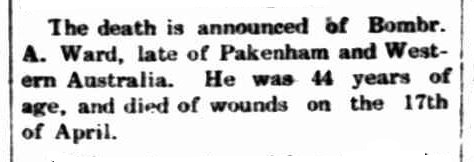
Ward, Arthur  (SN 20154)  Arthur Ward was two months off the age of 42 when he enlisted at Blackboy Hill in Western Australia, on November 19, 1915. He was born at Ballarat and his occupation was a miner and his next of kin was his sister in law, Ellen Hawes of Cowwarr. As the article in the Pakenham Gazette, above, states he died of wounds on April 17, 1918. He had received a gun shot wound the previous day in the shoulder that penetrated the spine, fighting in France. I wonder how long he had been away from Pakenham. Arthur's mother, Eliza Fraser and her second husband, operated a hotel in Pakenham from 1881 to 1890, you can read about Eliza, the Hotel and the rest of the family, here.


This is St Patrick's Catholic Church at Pakenham, built in 1872. It would have been a familiar sight to all the men listed on this Honour Roll. The School opened in 1888.
Photo from North of the Line: a pictorial record, published by the Berwick Pakenham Historical Society.