Showing posts with label Pakenham. Show all posts

Thursday, March 11, 2021

Alfred Hillman - first man to enlist from Pakenham for War Service

The coronation of King George V1 and Queen Elizabeth took place on May 12, 1937. This was celebrated all over the Commonwealth including in Pakenham where more than 1000 people competed in or witnessed a procession or gymkhana which had been arranged to mark the occasion.  The report in the Pakenham Gazette continued with a list of the activities that happened on the day including the best decorated vehicle competition, a colourful display by the men of the 52nd Battalion, foot races and in the evening a Ball which was held at the Pakenham Theatre (1).

Right: Pakenham Gazette May 21, 1937. It is transcribed below.

The next week, May 21 1937 the Pakenham Gazette had the following report  - Amongst the hundreds of interested  spectators who saw the Coronation procession at Pakenham last week was  Mr A. E. Hillman, of Pakenham, a member of the Australian Contingent which went to England in 1902 for the coronation of King Edward VII. Mr Hillman was in the Garrison Artillery and served in the Boer War from 1899 to 1901 under Major (afterwards General) Monash and was awarded the South African medal with six clasps. The Australian Coronation Contingent in 1902 comprised 150 officers and men, 42 of whom were selected from Victoria. The troops were away from Australia for about six months, and in addition to taking part on the Coronation festivities in London toured England and Scotland. Mr Hillman recalls many pleasant memories associated with the tripAs we can see from the short article, Alfred Ernest Hillman, not only witnessed the coronation of Edward VII but also served in the Boer War (also known as the South AfricanWar). 

Alfred was born in Drysdale in 1869 and had had come to Pakenham with his parents, Edward and Eliza (nee Hopkins) Hillman in 1885 (2). His obituary in the Pakenham Gazette said that he had the distinction of being the first man to enlist from Pakenham for war service (3)

Alfred enlisted in the 2nd Victorian Mounted Rifles (4).  He was awarded the South Africa medal with six clasps.This medal was officially called the Queen's South Africa medal and was awarded to all those who served. You can see the clasps on the photograph, at left. Each clasp represented a location (presumably where a battle took place?) such as Transvaal, Modder River, Johannesburg. The Defence Department, where this photograph comes from, has an explantion and description of the badge as well as a list of the twenty six clasps, here.

The other interesting thing the article said was that he served in the Boer War from 1899 to 1901 under Major (afterwards General) Monash. This is, of course, Sir John Monash, World War One General and later the General Manager of the State Electricty Commission. However, Monash's Australian Dictionary of Biography entry (see here) written by Geoffrey Searle, said that although Monash was a member of the  North Melbourne Battery of the Metropolitan Brigade of the Garrison Artillery, he did not volunteer for and was not invited to take part in the South African War.  Possibly, Alfred may have served under Monash in the Garrison Artillery before he went to South Africa. 

Alfred lived for a time in Melbourne after his War service where he married Eva Murcutt in 1904. They had two daughters, Eva Forence, born in 1905 and Winifred Mary, born in 1906, both in Richmond (5). In the Boer War nominal rolls (6) Alfred is listed with the service number of 252 the man with the service number of 253 is Joseph Murcutt, Eva's brother (7). Did they know each other before they enlisted or did they met in the recruiting office, become friends and then Joseph later introduced Alfred to his sister? 


Alfred Hillman and his future brother-in-law, Joseph Murcutt.
Boer War Nominal Rolls for the 2nd Victorian Mounted Rifles.

Sadly, Eva died in 1906 at the age of 24, and in 1909 Alfred married Cecelia Elizabeth Smith (8). They had one son Alfred George, known as Fred, born in Pakenham in 1912 (9).  Alfred actively associated himself with practically every public body in Pakenham - the Horticultural Society, the Mechanics' Hall, Recreation Reserve, Cemetery Trust, St James Church, Racing Club and the Farmers Union (10).  In the last twenty years of his life, Alfred operated a poultry farm  in Main Street, near the railway station (11).


Alfred Hillman's Poultry farm at Pakenham

Alfred died on October 15, 1947, aged 78. He was  survived by his wife Cecilia; daughter Eva; daughter & son-in-law, Winnie and Ted Law and their daughter Enid; and son Fred (12).


Death notices for Alfred

Footnotes:
(1) Pakenham Gazette, May 14 1937
(2) His obituary in the Pakenham Gazette October 17, 1947 lists his place of birth and date of arrival in Pakenham. Edward Hillman and Eliza Hopkins had the following children, the first two were born in England and the rest on the Bellarine Peninsula  - 
Albert Edward (1861-1907)
Francis John (1863 - 1949)
Adeline Mary (1865 - 1956, married William Ferguson in 1898)
Julia Anne (1867 - 1934, married Martin John Hitchins in 1892)
Alfred Ernest (1869 - 1947) 
Edward Hopkins (1871 - 1931)
Florence Emily (1871 - 1954, married Robert Francis Lovibond in 1906)
Edith Augusta (1876 - 1876)
Maud Alice (1877 - 1947, married John Charles Whitmore in 1908)
Ida May (1882 - 1909, married James Luke Rees in 1908)
Edward died March 21, 1920, aged 86; Eliza died in 1930, aged 93.
(3) Pakenham Gazette October 17, 1947 
(4) Boer War Nominal Rolls, see here.
(5) Index to the Victorian Births, Deaths and Marriages
(6) Boer War Nominal Rolls, see here.
(7) Eva was the daughter of William John and Eva Susannah (nee Ratcliffe) Murcutt. They had thirteen children between 1881 and 1908 - Joseph who enlisted with Alfred was the first child, born in 1881 and Eva was the second oldest, born in 1882. 
(8) Cecelia (1887 - 1978) was born in Pakenham, the daughter of Oscar and Elizabeth (nee Flower) Smith. Oscar was a blacksmith in Pakenham, he died in 1935 aged 77, you can read his obituary in the Dandenong Journal of October 10, 1935, here. Elizabeth died in 1955, aged 91. 
(9) Alfred's children - Eva Florence (1905 - 1999, married William Thomas Tonkin in 1954); Winifred Mary (1906 - 1983, married Edward Leslie Law in 1930); Alfred George 'Fred' (1912 - 1986).
(10) Obituary - Pakenham Gazette October 17, 1947 
(11) Obituary - Pakenham Gazette October 17, 1947. There was also a short obituary in the Dandenong Journal of October 29, 1947, see here.
(12) Death notice - The Argus, October 16 1947, see here.  

Monday, November 12, 2018

A Century After the Guns Fell Silent: Remembering the Pakenham District's WWI Diggers 1914-1918

On Sunday, November 11, 2018 Patrick Ferry launched his book on the men and women from the Pakenham area who served in the Great War. The book is called A Century After the Guns Fell Silent: Remembering the Pakenham District's WWI Diggers 1914-1918. A limited edition of 250 copies of the book was produced courtesy of a Centenary of the Armistice Grant from the Department of Veterans' Affairs. However, you can also access the information and download  a free copy of the book on this new website  https://www.pakenhamww1.com/

The  book covers all the people listed on the Pakenham & District War Memorial, Pakenham Upper Roll of Honour, Pakenham Upper State School Honour book, St Patricks School Roll of Honour, Pakenham State School Roll of Honour and the Pakenham South War Memorial.

Patrick spent many hours talking to family members of the soldiers - sometimes it was easy to track down relatives as their family still lived in the area, at other times a fair bit of detective work went into finding family members, some of whom had no idea that their Digger was listed on a memorial in the Pakenham area. This has all resulted in a book with family photos and personal insights in the soldiers and their life after they returned home. The book was also produced with the assistance of members of the Berwick Pakenham Historical Society.The book and website is a great contribution to the history of our area and a tribute to the sacrifice that so many local families made to support Australia during the Great War.


Screen shot of the website showing two of the Ellett brothers of Pakenham South

Sunday, September 18, 2016

St Patrick's Catholic School, Pakenham, Honour Roll

The following article appeared in the Pakenham Gazette of April 26 1918 about the recent unveiling of the Honour Board at St Patrick's Catholic School in Pakenham.  The Board is described as a very handsome one, the panel being of blackwood, with a massive  frame of Queensland figured oak. I don't know if it is still there. You can read the full article from the Pakenham Gazette here and another report about the unveiling of the Honour Roll in The Advocate of May 4, 1918 here.


Pakenham Gazette April 26 1918

Here are the 22 names listed on the Honour Roll including their Service Number (SN) so you can look up their full service record at the National Archives of Australia

Rhoden, Norah Sister. Sister Rhoden is listed as Norah in the report but her first name was spelt as Nora  on her enlistment papers. Nora enlisted in Ismaila in Egypt on March 15, 1916. She was 35 years old and served in France and England and Returned to Australia February 2, 1919. Nora was the daughter of John and Kate Rhoden, who were obviously at Pakenham during Nora's school years. Nora died on July 22, 1952 and her obituary appeared on page 2 of The Age of July 24, 1952. 


The Age July 24, 1952


Bourke, James Harrison  (SN  2781)    James enlisted on  November 11, 1914 - he was  28 years old and an Auctioneer.   He  Returned to Australia August 17, 1916 and was discharged on medical grounds on October 9, 1916 due to a 'recurrent high inguinal hernia'
Bourke, Robert Ievers (SN 1885)  Robert enlisted on June 16 1915 aged 28. He was also an Auctioneer. Robert was wounded in action in August 1916, gun shot wound to back and chest, which he recovered from and he returned to fight again and gained a promotion to Lieutenant.  Robert was wounded again in May 1918 - a gun shot wound to the left leg where his tibia and fibula was fractured and was sent back to Australia in November 1918.
Robert and James were the sons of Daniel Bourke and Frances Ievers, who were living in Stratford when their sons enlisted. Daniel had previously owned 400 acres in Pakenham, Mt Bourke, which was part of Thomas Henty's Pakenham Park. Daniel's parents were Michael and Kitty Bourke who took up the 12,800 acre Mintons Run property in 1843 and in 1849 built the La Trobe Inn (also known as Bourke's Hotel for obvious reasons) on Toomuc Creek.

Clancy, Arthur John (SN 557) Arthur was a 31 year old labourer when he enlisted on February 16, 1916. He was Wounded in Action in Belgium and died four days later on October 8, 1917.
Clancy, David Edward  (SN 11927)  David enlisted on November 6, 1915 at the age of 21. He Returned to Australia on September 25, 1919.
Arthur and David were the sons of William Bailey Clancy of Wyuna, Pakenham.

Dwyer, Thomas Kelly (SN 7243) Thomas enlisted on November 20, 1916 in Blackboy Hill in Western Australia. He was a 26 year old Hospital Attendant. Thomas was Killed in Action in Belgium on March 12, 1918.
Dwyer, William Joseph (SN 7233) William enlisted in Sydney, on January 25, 1917. He was a 25 year old Coal Lumper. He was Wounded in Action in France in May 1918 (Gun shot wound to left buttock) but recovered and rejoined his Battallion and Returned to Australia July 23 1919.
Thomas and William were both born in Pakenham. Thomas' next of kin was his father, John Kennedy Dwyer, of Claremont in Western Australia and William's next of kin was his mother, Mary Dwyer, also of Claremont.

Fahey, Edward Joseph (SN 1671A) Edward was 21 when he enlisted on May 4, 1915. He was born in Pakenham and was a grocer. He Returned to Australia March 28, 1919.
Fahey, James  (SN 1695) James enlisted at the age of 31 on August 10 1915. He Returned to Australia December 18, 1918. He was born in Carlton according to  his enlistment paper, but the Victorian Births, Deaths and Marriage Index have him listed as being born in Pakenham.  His occupation was labourer. James died in 1954 aged 65.
Fahey, Patrick (SN 2316) Patrick enlisted at the age of 24 on November 16, 1915. His occupation was a wheeler and he was born in Pakenham. Patrick Died of Wounds received in Action in Belgium on October 16, 1917.
Fahey, Thomas   (SN 3289B) Thomas was born in Pakenham and enlisted, at the age of 25,  on July 21, 1915 in Liverpool in New South Wales. He was Killed in Action in France on November 18, 1916.
Fahey, William Alexander  (SN 377)  William enlisted on January 22, 1915, he was a 26 year old labourer. He was born at Pakenham. William was awarded the Military Medal - For most conspicuous gallantry in action at Mouquet Farm on 26th August, 1916, in continuing to fire on the enemy after he had been wounded in both arms.  William Returned to Australia on March 13, 1918 and was discharged ion medical grounds in July - he had Tachycardia - an abnormally rapid heart beat. William died in 1956 aged 65.
The Fahey brothers all had their mother Margaret  of Carlton as their next of kin. She was listed variously as  Margaret Christopherson, Margaret C Fahey or Margaret Christopherson Fahey. I think we can assume that their father John Fahey was deceased (I believe he died in  1895 aged 45 and is  buried at the Pakenham Cemetery)   but I cannot find a marriage of Margaret to Mr Christopherson, although I did find her death in 1927 at the age of 64 where she was listed as Margaret Christopherson.  John and Margaret (nee Kelly) Fahey had six boys - there was also a John, born in 1886, so he was the second eldest. I don't have any information about him.
So far, the Fahey Brothers are the only set of five brothers that I have come across from our local area who enlisted, but I have written about other sets of three or more brothers who enlisted in various other posts.

Fennell, James Patrick (SN 33181) James enlisted on October 25, 1916 aged 25. His occupation was a driver and his next of kin was his father, Michael, of Pakenham, He Returned to Australia July 8, 1919.

Halloran, Timothy  (SN 3134) Tim was the son of John and Joanna Halloran of Pakenham and they were both listed as his next of kin when he enlisted on July 19, 1915 at the age of 33.  Ironically, he was Killed in Action in France, exactly one year later on July 19, 1916.

Hayes, John Edward (SN 2451) John enlisted on May 10 1916 and said he was 18, born in Pakenham and an orphan - he also said his name was Robert Campbell Pattison. In reality, as he said in his Statuary Declaration of October 29, 1917, he was actually John Hayes and had been born June 24, 1899, which would have only made him 16 when he enlisted.  John was the son of Jeremiah Joseph and Ellen Mary Hayes of Pakenham.  John Returned to Australia on October 8, 1919.

Hogan, Albert William (SN 14434) Albert enlisted on September 23, 1916 at the age of 22. He was a motor driver. He was born in Pakenham but living in Hawthorn when he enlisted, as was his father Charles, his next of kin. Albert Returned to Australia July 5, 1919.

Kelly, John  Patrick (SN 5388)  John was born at Nar Nar Goon and enlisted on March 10 1916 at the age of 36. His next of kin was his wife, Mary Kelly, of Carlton and he was a  rubber worker. He died of disease in England on October 26, 1918. I couldn't identify this John Kelly until I  found an entry for him in the Narre Warren & District Family History Group's book Sacrifice and Patriotism: a World War One walk in Pakenham Cemetery. John was a cousin to  the Fahey Brothers.

Keogh, Eustace Graham (SN 14516) Eustace was an 18 year old student when he enlisted on May 18, 1916. Eustace Returned to Australia on March 22, 1919.  His next of kin was his father, Dr Arthur George Keogh, who was listed in the Electoral Rolls at Pakenham in 1908 and 1909 and then at 14 Droop Street in Footscray, the same address as Eustace. We can't actually access his records on the Australian National Archives website as they have been 'amalgamated with this person's later service documents'

Keogh, F.A  Not sure who this is - is he a brother of Eustace, above? Eustace did have  a brother who enlisted, Basil Hewlett Keogh (SN 14353) but I don't see how B.H Keogh could be listed as F.A Keogh. I can't see any F.A Keoghs in any list. Apart form Dr Keogh at Pakenham, in 1909 there was also a  Constable Patrick Keogh in the Electoral Roll at Pakenham the same year, is this person connected to him?  I don't know.

The Advocate May 4, 1918

Mulcahy, Richard Lindley (SN 5129)   Listed as L. Mulcahy on the Honour Board. Richard enlisted at the age of 22 on January 18, 1915 - he has various enlistment papers - one of the others say he enlisted on July 14 1915;  his mother Bridget was his next of kin on one and his father John on another - but they did have the same address 133 Charles Street, Ascot Vale. His occupation was a joiner and he was  born in Nagambie, but presumably spent some time at St Patrick's School as a child. Richard Returned to Australia January 31, 1919. As you can see from this excerpt (above) from the article   in The Advocate about the unveiling of the Honour Roll, Mr Mulcahy of Ascot Vale had a son listed on the roll and another son who died of wounds received at Gallipoli. The son that died was Thomas Edward Mulcahy (SN 773) who passed away on August 14, 1915 at the age of 30 at the Alexandria 19th General Hospital - he had fractured ribs and gun shot wounds to the back and shoulder.

Maher, Thomas Francis (SN 50190) Thomas was 18 when he enlisted on October 22, 1917. His occupation was student and he was the son of Stephen and Bridget (nee Ryan) Maher of Pakenham. He Returned to Australia July 23, 1919. Thomas was granted  a Soldier Settler Farm (80 acres in the Parish of Nar Nar Goon). You can read his full Soldier Settlement Record on the Battle to Farm website, here.

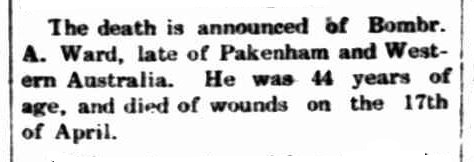
Pakenham Gazette May 10 1918


Ward, Arthur  (SN 20154)  Arthur Ward was two months off the age of 42 when he enlisted at Blackboy Hill in Western Australia, on November 19, 1915. He was born at Ballarat and his occupation was a miner and his next of kin was his sister in law, Ellen Hawes of Cowwarr. As the article in the Pakenham Gazette, above, states he died of wounds on April 17, 1918. He had received a gun shot wound the previous day in the shoulder that penetrated the spine, fighting in France. I wonder how long he had been away from Pakenham. Arthur's mother, Eliza Fraser and her second husband, operated a hotel in Pakenham from 1881 to 1890, you can read about Eliza, the Hotel and the rest of the family, here.


This is St Patrick's Catholic Church at Pakenham, built in 1872. It would have been a familiar sight to all the men listed on this Honour Roll. The School opened in 1888.
Photo from North of the Line: a pictorial record, published by the Berwick Pakenham Historical Society.

Thursday, July 21, 2016

Maher brothers of Pakenham

I thought we would take  a look at some brothers who enlisted in the War, because it's an interesting to think about how their family back home must have felt - it would be stressful enough with one son enlisting let alone two or, in this case, three sons. We have found examples of three brothers enlisting before. Frederick, John and Julian Whiston were from Garfield, you can read about them here; Alfred, Charles and Norman Kent were from Narre Warren and you can read about them here.  Our post on the Yallock Honour Roll had four sets of three brothers - Alfred, Arthur and Claude Leeson from Yannathan;  Alfred, Norman and Thomas Light of Yallock; George, Robert and William Harker and David, George and Thomas Hatty. You can read about them here. Their were five Fahey Brothers who enlisted, they are on the St Patrick's Catholic School Roll - you can  read about them here.

This post looks at  three sons of Stephen and Bridget  (nee Ryan) Maher of Pakenham. Stephen was a member of the Police Force and he was stationed at Pakenham for a number of years from around 1912 until he retired in 1920, after 33 years of service.Stephen and Catherine had ten children, Rosaline (born 1886), Cathleen (1888), Florence Mary (1890), Olive Veronica (1893), Stephen Raymond (1894), John Thomas (1896), Thomas Francis (1899), Daniel Michael (1901) and Leonard Joseph (1903) Mary Monica (1905). According to a report in the South Bourke and Mornington Journal of June 17, 1920 after his retirement he planned to take up farming and grazing on a property he has acquired locally. Stephen died in April 1931 aged 70 and is buried at Pakenham and Bridget died in January 1939 aged 77 and is buried at Box Hill. You can read an obituary of Bridget in The Advocate here and her death notice from The Advocate is below.

The Advocate February 9, 1939

The three sons of Stephen and Bridget who served overseas were Raymond Stephen (called Roy on his enlistment papers), John Thomas  and Thomas Francis. Mrs Maher's obituary said that four sons enlisted in the Great War, three seeing active service so I presume that the fourth son must have been Daniel who was born 1901, but that would still have made him only 17 when the War ended, so not sure about that and Leonard would have been far too young.

Roy (Service Number (SN) 2228) enlisted on August 27 1914 at the age of 20, occupation Labourer. He served in Gallipoli and France and Returned to Australia October 8, 1918.

John Thomas  (SN 1049) enlisted at the age of 21 on June 14, 1915. He is confusingly called Thomas on the Embarkation Roll.  He Returned to Australia on July 3, 1919. John also served in World War Two, he enlisted in December 1940 and was discharged in June 1944, when he was nearly 48 years old.

Thomas Francis (SN 50190) was an 18 year old student when he enlisted on October 22, 1917.   Corporal Thomas Maher Returned to Australia on July 23, 1919. Thomas was granted an 80 acre Soldier Settlement farm on his return, you can read his full record here on the Battle to Farm website.


Pakenham Gazette  November 1 1918


Pakenham Gazette July 15, 1915

Roy sent a letter home to his parents in 1915, he makes it all sound rather pleasant as though he was on holiday and not just having survived Gallipoli,  but obviously was restricted in what he could write. It's  a lovely letter and interesting letter and I have transcribed it below. It was published in the Pakenham Gazette.

AT THE DARDANELLES..
Mrs Maher, wife of Constable Maher, Pakenham, has received the following letter from her son Ray, who is fighting the Turks and Germans at the Dardanelles.

I received your most welcome letter a little time ago. We are back again from the Dardanelles, as there is not space to get the horses off, and the mules can do better there, as the country is very hilly and rough. We have a nice camp out from Alexandria about nine miles, with a train running right through the camp, and the tram within 10 minutes walk. Best of all, the beach is only about a quarter of an hour's walk. We go down to swim the horses now and then, but go our selves every evening, It is where all the tourists come for their holidays, and there are a lot of English and French people there, so we have a good time with them.  I only wish I could speak French; I can only speak a little of it, also a little Egyptian just enough to be understood.  

The people here seemed to think Australia .only a little island, but they were surprised to hear that it is bigger than Europe, and that most of the inhabitants are white, instead of black, as they thought. I am writing this in the horse lines, as I am on stable guard, taking the place of my mate, who wanted to go to the races. The sun is about 200 in the shade - that is what it feels, at any rate; and the flies would drive a fellow mad.  

Most of our chaps are at the Dardanelles, but a lot of us had to come back with the horses. Many of our men who were wounded are going back in a day or two; they are getting well again.

I think Italy will make a difference when she comes into the war; she will make the war end sooner. 

I must bring this letter to a close, with love to all at home from Ray.

Thursday, March 10, 2016

Pakenham War Memorial - the 'scene of beer parties'

I came across this article in the Dandenong Journal of May 21, 1941 about the neglected state of the Pakenham War Memorial. It's interesting that after the enthusiasm of having Memorials erected in the late 1910s and the 1920s that it didn't take all that long for the Memorials to be neglected. The Pakenham War Memorial was officially unveiled on January 15, 1921 by Brigadier General Brand. There is a report in Dandenong Journal of February 9, 1928, how the War Memorial is 'a disgrace' (you can read the article here http://nla.gov.au/nla.news-article200675138) The reason would have been, as Cr Bourke said in 1941 that 'that the trouble was that nobody was responsible for the care of the memorial'


Dandenong Journal  May 21, 1941

Here is the text from the article.

Pakenham War Memorial Neglected and Forgotten
"Scene Of Beer Parties", Declares Councillor
Talk of removal at later date

Asking that the position regarding the War Memorial at Pakenham be defined, the Pakenham R.S.S.I.L.A. said that at present it stands neglected and forgotten, and offers little encouragement for the young men of today to come forward and offer their services to their country. “We should remember the fallen always, and the memorial should be kept in a manner fitting to the dead,” the writer stated, in urging council to remove the memorial to a more fitting site. He paid tribute to Cr Bourke for his action in having the surroundings cleaned up at his own expense.

Cr Bourke said that the trouble was that nobody was responsible for the care of the memorial. He understood that the trustees were all dead. Cr C. Greaves said that the soldiers themselves couldn’t do much. If council thought it better to remove the memorial to another site where it could receive attention more easily,then they would fall in with that plan.

Mr Ahern; The site is leased from the railways. The memorial should never have been put there. Most people realised that at the time but the soldiers themselves wanted it there.

Cr Bourke: There’s generally 8 or 9 dozen beer bottles strewn round it. 

The Secretary: That’s what it’s used for - for drinking parties. Couples returning from dances .also use it as a parking place.

Cr Greaves: The memorial can never be satisfactory in a place like it is.

When other councillors suggested removing the memorial, Cr Kinsella pointed out that it would be hard to get a suitable site in the town. He suggested that the proposed removal be deferred until the, present war is over.

Cr Greaves: We’ll have to move it. Maintaining it as just a sort of beer garden is not much good.

He moved, and Cr Wadsley seconded, that the memorial be shifted to a more suitable site when one was found and that in the meantime council look after it.

Later, this resolution was withdrawn when it was pointed out that council could hardly act in the matter without giving the public a say.

After a motion had been carried that council maintain the memorial at half cost to Pakenham and half to lona ridings, Crs Greaves and Wadsley moved that a public meeting be convened by the shire president to consider the position regarding the site.

Where was the Memorial Park?  According to the Back to Pakenham: Souvenir Booklet of March 1951 the community first asked the Railway Department 'for the block of land to the Station Entrance' This was refused on the grounds that it might be needed for railway purposes, but the Department allowed a  portion about one chain wide, running from Station Street to Station Road. The stone was erected and the community raised money for a fence, a hedge and gates, garden seats and a machine gun enclosed in brickwork with a glass front. The booklet goes onto say that for  a number of years it was well cared for, but as time went on it was allowed to get into a state of untidiness - everybody's business being nobody's business.

The War Memorial is now outside the Hall and Library Complex in John Street.

Tuesday, July 29, 2014

Sister Muriel Instone - Army Nurse

Sister Muriel Instone enlisted on May 5, 1915 as an Army Nurse and embarked on the Mooltan on May 18, 1915. She served in hospitals in England and France throughout the War and returned to Australia on the Konigen Luise in January 1920. Table Talk, a weekly Melbourne newspaper at the time, had a full page feature on Nurses who have recently left for the Front in their May 27 1915 issue, so we are lucky to have  a photograph of Muriel.

Table Talk May 27, 1915

Muriel's Embarkation record, from the Australian War Memorial,  is reproduced below. As you can see, her address at the date of her enrolment was Pakenham.  

 Australian War Memorial (click on image to enlarge it) 

To find out where she lived in Pakenham I went to the Electoral Rolls, available through the Ancestry Family History database. In 1914 Sister Instone was living at IYU, a large property at Pakenham. 


This is the entry for Muriel Instone from the 1914 Federal Electoral roll.
Source: Ancestry Family History database

The IYU run  in Pakenham was taken up in 1839 by Dr W. K. Jamieson. It was originally nearly 13,000 acres (about 5, 200 hectares).  In 1849, William Waddell took over the pastoral lease and after his death his widow, Annie purchased the pre-emptive right section plus other land. Mrs Waddell built a large brick house, pictured below,  on the property in 1858 and this would have been where Muriel was living when she was on the property. The property at that time was around 4,800 acres and some subsequent owners were George Watson, Steven and Samuel Staughton and  John Kitchin, who operated what is thought to be Australia's largest dairy farm on the property.


This is the IYU  Homestead. It was built in 1859 and destroyed by fire around 1929.
Photograph from: In the wake of the pack tracks, published by the Berwick Pakenham Historical Society.

According to the Shire of Berwick rate books, Robert and Constance Staughton took over IYU in 1913, which by then  was a mere 2,000 acres. I believe Robert was the son of former owner, Stephen Staughton. The Electoral Rolls indicate that  Muriel was in Melbourne until about 1914, so I am surmising that she took a job with the Staughtons - they had  four children between three and ten to look after and in March 1915 the entire family came down with ptomaine poisoning or food poisoning and needed medical assistance, so they were fortunate they had  an experienced nurse on hand. 


Dandenong Advertiser March 4, 1915
http://nla.gov.au/nla.news-article88662306

Muriel Instone was born in Riverton, New Zealand in 1878 to Matthew and Emily (nee Brodrick) Instone, so she was 36 when she enlisted in 1915. Muriel was in Victoria in 1903 as she is listed in the Electoral rolls at the Homeopathic Hospital in South Melbourne. The Homeopathic Hospital was renamed Prince Henry's Hospital in 1934. Muriel's service record at the National Archives www.naa.gov.au  also indicates that she had experience at the Women's Hospital, that she had her midwifery certificate,  as well as experience in private hospitals and private nursing.  In 1909, Muriel and Daphne Instone were listed as living at 16 William Street, South Yarra. I am not sure of the relationship between Muriel and Daphne, but she was also a nurse. As I said before Muriel returned to Melbourne in 1920 but I cannot find any trace of her after that until her death on October 11, 1932 aged 54.

I was interested to find that when Muriel was still in England and still with the Australian Army Nursing Service that she undertook a three month motor driving and workshop course at Mansions Motor Training Garage in London and she made good progress and passed satisfactorily.  Many of our Army nurses were single women who had to support themselves and make their own way in the world and this training just supports this idea, so that when Muriel returned to Melbourne she could drive her own car and have a basic knowledge of the mechanics of it.

From Muriel's service record at the National Archives of Australia www.naa.gov.au