Sunday, September 15, 2019

Phillip, Rupert and Robert Gay of Lang Lang

As part of our series of Brothers who enlisted, this post will look at the Gay brothers of Lang Lang. The three brothers - Phillip, Rupert and Robert - all enlisted and all returned. They were the sons of Robert and Alice Elizabeth (nee Bray) Gay of Lang Lang. Robert and Alice farmed at their property, Noorong, at Lang Lang and they had nine children - Phillip (born 1891), Rupert (1893), Susan (1895), Robert (1897),  Arthur (1899), Alice (known as Dot, 1902), Marjorie (1904), Sam (1908) and Gus (1910) and Keith (1912). I believe the family arrived  at Lang Lang in 1905 as the boys and their sister, Susan, are listed in the school roll for that year. The School roll is published in the book, Protector's Plains: history of Lang Lang Primary School, No. 2899 and district, compiled by Barbara Coghlan in 1988. Robert Gay died in February 1939 at the age of 79 and Alice died in June 1951 at the age of 84. They are both buried at the New Cheltenham Cemetery.


Alice Gay's death notice
The Argus, June 18, 1951   http://nla.gov.au/nla.news-article23060725

Here are the details of the War Service of the brothers. I have included their Service number (SN), so you can look up their full record on the National Archives, www.naa.gov.au

Gay, John Phillip McCandlish (SN 1474) Phillip as he was known,  was 23 when he enlisted on July 31, 1915. He was a farm labourer, his next of kin was his mother, Alice, and he Returned to Australia April 12, 1919.

Gay, Rupert Alfred   (SN 1479)  Rupert was in the 1st ANZAC Cyclist Corp, and he enlisted on August 14, 1915 at the age of 21. He was labourer and his next of kin was his father, Robert. Rupert Returned to Australia June 12, 1919.

Gay, Robert  (SN 5356)  Robert enlisted on April 10, 1916 at the age of 18. His next of kin was his father, Robert, and his occupation was farm labourer. Robert Returned to Australia October 8, 1919. Robert was granted a soldier settler farm, you can read his file, here, on the Battle to Farm website.


A farewell was held at the Lang Lang Hall on August 30, 1915 to say goodbye to some of the local boys who had joined up - including Rupert Gay.
Lang Lang Guardian September 1, 1915.   http://nla.gov.au/nla.news-article119512821


This very nationalistic and patriotic poem, written by Robert Gay, was published in the Lang Lang Guardian, June 14, 1916. I don't know if it was Robert Gay, the father or Robert Gay, the son. I suspect  it was the father,  as Robert Junior was only 18 in 1916.

Wednesday, September 4, 2019

Heath Hill State School Honor Roll

The Heath Hill State School unveiled their Honor Roll on Friday, March 28, 1919.  William Kelly whose son, Thomas, was one of the fallen, had the honour.  According to the report in the Koo Wee Rup Sun of April 2, 1919 the Hon. A. Downard, M.L.A spoke, as did the Reverend Nasib Jaboor (1), the Presbyterian Minister;  Mr E. Cougle, J.P and the head teacher, Lewis Tamblyn. After the ceremony refreshments were served and the report finished with the day was perfect and a most enjoyable outing resulted.  The Board was made by Herbert Rawlings of Dandenong (2), who also made the Yannathan Honor Board. The Board is now at the Yannathan Hall. Some of the soldiers on the Heath Hill Board are also on the Yannathan Honor Boards, see here.


Heath Hill State School Honor Board.
Image courtesy of the Narre Warren & District Family History Group website http://www.caseycardiniaremembers.org.au/

The Heath Hill State School, No. 3225, opened in April 1895, under the name Protector's Flat. The school moved from its Lang Lang East location to Heath Hill in 1914 and the name was changed to Heath Hill. In 1951, the name changed again to Yannathan South (3).


Unveiling of the Heath Hill Honor Board
Koo Wee Rup Sun, April 2, 1919

What follows is information on the soldiers on the Heath Hill Honor Roll. There are eighteen names on the Roll. I have included their Service Number (SN) so you can look up their full record on the National Archives of Australia, www.naa.gov.au

Brunt, Archibald Andrew (SN 101)  Archibald enlisted January 11, 1915. He was a 21 year old farmer. Archie Returned to Australia December 18, 1918. Archie's brother Trevor (SN 358)  also enlisted. Trevor enlisted at the age of 24 on August 20, 1914 and he  Returned to Australia March 5, 1919. The boys were the sons of William and Sarah (nee Buckland) Brunt, who lived at Pines, Lang Lang.  William died on September 3, 1912 and Sarah moved the family to Albert Park to live. William was the son of Ralph and Mary Jane (nee Funston) Brunt of Gin Gin Bean, Officer, and thus Archie and Trevor are also listed on the Officer Honor Board.


South Bourke & Mornington Journal February 27, 1913

Glover, Robert Henry (SN 3179)  Robert was born in Nyora, he was a farmer and he enlisted at the age of 21 on November 15, 1916. Robert Returned to Australia July 3, 1919. Robert was granted a Soldier Settlement farm in Poowong, you can read his file, here, on the Battle to Farm website. Robert's brother George Edward Glover  (SN 3774) also enlisted on July 24, 1915, when he was 21. He was wounded in action and died as a result on March 16, 1917. The boys were the sons of Daniel and Emily (nee Jolley/Jolly) Glover, they were also the first cousin of Abraham Patullo, listed below.

Hatty, George Frederick (SN 66) George enlisted March 27, 1916 at the age of 21. George was Killed in Action in Belgium on October 12, 1917. George was the son of William and Jessie Augusta (nee Brown) Hatty and the family was living in Timboon when he enlisted. According to the Electoral Rolls they had previously lived in Lang Lang East and Yallock for a number of years. Two of George's  brothers also enlisted -  David Samuel (SN 279) and Thomas Alfred (SN 5607). The three brothers are listed on the Yallock Honor Board.

Head, Charles Arthur (SN 77664)  Charles enlisted on May 31, 1918, he was a 29 year old wheel wright, born in Oakleigh,  and was living in Goroke when he enlisted. His next of kin was his father, John, of Lang Lang. Charles did not serve overseas and was discharged December 24, 1918, due to the War ending.
There is also a C. Head on the Honor Board. I can't find another C. Head with  a local connection, however Charles' brother Alfred also enlisted. 
Head, Alfred John Head (SN 316). Alfred enlisted on July 19, 1916 at the age of 19, he was born in Lang Lang and he was a farmer.  Alfred Returned to Australia April 8, 1919. He was granted a Soldier Settlement farm, you can read his file, here, on the Battle to Farm website
The brothers were the sons of John and Margaret (nee Forster) Head of Lang Lang.

Henham, F. There are two F. Henhams on the Honour Board and it was difficult enough to indentify one F. Henham, so it there really are two F. Henhams, I have no idea who the other one is. I could not find an enlistment for a F. Henham, so  I looked on the Victorian Births Deaths and Marriages Index and found a Frederick Ernest Henham born in 1895 in Berwick to William Iden Henham and Annie Simmons.  He looked likely, but I could not find his enlistment papers. Then I looked on Trove and found a divorce report of William and Annie from 1906 (read it here). The report said they had lived in Lang Lang and that William was divorcing Annie on the grounds of her 'misconduct' with William Brisbane of Hawthorn. Brisbane was a 'land agent' and the Henhams had purchased their Lang Lang farm through him. In the end the divorce was granted. Now I knew that Frederick  Ernest Henham had a connection to the local area, but I still couldn't find his enlistment records, but discovered the enlistment of a Frederick Ernest Brisbane, who I believe is the same man.
Annie Henham and William Brisbane married on December 10, 1906. Whether William Brisbane was Frederick's real father or he just took his name, I cannot  tell you. William died in November 1910. In 1912, Annie married Gordon Forrest. Annie Forrest died at Loch in 1939 aged 75  - her father's surname was listed as Simmonds, so that confirms she was the same woman as Annie Henham.  Frederick's death record in the Victorian Births Deaths and Marriages Index lists his father as William Brisbane. His two brothers James William (1888-1955) and Reginald Walter (1899-1919) also changed their surname to Brisbane.  There were two sisters as well Annie Grace (b.1884) and Ethel Rose (b. 1885), I am still tracking them down. Here's Frederick's details-
Brisbane, Frederick Ernest (SN 3969). Fred was born in Berwick and was a 21 year old farmer when he enlisted on July 9, 1915. He Returned to Australia April 11, 1916 and was discharged on medical grounds (chronic laryngitis) in August 1916.  When he enlisted, Frederick's next of kin was his mother, Mrs G. Forrest, of Athlone, who as we know was the former Mrs William Brisbane and the former Mrs William Henham.

Kelly, Thomas (SN 16078) Thomas was 21 when he enlisted on December 10, 1915, He was wounded in action and Died of Wound September 27, 1917.
Kelly, William (SN 16077) Nineteen year old William enlisted the same day as his brother. He Returned to Australia September 23, 1919.
Thomas and William, born in Yannathan, were the sons of William and Sarah Ann (nee Stephens) Kelly.


From Thomas Kelly's Roll of Honor circular, held at the Australian War Memorial. It tells us that he attended Heath Hill State School.

Ketels I cannot find a Ketels who enlisted, or a Ketel, Kettel, Kettels, Kietel, Kietels or a Kettles. There were 14 men with the name Kettle who enlisted, however, none had a local connection that I could find, so this person is a mystery. There is, of course, Kettle's Road in Lang Lang that goes from McDonald's Track to the South Gippsland Highway, so I wonder if that has a connection.

McGhee, Gordon General (SN 22949) Gordon enlisted on October 27, 1915, he was a 23 year old labourer.  Gordon Returned to Australia May 12, 1919. Gordon's brother, Donald Malachi McGhee (SN 3416) also enlisted, on June 24, 1915. He was a 19 year old railway porter and he was Killed in Action in France on July 19, 1916. The boys were the sons of John and Margaret (nee Johnston) McGhee; they were living at 61 Bridge Street, Northcote when their sons enlisted. Donald was born in Heath Hill and Gordon was born in Lang Lang, according to the Victorian Births, Deaths and Marriages Index or Warragul according to his enlistment papers. Donald's Roll of Honor circular says he attended Yannathan State School. Gordon and Donald are also on the Yallock Honor Board.

McGrath, Edmund (SN 2604)  Edmund was born in Lang Lang and he enlisted at the age of 19 on June 30, 1916.  He was a farmer and his next of kin was his father, Patrick, of  Woolamai. Edmund was wounded in action, gun shot wounds to the shoulder and thigh, and Returned to Australia March 12, 1918. Edmund was the son of Patrick William and Anne Jane (nee Carlton) McGrath. They held a clearing sale on November 23, 1899, so we can clearly establish Edmund's connection to Heath Hill.


Warragul Guardian November 10, 1899

Patrick later became the Valuer at the Shire of Phillip Island and Woolami and he will be assisted in the work by his soldier son, who has recently returned from the front. I presume this was Edmund

Powlett Express July 12, 1918

McGrath, M - this person is also on the Heath Hill Honor Roll, but I cannot find a M. McGrath with a local connection. Edmund (above) had a brother, Michael, born in 1894 in Lang Lang, so he is a potential, but I can't find an enlistment record for him so at the moment this man remains a mystery. 

O'Connor, Robert James (SN 382) Robert was 34 when he enlisted on November 21, 1914. He was born in Heath Hill, was a farmer and his next of kin was his sister, Mary Hanley of Longwarry South.  Robert Returned to Australia May 11, 1919. Robert and Mary were the children of James and Bridget O'Connor. Bridget had died in 1903 and James in 1909.

O'Keefe, Matthew John Allan (SN 3591) Matthew enlisted on April 25, 1916. He was born in Lang Lang, was 19 years old and employed by the Victorian Railways. His next of kin listed was his mother, Charlotte, of Lang Lang. His father was Nicholas Francis O'Keefe. Matthew Returned to Australia May 11, 1919.

Patullo, Abraham Albert (SN 31500) Abraham enlisted on October 2, 1916, at the age of 25. He was a farmer and his next of kin was his father, Thomas, of Lang Lang, which is also where Abraham was born. He Returned to Australia July 13, 1919. Abraham was the cousin of Robert and George Glover, listed above; his mother Elizabeth was the sister of Daniel Glover. Elizabeth and Daniel were the children of Abraham and Ann (nee Lee) Glover.

Priestley - brothers Alfred and Arthur both enlisted, I am not sure which brother was honoured on the Board.
Priestley, Alfred (SN 6877)   Alfred was born in Lang Lang and enlisted on July 11, 1917. He was a 20 year old farmer. Alfred Returned to Australia December 20, 1918 and was discharged on medical grounds - gunshot wound, right shoulder. 
Priestley, Arthur (SN 2200) Arthur enlisted at the age of 21 on June 20, 1916. He was a farmer and also born in Lang Lang.  He was wounded in action and died on January 6, 1918.
Their next of kin was their father, Alfred Turner Priestley, of Nullawil. Their mother was Fanny Gray. Her sister, Ellen, was married to David Johnston McGhee, the brother of Gordon and Donald McGhee, mentioned above. Ellen and Fanny were the daughters of George and Mary (nee Kelly) Gray. George's obituary in the Gippsland Independent of October 29, 1915 (read it here) said that the deceased was well known and highly respected around the district, having lived at Heath Hill for a number of years before coming here [Modella].

Shandley, John Adam (SN 2206) John is not actually on the Heath Hill roll, but he was living in Heath Hill when he enlisted, so he deserves a place in this blog post. John was born in Bunyip, enlisted on October 12, 1916 at the age of 21 and he was a horse breaker. His next of kin was his father, Adam, of Longwarry. John Returned to Australia July 1, 1919.

Thompson, James Henry (SN 4953) James enlisted on October 11, 1915. He was a 22 year old farm labourer and his next of kin was his father, Thomas Alfred Thompson, of Glen Wattle, Yannathan. In September 1916,  his parents Thomas and Catherine, were informed that their son had been Killed in Action on July 21, 1916, this fortunately for the family turned out to be false and James Returned to Australia May 15, 1919.

.......................................................................................................................................................

Footnotes
(1)  The Reverend Nasib Murad Jaboor, came to Lang Lang in 1916. He was born in Syria and did his B.A at the American University in Beirut. When he came to Melbourne he studied at Ormond College and Lang Lang was his first Parish. He died at the age of 66 in 1942. You can read his obituary, here.
(2) South Bourke & Mornington Journal, March 13, 1919, see here.
(23) School history from Vision and Realisation: a Centenary history of State Education in Victoria.

Tuesday, August 27, 2019

The Gardiner brothers of Berwick and their nephews, the Sibert boys

Four brothers from the Gardiner family of Berwick served in the Great War. They all returned, however, two grandsons, who also served in the War did not return. The Gardiner boys were the sons of  James and Mary (nee Church) Gardiner, who had married in 1870. They lived in Brisbane Street.  Mary was the daughter of Isaac Church, she died in 1920, aged  71, and according to her obituary she had been a resident of Berwick for 53 years, hence since 1867. James died in 1923 at the age of 77, and his obituary said that he had been a resident of Berwick for 60 years, thus since 1863.


Brisbane Street, Berwick, c. 1880
This is a great photo - seated on the wagon is John Gardiner, who served in the Boer War and the Great War; his father James Gardiner;  E. Sibert, who I assume is Edward Sibert, the husband of Amelia Gardiner. Standing is G. Church, who is probably Mary Gardiner's brother.

The couple had the following children, all born in Berwick -
  1. John James (1870, married Matilda Ann McCann in 1903 and died 1946) 
  2. Amelia Jane (1872, married Justin Edward Sibert in 1890, died 1941 in Western Australia) It was Amelia's two sons, Frederick and Edward, who died in the War. 
  3. Isaac Henry (1874 - 1875)
  4. Mary Anna (1876,  married Francis Henry Montgomery Marsh in NZ in 1902, died 1962 in Queensland)
  5. George Peter (1878 - 1968, never married)
  6. Walter Israel (1880 - 1881)
  7. Joseph Arthur (1882, married Martha Elizabeth Glenn in 1908, died 1924)
  8. Albert Charles (1884, married Ruth Sherriff in 1909, died 1961)
  9. Clyde (born and died 1886)
  10. Alexander (born and died 1886)
  11. Ernest Edward (1887, married Daisy Campbell in 1925, died 1967)
  12. Emily Edith (1890 - 1970, never married)
  13. Clarence Eustace (1892, married Margaret Fogarty in 1918, died 1965)

Berwick Shire News May 10, 1916

Here are the details of war service of the Gardiner Boys. I have included their Service number (SN), so you can look up their full record on the National Archives, www.naa.gov.au

Gardiner, John James (SN 1651) John enlisted at the age of 44 on May 11, 1916.  His occupation was Civil Engineer and Surveyor and his next of kin was his wife, Mary Ann, of Berwick. Mary is called Matilda and Moya in some sources. John Returned to Australia August 24, 1918. John had also served in the Boer War, he was part  of the 2nd Tasmanian Imperial Bushmen and was Mentioned in Commander-in-Chief's Despatches on April 2, 1901. John  was a Shire Engineer in New South Wales and Queensland and after his retirement in 1935 he returned to Berwick and was elected as a Shire of Berwick Councillor. You can read his obituary in the Dandenong Journal of January 9, 1946, here.

Gardiner, George Peter (SN 4401)  George enlisted on January 5, 1916. He was 37 years old, his occupation was Slaughterman and his address was Cockatoo Creek, a previous name for Cockatoo. George's next of kin was his father, James, and he Returned to Australia April 10, 1919.

Gardiner, Ernest Edward (SN 48) Ernest enlisted on August 22, 1914 at the age of 27. He was a farmer and he enlisted in New South Wales. He was reported as being 'dangerously ill'  and invalided to Australia July 31, 1915 and medically discharged June 6, 1916. Ernest is incorrectly listed on the Embarkation Roll as Gardener.

Gardiner, Clarence Eustace (SN 4707) Clarence enlisted on August 7, 1915. He was a 23 year old fireman, working for the Victorian Railways. His father was his next of kin.  Clarence was Wounded in Action  - gun shot wound left ankle and compound fracture right thigh. Clarence was discharged on medical grounds on April 9, 1918.

Sadly, for James and Mary Gardiner, even though their four sons survived, two of their grandsons did not, Frederick and Edward, who were the sons of Amelia Gardiner and her husband, Justin Sibert, did not return.

Sibert, Frederick John  (SN 3482) Frederick was born in Berwick and  living in Blackbutt in Queensland when he enlisted at the age of 22 on October 18, 1916. He was a timber-getter. His next of kin was his mother, Amelia, of Yarloop in Western Australia. Frederick Died of Wounds received whilst fighting in France, on October 10, 1917.

Sibert, Edward Justin (SN 4551, listed in NAA as 4557) Edward was born in Collie in Western Australia and was 18 when he enlisted on March 1, 1916. His mother was his next of kin. Edward was Killed in Action, sometime between November 3 and November 6, 1916.


Edward's death notice in the West Australian of April 27, 1917


The report on Edward Sibert's death in the Pakenham Gazette - it is transcribed, below.
Pakenham Gazette May 11, 1917 http://nla.gov.au/nla.news-article92152744

News has been received of the death of Private Sibert, an old Berwick school boy, and grandson of Mr and Mrs Jas. Gardiner. He was 18 years of age, enlisted from Western Australia, and sailed for the Front early last year. He was killed in France on 5th Nov. last when charging across " No Man's Land," when the Australians took Baupaume. He has a brother still in the fighting line, and also three uncles -Sergeant C. Gardiner, Sergeant major J. Gardiner and Private George Gardiner. Another uncle - Sergeant E. E. Gardiner who is now with us, took part in the memorable landing at Gallipolli and was severely wounded. Trooper Arthur Gardiner was at the South African war, where his brother, now sergeant-major, was twice mentioned in despatches by Lord Roberts. (Pakenham Gazette May 11, 1917)


The report on Frederick's death in the Pakenham Gazette
Pakenham Gazette  December 7, 1917  https://trove.nla.gov.au/newspaper/article/92152769

Friday, July 19, 2019

The Fisher family of Bunyip - eight sons and a grandson fight for Australia

I came across this article in The Herald with the headline - Footscray Family Produces Nine Men for Ranks. As it turns out four of the sons were born in Bunyip and some of the children also went to school in Bunyip. These men were the family of John and Annie (nee Whelan) Fisher. They were the parents of twelve children born between 1881 and 1898, the ten boys listed below and two daughters, Theresa and Catherine. The family had their story written up in The Herald of May 27, 1916 (see it here) It is transcribed below, in italics. Eight of their sons enlisted in the A.I.F, one son had poor eye sight so was not accepted.  Their eldest son, had enlisted in a Scottish Regiment years before and had been killed, but his son, John,  had enlisted in Melbourne to fight along side his eight uncles. I have added their Service Number (SN) so you can look up their full record on the National Archives, www.naa.gov.au


The article has a photos of all the Fisher boys, and this photo of their mother, Annie, who deserves a medal for giving birth to twelve children and having the heart break of three of her sons dying due to fighting for their country.


A remarkable record of enlistments is claimed by the family of the late Mr. John Fisher, formerly of Bunyip, Gippsland, and Mrs. Fisher, of 2 Newell street, Footscray. Eight of their sons enlisted and a ninth has been rejected.

The eldest son, John, was a lieutenant in the Scottish Regiment, but was killed many years ago, leaving a son, who is now at the front.

Staff sergeant - major, Edward Fisher, the eldest son, is now in the Broadmeadows camp. He was born Kangaroo Flat, Bendigo, and later attended school at Bunyip, Gippsland. He was a member of the Fourth Contingent in the South African War, under Colonel Kelly, and gained a Distinguished Conduct Medal. His wife and children live at Essendon. Edward (SN 6765)  Returned to Australia July 24, 1919.


Edward, went to school at Bunyip.
The Herald May 27, 1916

Lieutenant Walter Fisher was the next son, and he is now at Broadmeadows camp. He was formerly a color-sergeant in the 5th Australian Infantry Regiment, and won the battalion badge for shooting and the company's badge five yearn in succession. His is the only name on the merit-hoard of the company. He enlisted as a private on September 24, 1914, in the 7th Battalion, and was promoted lieutenant at Gallipoli. He commanded the battalion in the battle of Lone Pine. In the first landing he was wounded in the arm, leg and side, but returned to the firing line after four weeks' absence. At Lone Pine he was again wounded in the right arm, the bone being partly shattered. He was buried at Steel's Post, Gallipoli, in July, 1915 through the bursting of a high explosive shell, and it took 20 minutes to dig him out. In the following week he had a similar experience. He was invalided home  on August 20, being discharged as unfit, for further, service. His wife and five children live at Frankston. Walter was born at Kangaroo Flat, he Returned to Australia March 20, 1916.

Sgt James Joseph Fisher is now in Wandsworth Hospital, London, having been wounded in Galllpoli in the Lone Pine attack. He is married, 30 years of age, and his wife and five children live at Sunshine. James (SN 1621) was born in South Melbourne and Returned to Australia in August 1916 and discharged on medical grounds in March 1917 and died June 29, 1919.

Sgt.-Major Terence Rufus Fisher, 38, is married, and has a wife and four children. He is an engineer, and lived in Milton street, West Melbourne. He is in camp, being a member of the Pioneer Battalion. Terence (SN 1502) was born in Bunyip. He Returned to Australia June 12, 1919.

Mr Robert Fisher, 36, married, of Footscray, has made five efforts to enlist, but has failed to pass the sight test. He is the only living boy in the family that has not enlisted.


Martin, was born at Bunyip and Killed in Action at Lone Pine
The Herald May 27, 1916


Cpl. Martin J. Fisher, 24, single, was killed at Lone Pine. He was shot through the thigh on the day of the landing, and returned to the firing line five weeks later. He was a first-class shot and was selected as one of five battalion snipers. He was a member of the Coburg Harriers, and lived at Sunshine where he worked as a carpenter.  Martin (SN 439) was born in Bunyip.

Armourer-Stg George Fisher, 22, of  Sunshine, has a wife and two children. George (SN 63) was born in Bunyip. He Returned to Australia June 12, 1919.


Eli, Cecil and their nephew John Fisher.
The Herald May 27, 1916


Driver Eli Fisher, 20, single, is now at Broadmeadows, in the Pioneer Battalion. Eli (SN 12) was born in Melbourne. He Returned to Australia June 12, 1919.

Private Cecil Fisher, 18, is in camp at Broadmeadows. Cecil (SN 2742A) was born in North Melbourne. He was awarded the Miltary Medal and  Returned to Australia December 18, 1918.

Pte. John Fisher, 18, of the 8th Battalion, is the son of Lieutenant John Fisher.  John (SN 3754) was born in Brunswick, and he Returned to Australia April 12, 1919.

Monday, July 1, 2019

Soldiers with a connection to Bangholme

Bangholme is a small town near Dandenong - it used to be part of the Shire of Dandenong and then when the Shire of Springvale and Noble Park was created in 1955, it became part of this Shire. In 1961, the Shire became the City of Springvale and  the area is  now part of the City of Greater Dandenong. Bangholme, is just outside the City of Casey, and is a neighbour to Lyndhurst. Much of Bangholme is now covered by Melbourne Water's Eastern Treatment Plant. This plant covers 1,100 hectares and opened in 1975.

What was at Bangholme? Not a lot, it seems. The 1940 Victorian Municipal Directory had this to say - BANGHOLME - Agricultural district, with State School and tennis club. This wasn't quite correct as Bangholme also has a Soldiers Memorial Hall, in Worsley Road,  which was opened on August 19, 1931. One report said that the Hall was originally the old Dandenong Fire Station.

The State School had opened on January 23, 1915. There is a delightful account of the opening of the school in the Dandenong Advertiser of January 28, 1915 - which reads in part on Saturday afternoon the new State school, situated at the corner of Mr. S M.Keys' paddock, Harwood and Bangholme roads, was formally opened by Mr. W. S. Keast, M.LA. .....He had much pleasure in expressing his appreciation of the generosity of Mr S. M.Keys, (who was a bachelor in search of a wife) who gave the site for the school, and this was the only instance in Victoria where a landowner had contributed 2½ acres to the Education Department for school purposes...He hoped that in time to come Mr Keys would be the happy daddy of a large family, and they would learn the rudiments of their education at the Bangholme State School... Mr Scott proposed a vote of thanks to the ladies for the important and pleasing part they had taken in the good work. He said there were a number of married people in
the district who were not blessed with children, and he hoped now they had a fine free school they would help to fill it..... Miss Dorothy Field is in charge of the school, which will be attended by about 25 children to commence with. (Read the full report, here)

What follows is a list of soldiers with a connection to Bangholme. I got all the names from newspaper reports of the time, so there may be others and if you know of them,  I would be happy to hear from you. I have included their Service Number (SN) so you can look up their full record on the National Archives of Australia, www.naa.gov.au

Blackmore, Frederick William (SN 1825) Frederick was a 22 year old market gardener when he enlisted on May 31, 1916. His next of kin was his mother, Christina, of Dandenong. Frederick Died of Wounds September 23, 1917.


A memorial service was held for Private Blackmore at a Methodist service at the Bangholme State School on October 14, 1917. 
The service was reported in the Spectator and Methodist Chronicle of November 28, 1917. It is a lovely tribute and well worth reading the full report, which you can do, here


Cameron, Dugald (SN 2839A) Dugald was 40 years old when he enlisted, on March 11, 1916.  He Returned to Australia January 16, 1919.
Cameron, George William (SN 4172) George was 32 years old when he enlisted on July 17, 1915. George was Killed in Action on September 20, 1917.
The Cameron boy's next of kin was their widowed mother, Hughina Cameron and they lived in Harwood Road, Bangholme. Mrs Cameron died in April 1921 and there are a series of letters between Agnes Cameron (Hughina's daughter) and the Army regarding George's medals. Agnes claimed them as next of kin as their older brother, John, was in 'Portuguese East Africa' and had been there since 'he went over to the Boer War.' John wrote a letter from  his home in Inchape, Mozambique, as Portuguese East Africa is now called, asking that the medals be given to Agnes. I don't know why Dugald could not claim the medals, I am not sure what happened to him, but there is a Dugald Cameron who was assigned a Soldier Settlement Farm in the Mildura region, who died in 1961, and that may be our Dugald.


George Cameron had been declared Missing, before it was confirmed that he was Killed in Action and the local papers reported on this. 
Dandenong Advertiser November 8, 1917  http://nla.gov.au/nla.news-article88818555

Gamble, John Clement (SN 1925) John enlisted on March 11, 1916, he was a 27 year old farmer. His next of kin was his mother,  Mrs Mary Wines, of Warrnambool. John Returned to Australia April 8, 1918 and was discharged on medical grounds - Trench Fever and Pleurisy. John's address is listed as Dandenong in the Embarkation Roll, his address in the 1919 Electoral Roll is Harwood Road and in 1921 he is listed at Clyde North.

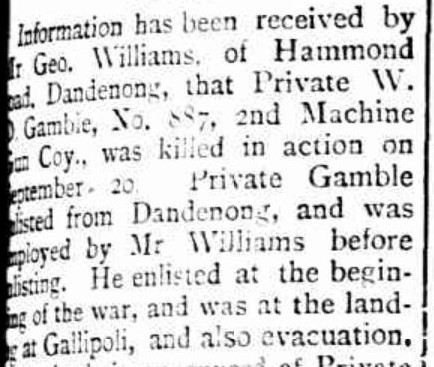
Gambles,  William Denis  (SN 887) William was 19 when he enlisted on August 18, 1914.  His next of kin was his mother, who lived in York in England. William was Killed in Action on September 20, 1917 in Belgium. What was his connection to Bangholme? The Dandenong Advertiser of November 1, 1917 had the following report - which mentions that William was working for George Williams of Hammond Road. Was Hammond Road considered to be Bangholme? It does connect to Banghholme Road and there is a report that Mr Williams attended a function at the Bangholme Hall at the end of April in 1916, where local soldiers were given a presentation before they left the district, so that's enough of a connection to give William a place in this blog post.


Notice about the death of Private William Gambles
Dandenong Advertiser, November 1 1917   http://nla.gov.au/nla.news-article88819005


Giles - the papers report that A. Giles, along with other soldiers, was presented with a wristlet watch at  a function in April 1916; there is  also a report in July 1918 that Corporal Giles was welcomed home. The only Giles with a connection to Bangholme that I could find is John Giles (SN 16015) and he wasn't a Corporal. John enlisted January 19, 1916 and his address at enrollment was 'Boxleigh Farm, Dandenong' and his next of kin was his sister, Mrs George Taylor, of said 'Boxleigh Farm.  I found an advertisement for  a clearing sale at Boxleigh Farm in May 1914 and the address was Harwood Road, which is Bangholme.   John was  43 years old when he enlisted. John never reached Europe but was in India and South Africa where he was 'dangerously ill' with malaria and eventually returned to Australia in December 1917 where he was discharged on medical grounds on February 1, 1918.

Halshaw, J    There is a  J. Halshaw is listed, along with A Giles, whom I wrote about above, and others, as one of the men who would receive a wristlet watch at a send off on April 27, 1916 (see report, below)  You would think that he would be easy to find - but no. There are no soldiers who have a record at the National Archives called Halshaw, Halshore, Holshaw or Holshore. There is a Michael Holschier who enlisted (I have written about him, below) so was Halshaw a phonetic rendering of Holschier? I believe it was.


A report of a 'send off' to be held for Bangholme soldiers. 
South Bourke and Mornington Journal April 20, 1916   http://nla.gov.au/nla.news-article66189742


Hayes, Stanley William James (SN 2675)  I presume this man was known as James as he is listed as J. Hayes in the 'send off' function article, above, so that's what we will call him. James was born in Ireland and was a 23 year old labourer when he enlisted on March 1, 1916. He Returned to Australia April 1917 and was discharged on medical grounds in July 1917. His next of kin was his friend, Hettie Williams, of Willaura, Hammond Road, Dandenong. As a matter of interest, there is a document in his file from 1956  saying that the Imperial War Graves Commission was trying to locate a Stanley Alan Anderson, but that he had actually served as Stanley William James Hayes, so not sure whether he was really Mr Anderson or Mr Hayes.


Michael Holschier's death notice.
The Age October 20, 1917    http://nla.gov.au/nla.news-article155176752

Holschier, Michael Herman (SN 2638)  Michael enlisted on March 1, 1916 at the age of 21, he was a farmer and his next of kin was his widowed mother, Margaret Holschier, of Frankston Road, Dandenong. Michael Died of Wounds, received while fighting in Belgium, on September 30, 1917. The family put a death notice in the paper for Michael (see above) and it mentions that his brother, Harry, was also on active service, but I cannot find any record of him.


The report of the 'send off' held on April 27, 1916 where Corporal Holschier was present. I believe that Michael's name was incorrectly listed as Halshaw in an earlier report of this function (see newspaper report under Halshaw) 
Dandenong Advertiser, May 4 1916   http://nla.gov.au/nla.news-article88658509


Hume, William  Reports of the 'send off' function held on April 27, 1916 said that two recruits joined up on the night - 'Wm Hume and Smith.'  I cannot find a Hume, who enlisted,  with a connection to the Bangholme or Dandenong area.

Jamieson, Duncan (SN 1946)  Duncan was 35 years old when he enlisted on March 11, 1916. His occupation was farmer and his next of kin was John Jamieson, his parents were listed as deceased, so I presume John was his brother.  Duncan Returned to Australia June 10, 1919. Duncan was granted a Soldier Settlement farm in Lyndhurst, you can read his file, on the Battle to Farm website, here.

Keating, Thomas Francis (SN 6294)  There is a J. Keating listed in the 'send off' function of April 1916  referred to previously and at first I thought it might refer to William Joseph Keating (SN 3204 of Dandenong) but he enlisted in August 1918, so that wasn't him. Then I found  a listing of Dandenong Shire volunteers (see here) and it lists a T. Keating -  and I believe Thomas is the man referred to. Thomas enlisted on May 24, 1916 - he was 35 years old. He was born in Skipton and his next of kin was his mother, Matilda, of Skipton.  Thomas was Killed in Action on August 23, 1918. What was his connection to Bangholme?  His address on enlistment was Carrum. His Will lists his sister, Margaret Curley, of Carrum as his executor. The Electoral Roll in 1919  has Margaret Curley at Thompson Road, Carrum and her husband, Matthew Michael Curley,  at Thompson Road, Lyndhurst so in between Carrum and Lyndhurst is Bangholme.  I believe this discrepancy just reflects the fluidity of place names at the time.

Lewis, Albert Reginald (SN 83) Albert was a 25 year old farm worker from Dandenong when he enlisted on March 10, 1916. His next of kin was his father,  Samuel, who lived in England. Albert Returned to Australia June 12, 1919.

Pillar, George (SN 109) George enlisted on March 21, 1916. He was a 20 year old gardener, born in Carrum. George Returned to Australia May 27, 1919.  George was granted a Soldier Settlement farm in Lyndhurst, you can read his file on the Battle to Farm website, here.
Pillar, Harvey (SN 1968)  Harvey was 24 when he enlisted on March 2, 1916. He was a market gardener, born in Carrum and Returned to Australia June 2, 1919. Harvey was also granted a Soldier Settlement farm at Lyndhurst, read his file here.
Pillar, Stewart (SN 962) Stewart enlisted on March 1, 1915 at the age of 27, his occupation was Dairyman.  Stewart was award the Military Medal. He Returned to Australia May 15, 1919.  Stewart, was also granted  a Soldier Settlement farm, near Cobden, read his file, here.
The Pillar boys  all listed their mother, Catherine, as their next of kin. They had her address as Dandenong and once as Island Road, Keysborough. Island Road runs off Perry Road, and Keysborough also borders Bangholme.  Catherine (nee Thompson) married Thomas Pillar in 1874. Thomas died in 1911. There is a Pillars Road in Keysborough and Bangholme, which is named after the family.

Solley, Henry  Captain  Henry was 44 when he enlisted on February 23, 1916 as a Lieutenant. He had already served 21 years in the Army, including serving in India  and five years in the Civilian Military Force. His next of kin was his wife, Annie, they had three children and lived in Albert Park. Henry was promoted to Captain in October 1917. He Returned to Australia May 29, 1919. The connection to Bangholme came in June 1916, when Mrs Solley sent a letter to the Army saying that she had changed her address to Island Road, Dandenong. The family were obviously connected to the Methodist Church at Bangholme as Captain Solley was listed on their Honor Roll (see below).


A report on the first anniversary of the Bangholme Methodist Church and Sunday School, held on Janaury 14, 1917. It also mentioned that a Methodist Roll of Honor was unveiled. 
South Bourke & Mornington Journal  January 25, 1917  http://nla.gov.au/nla.news-article66191400

Smith  Reports of the 'send off' function held on April 27, 1916 said that two recruits joined up on the night - 'Wm Hume and Smith' The only Smith that I can find, with an enlistment date after April 1916 and a local connection is Frederick William Smith  (SN 7085), but I am not convinced that he is the same man who volunteered on the night of the 'send off' function. I have Frederick listed in my Lyndhurst soldiers list (see here)  but here is a short record of his service -   Frederick was born in Lyndhurst and was living in Dandenong when he enlisted on September 17, 1916. He was 24 and his occupation was listed as grocer.  He Returned to Australia on February 19, 1919.

Thompson, Middleton Cooper (SN 1948)  Middleton enlisted on March 2, 1916, he was a 29 year old market gardener - his address in the 1914 Electoral Roll was Main Drain Road in Carrum.  Middleton was awarded the Military Medal. Middleton's next of kin was his mother, Jane, of Richmond. He Returned to Australia July 4, 1919.

Turner, Francis Herbert Blackley (SN 32421) Francis enlisted on September 11, 1916;  he was a 26 year old grazier. His address on the Embarkation Roll was Glen Innes, Dandenong.  His next of kin was his mother, who lived in Kew.  The South Bourke and Mornington Journal of September 21, 1916 had this report of an event at the Bangholme State School where Cr Burden, on behalf of the residents, presented Private Turner (who will soon be leaving for the front) with a case of pipes, and in a few well chosen remarks expressed the pleasure it gave him to be present at such a gathering, it being the first since he became president of the shire, and concluded by wishing that Pvt. Turner would live long to enjoy a smoke out of the pipes he had the honor of presenting to him that evening. I am pleased to report that Lieutenant Turner did survive the War and  Returned to Australia May 22, 1919.

I have created a list of newspaper reports on Trove,  about soldiers who enlisted from the town of Bangholme,  in the First World War. There are also some articles on the Bangholme Memorial Hall, which was opened on August 19, 1931. The hall was originally the old Dandenong fire station. You can access the list, here. All the articles referenced here, are on the list.

Saturday, June 22, 2019

How to plant an Avenue of Honor

This letter to the Editor, from Cr E. Simpson Hill of Tooradin,  on the best way to plant an Avenue of Honor, was published in the Koo Wee Rup Sun of June 18, 1919. 

Honor Avenues and Tree Planting

(To the Editor)

Sir - The time for planting the above is now at hand. Will you kindly permit me to point out a most important matter in connection therewith, so that material benefit may accrue as the result thereof. Shaded roads in winter mean bad roads, ruts and holes and increased expenditure in upkeep, hence a heavy toll on the rates. The proposal I make will, whilst adding to the beauty of our roads, give us shelter, protection from the bleak west and south winds, and allow the sun to exert its beneficent rays where most needed and when most required, upon our avenues of traffic. Plant our notable evergreen, life-giving, anti-malaria gum trees on the south and west sides of all roads running east and west  and north and south respectively. They will thus afford protection from the heavy rains and bleak winds that sodden our roads and sweep sand and gravel and light blinding away. Plant deciduous trees, such as oak, elm and ash on north and east sides of roads running east and west and north and south respectively. By doing so, when these trees shed their leaves in autumn, they admit the rays of the sun to keep the roads dry and warm in winter and keep down expense. I sincerely hope we shall all see this principle extended all over the State, thereby beautifying our land whilst paying a just tribute to the brave lads and heroes, and at the same time add material wealth in money and kind to our coffers.
E.Simpson Hill.
Councillor, Tooradin Riding, Tooradin, 14/6/19

This would, of course,  mean that the Avenues would have gums on one side of the road and exotic, deciduous trees on the other side of the road. It may have been practical, but not very symmetrical. 

Who was E. Simpson Hill?  Niel Gunson, in The Good Country: Cranbourne Shire had this to say - E.Simpson Hill was a well known contractor who reduced much of the Dalmore country to a fertile plain. Edward Simpson Hill was a Cranbourne Shire Councillor from 1918 to 1924 and Shire President 1922 to 1923. The family had been at Cora Lynn and around 1917 they moved to Tooradin, where his occupation in the Electoral Roll was listed as Postmaster, so not sure how that tallies with him being  a Contractor, maybe that was his weekend occupation. 


Edward Simpson Hill died on July 16, 1930. He was the husband of Charlotte and the father of Abner, Queenie. Roland, Crissie, Dudley, Rosie, Arthur and Ivy. 
The Argus July 17, 1930   http://nla.gov.au/nla.news-article4099960

Monday, May 13, 2019

Lyndhurst Memorial Hall

Communities commemorated the Great War in various ways -  War Memorials, Avenues of Honour, Memorial Gates, Memorial Hospitals and Memorial Halls. This is an account of the Memorial Hall at Lyndhurst.

The South Bourke and Mornington Journal reported on April 25, 1912 the following - At the Cranbourne Council meeting on Saturday, 13th inst., a communication was received from eight residents of Lyndhurst making application for a piece of land as per plan forwarded, at the end
of Kirkham's lane, with a frontage to Lyndhurst road, for the purpose of erecting thereon a public hall. 

A year later the matter was back before the Council again as they were dealing with correspondence from the Lands Department regarding the site of the Hall and at the  May 1913 Cranbourne Shire Council meeting the following was reported -  From W. H. Peers, shire solicitor, forwarding copy of plan attached to title for allotment 24 and part of allotment 44, Lyndhurst, proposed site for public hall. On the motion of Crs Brunt and Gamble, secretary to write to owners of land re transfer of same. Lyndhurst Road is the same road as Dandenong-Hastings Road which is now called the Western Port Highway.

However, the Lyndhurst community had obviously been very confident obtaining  the land and  thus building a hall as in October 1912, they purchased a piano for the hall at the cost of  £40, a price which was considered a bargain according to the report in the South Bourke and Mornington Journal.

I cannot find any references to the Hall between 1913 and 1920 as presumably everything was put on hold due to the First World War, but from 1920 there were reports of fundraising activities for what was now called the Lyndhurst Memorial Hall. I also cannot find an exact opening date and the earliest report that I could find that the hall was completed, was this one, below, from the Koo Wee Rup Sun of April 7, 1921


Koo Wee Rup Sun April 7, 1921 - report of Cranbourne Shire Council meeting held April 2, 1921.

In the Dandenong Journal of March 21, 1935, the following was reported - The Lyndhurst Memorial Hall was erected in 1922 to do honor to the late Lieut. M. Kirkham and Driver C. Payne, who paid the supreme sacrifice in the Great War. Apart from the date being incorrect this is interesting as it is the first mention in the newspapers of the fact that the hall was a memorial to the two men and not all the men who had served from the area, which was more common. I have found twenty one men with a connection to Lyndhurst, who enlisted, you can read about them, here.

This is more detail on Lieutenant Kirkham and Driver Payne - 
Kirkham, Malcolm (Service Number 913)  Malcolm was 29, and a farmer from Lyndhurst, when he enlisted on June 8, 1915. His next of kin was his mother, Margaret. Lieutenant Kirkham was Killed in Action in France on September 2, 1918. Malcolm is listed on the Cranbourne Presbyterian Church Honour Roll.

Payne, Charles Lyndhurst (Service Number 4801) Charles Lyndhurst Payne was born in Lyndhurst, and presumably named after his place of birth. He was 21 when he enlisted on April 1, 1916 and his guardian was listed as Mrs Margaret Greaves of Picnic Park, Lyndhurst.   He Died of Wounds received whilst fighting in France on April 26, 1918. Margaret Greaves (1842-1921) was married to William Greaves and was the daughter of Stephen and Alice Payne, so I presume that Charles was her nephew. (Family information from 100 years in Skye: 1850-1950 by Dot Morrison)

The Hall was the centre of social life in Lyndhurst - it was a very active community and many fundraising functions were held - mainly balls. In 1935 it was reported In the month of October, it is estimated that approximately £50 has been raised for church, charitable and local objects, as the result of efforts in the Lyndhurst Memorial Hall (Dandenong Journal November 7, 1935) They also held many functions during the Second World War to raise funds for the Red Cross. I have created a list of articles on Trove on the Lyndhurst Memorial Hall, which you can access here, and so you can read for yourself the many and varied social activities that the Hall hosted. 

However, sadly these events came to an end on the night of January 25, 1944 when the hall was destroyed by fire. The Dandenong Journal of January 26 reported the fire  the Lyndhurst Memorial Hall, which possessed one of the best dance floors in the district, was completely destroyed by fire early yesterday morning. Built in 1921 by the residents of the district as a memorial to Lieut. M. Kirkham and Dvr. C. Payne, the hall cost over £700 then and its value was increased to over £1000 by subsequent additions. It was well appointed and was one of the most popular social centres in the district. The night previous to the fire, a successful function had been held in the hall, and it is surmised that the blaze started from a smouldering cigarette butt.  This was a bit ironic as The Dandenong Journal of September 27, 1934 reported that the Lyndhurst Memorial Hall Social Committee meeting was held on Friday....... Objections were raised to  so much smoking being allowed in the hall, and after discussion it was decided to prohibit smoking in the main hall and kitchen; notices to be put up to that effect. 

The Lyndhurst Social Club still continued to hold functions at other halls, such as Cranbourne and Hampton Park. A public meeting was held in May 1946 where it was decided to build the new hall in brick and they had raised over £1000 for the rebuilding. In 1952, the Lyndhurst Progress Association wrote to the Cranbourne Shire for permission to erect a new hall. But the new Hall was never built and I don't know why. It certainly wasn't for lack of community spirit. I do not have  a photo of the Memorial Hall, so if you have one in your possession I would be interested in seeing them.

A new memorial was unveiled in Lyndhurst on Remembrance Day, November 11, 2017 - it lists just eight soldiers - two from the Great War and six from the Second World War - 
Lieutenant Malcolm Kirkham 
Driver Charles Lyndhurst Payne 
Lieutenant Ivor Kenneth Allison 
Private Allen John Brereton 
Private Raymond George Brereton 
Sergeant James Murray Thomson 
Flying Officer Eric Hurlstone Renfree 
Private Thomas Alfred Wear 

The Memorial was funded by the City of Casey and the money that had been collected to rebuild the Lyndhurst Memorial Hall and kept in Trust for over sixty years was also used. Casey Cardinia Remembers website, has a photograph and some information on this new memorial - see here.

I have created a list of articles on Trove on the Lyndhurst Memorial Hall, which you can access here