Tuesday, November 8, 2016

Celebrating the Armistice at Nar Nar Goon in 1918

I thought we would have  look at how Armistice Day was celebrated in 1918. In this post we look at celebrations in Nar Nar Goon and in  two other posts we will look at how the Cranbourne Shire celebrated the end of the Great War (click here to read) and how the township of Emerald celebrated the Armistice (click here to read) 

This short article was in the Pakenham Gazette on November 29 1918

Pakenham Gazette  November 29, 1918

The following week's edition (December 6)  had  a full report of the activities. The article is on-line on Trove and you can access the article here and I have provided a transcription, below. The day was highly successful with over 1,000 people attending the event, a huge amount of people, nearly everyone in the district must have attended.


Pakenham Gazette  December 6, 1918


NAR NAR GOON
A PEACE CELEBRATION
Wednesday last was a red letter day in the history of Nar Nar Goon, the occasion being a public demonstration  and picnic in connection with the celebration of peace. 

The day was observed as a public holiday, all business places being closed, and it may be safely asserted that most of the residents of the district not only took part in the demonstration but did their best towards making it a success. 

About a fortnight ago the towns people decided that it was desirable that something should be done to mark their appreciation of the glad news that an armistice had been declared and that there was every indication of an early and lasting peace. An appeal was made for funds to meet the expenses of the celebration, and this met with a most generous response, about £50 being raised. 

Wednesday's event was a credit to the town and district, and it will always be looked back upon with interest. Both young and old entered into the spirit of the day, and as a result everything worked smoothly and all had an enjoyable outing.

The day's proceedings opened with a monster procession, which completely eclipsed anything of the kind ever seen in the district, comprising 130 vehicles and numerous horsemen. A number of the vehicles, including buggies, jinkers and lorries, were nicely decorated with greenery and flowers, and there was a profusion of flags, all the Allies being represented. 

An effigy of the Kaiser, the handiwork of Mr Mappin, of Tynong, was mounted on a horse. This was safe guarded by Master J. Ede, in the character of ‘ John Bull’,  and was a special attraction.

Space will not permit of a description of the various vehicles, but it may be said that all were  attractive, those of Mr E. Oram, representing ‘The Day’ and Mr J. Spencer, representing ‘Peace’ being worthy of special mention.

Amongst those with decorated vehicles were :- Messrs A. Harris, M. Dore, J. Mortimer, J. Mulcare, T. Eves, A. Thorn, J. Kenny, J. Gray, S. Collins, T. Garrett, J. Latta, R. Brooke, T. Grigg, E. Oram, J. Spencer, jun., and J. R. Spencer, the last named driving a fine team of four greys in a buggy. There was also a decorated motor, driven by Mr Donald. Some of the riders were in fancy costume. amongst the number being Miss M Raftis (Ireland) and Master Wadsley (England). 

The procession was formed into line at about 11 o'clock, and, headed by the Richmond Juvenile Brass Band, marched from the township to the place chosen for the day's picnic. 

Four returned soldiers, viz., Ptes. W. Comely, P. Neilsson and H. J. Lennon, of Tynong, and Pte. G. Bjursten, of Cora Lynn, held a prominent position in the procession. 

On arrival at the ground judging took place for prizes in connection with the procession, and the awards were as follows: 
Best decorated vehicle: Mr E. Oram, Tynong, ‘The Day’. 
Best Group: Nar Nar Goon. 
Most original character: Master Ede, Tynong, ‘John Bull’.
Special prize: The Kaiser. 

There were about 1,000 persons on the ground, and a sports programme was carried through, providing plenty of enjoyment for young and old.  A merry-go-round was provided for the children. 

Thanks to the excellent management of the committee and the cordial cooperation of all present, the celebrations throughout were a decided success.

In this post we looked at Armistice celebrations in Nar Nar Goon. To see how the Cranbourne Shire celebrated the end of the Great War,  click here. To see how the Emerald township celebrated the Armistice, click here

Sunday, October 23, 2016

Irwin Brothers of Harkaway

This is another post about Brothers who enlisted - these are the Irwin Brothers of Harkaway. They were all born in Carlton to David Gray Irwin and Hannah Purser, who married in 1894. David and Hannah were farming at Harkaway but in 1918 moved to the suburbs (St Kilda, Caulfield areas) and he became a tramway employee, according to the Electoral Rolls. David died in 1928 aged 65 and Hannah died in 1934.


Dandenong Advertiser April 25, 1918

Irwin, James Purser (SN 5035) James enlisted on January 20 1916 at the age of 20. He was a warehouseman. James served in France but  Returned to Australia on  August 27, 1917 and was medically discharged in January 1918 - he suffered from Psoriasis. In 1918 he married Daphne Idina (known as Ida) Mickle and they are  listed in the Electoral Rolls as living at Brighton for twenty years and then various other Melbourne suburbs, he was a Clerk.  James died in 1986. James' dairy recording his experiences in the War is held at the State Library of New South Wales and can be accessed here. He donated the diary to the Library in 1920. The Trustees of the Mitchell Library (as the State Library of N.S.W is known) started the Soldiers' Diaries Collection in 1918 - we are fortunate that they had the foresight to start this collection when many soldiers were still in possession of their diaries..

Irwin, Horace Mark  (SN 967) Horace enlisted on February 9, 1915 at the age of 18 years 8 months. He was an Orchardist.   David Returned to Australia on July 8, 1919. After the War, Horace married Mina Slater in 1922 and they lived in St Kilda and other suburbs.   Horace was a tramways employee, like his father, and died in 1972.

Irwin, Walter Gray (SN 968)  Walter enlisted on March 3 1915 at the age of 18 years and 7 months. He was  a farmer. Walter served at Gallipoli and Returned to Australia  February 8, 1916 and was discharged on medical grounds in the July of the same year. He suffered from 'Neurasthenia' which is now described as an obsolete term to cover lassitude, inability to concentrate, mental and or physical fatigue. Walter married Lena Petersen in 1918 and died in 1968. Walter and Lena lived in Bendigo and Tatura then in the mid 1930s moved back to Melbourne to Oakleigh. Walter was a 'traveller' or salesman.


Berwick Shire News July 12 1916

A 'complimentary social' was held at Harkaway on July 8, 1916, with over 200 people present, to honour new recruits and also to welcome home Private Walter Irwin.

I can't quite work out the ages of Horace and Walter - according to the ages on their enlistment papers they were born two months apart which is clearly unlikely and the  Index to the Births, Deaths and Marriages says that Walter was born 1897 and Mark in 1896, so there was possibly  a mistake on the enlistment papers - if anyone knows the answer to this, I would love to find out.

Wednesday, September 28, 2016

Sister Norah Lehman and Sister Aileen Lehman

The Cranbourne Avenue of Honour was officially opened on August 9, 1919. The Avenue represented 59 men and two women, Sister Norah Lehman and Sister Aileen Lehman. Norah and Aileen  both enlisted on July 17, 1915 into the Australian Army Nursing Service. They were the daughters of George John Lehman and Kate Mary O'Connell who married in Adelaide in 1877. George and Kate had five children in Burra (South Australia) - Stanley Hocking (born) 1878, George Reginald 1879, Norah Blanche, 1882, Ethel, 1884 and Aileen 1886. The next daughter  Cathleen Kate was born in 1888 in Queensland, then daughter Ada was born in  1892 in Dandenong and their last child, Sidney James was born in 1893 in Adelaide.

George Lehman took over the licence of the  Bridge Hotel in Dandenong in February 1889. There was an article in the South Bourke and Mornington Journal of May 10, 1893 saying that the Lehmans had resigned their interest in the licence of the Bridge Hotel. Mrs. Lehman's name was synonymous with attention, civility and good liquor- It is not improbable that they may return to Dandenong. This was prophetic as the same paper reported on July 1, 1896 that the Lehmans had returned to the Bridge Hotel which had been thoroughly renovated.  I presume, as their last child. Sidney, had been born in Adelaide that they had returned to South Australia in the intervening three years. In December 1897 the licence of the Hotel was granted to Kate Lehman (not sure how she had the time to run a hotel as she had eight children ranging in age from nineteen to four!) They operated the Hotel until the end of 1901.

The family was later living in Malvern East where John  was a 'stock dealer' and they were in East Caulfield when Norah and Aileen enlisted in July 1915. In the  1917 Electoral Rolls  George and Kate were at 'Springmeadows' Cranbourne and his occupation was grazier. At some stage they went back to Malvern East and that's where George died on July 27, 1932 at the age of 77. Catherine died on January 1, 1941 at her son's house in Moonee Ponds. It was her youngest son's house, Sid, who was a Doctor.

So back to Norah and Aileen. Aileen was 27 years old when she enlisted, in Egypt. She had trained and worked at the Melbourne General Hospital and also worked at the Albury Hospital.  Aileen served in France and then had a few bouts of pleurisy. Aileen was sent back to Australia on medical grounds, as 'exposure to cold' made her condition worse and she Returned to Australia on July 17, 1917.  On November 17 of the same year she married Cecil Paul Best at Kew. I believe it was a short lived marriage as by 1919 (according to the Electoral Rolls) Aileen (but not Paul)  is listed with her address as care of her parents in Cranbourne and from 1924 she is living at various addresses in Malvern East with her sister, Norah and sometimes other family members. Aileen died in December 12, 1953 aged 68. The death notice in The Argus listed her as 'late first A.I.F' and the mother of Dr Jim Best and the grandmother of three and no mention of the husband.


This lovely tribute to Aileen appeared in the Dandenong Advertiser.
Dandenong Advertiser October 17, 1918

Norah had also trained at the Melbourne General Hospital and had been Matron at Albury Hospital before she enlisted in Egypt with her sister. She served in France and was Mentioned in Despatches for distinguished and gallant service and devotion to duty, this was promulgated on June 29 1917. Norah Returned to Australia  on April 19, 1919.  On her return to Melbourne Norah, as I said before, was living in the Malvern East area and hre occupation from 1924 was listed as 'Inspectress'  - she was a Health Inspector. I have found references to her working at the City of St Kilda around 1930 (see below)


Notice how Sister Lehman earns 240 pounds per annum and the male Health Inspector earns 400 pounds per annum!

Prahran Telegraph October 11 1929


Sister Lehman died on May 24 1949 and this obituary appeared in the Dandenong Journal.
Dandenong Journal June 8 1949


I have created a list of newspaper articles from Trove about the Lehman family, click here to access this list.


Sunday, September 18, 2016

St Patrick's Catholic School, Pakenham, Honour Roll

The following article appeared in the Pakenham Gazette of April 26 1918 about the recent unveiling of the Honour Board at St Patrick's Catholic School in Pakenham.  The Board is described as a very handsome one, the panel being of blackwood, with a massive  frame of Queensland figured oak. I don't know if it is still there. You can read the full article from the Pakenham Gazette here and another report about the unveiling of the Honour Roll in The Advocate of May 4, 1918 here.


Pakenham Gazette April 26 1918

Here are the 22 names listed on the Honour Roll including their Service Number (SN) so you can look up their full service record at the National Archives of Australia

Rhoden, Norah Sister. Sister Rhoden is listed as Norah in the report but her first name was spelt as Nora  on her enlistment papers. Nora enlisted in Ismaila in Egypt on March 15, 1916. She was 35 years old and served in France and England and Returned to Australia February 2, 1919. Nora was the daughter of John and Kate Rhoden, who were obviously at Pakenham during Nora's school years. Nora died on July 22, 1952 and her obituary appeared on page 2 of The Age of July 24, 1952. 


The Age July 24, 1952


Bourke, James Harrison  (SN  2781)    James enlisted on  November 11, 1914 - he was  28 years old and an Auctioneer.   He  Returned to Australia August 17, 1916 and was discharged on medical grounds on October 9, 1916 due to a 'recurrent high inguinal hernia'
Bourke, Robert Ievers (SN 1885)  Robert enlisted on June 16 1915 aged 28. He was also an Auctioneer. Robert was wounded in action in August 1916, gun shot wound to back and chest, which he recovered from and he returned to fight again and gained a promotion to Lieutenant.  Robert was wounded again in May 1918 - a gun shot wound to the left leg where his tibia and fibula was fractured and was sent back to Australia in November 1918.
Robert and James were the sons of Daniel Bourke and Frances Ievers, who were living in Stratford when their sons enlisted. Daniel had previously owned 400 acres in Pakenham, Mt Bourke, which was part of Thomas Henty's Pakenham Park. Daniel's parents were Michael and Kitty Bourke who took up the 12,800 acre Mintons Run property in 1843 and in 1849 built the La Trobe Inn (also known as Bourke's Hotel for obvious reasons) on Toomuc Creek.

Clancy, Arthur John (SN 557) Arthur was a 31 year old labourer when he enlisted on February 16, 1916. He was Wounded in Action in Belgium and died four days later on October 8, 1917.
Clancy, David Edward  (SN 11927)  David enlisted on November 6, 1915 at the age of 21. He Returned to Australia on September 25, 1919.
Arthur and David were the sons of William Bailey Clancy of Wyuna, Pakenham.

Dwyer, Thomas Kelly (SN 7243) Thomas enlisted on November 20, 1916 in Blackboy Hill in Western Australia. He was a 26 year old Hospital Attendant. Thomas was Killed in Action in Belgium on March 12, 1918.
Dwyer, William Joseph (SN 7233) William enlisted in Sydney, on January 25, 1917. He was a 25 year old Coal Lumper. He was Wounded in Action in France in May 1918 (Gun shot wound to left buttock) but recovered and rejoined his Battallion and Returned to Australia July 23 1919.
Thomas and William were both born in Pakenham. Thomas' next of kin was his father, John Kennedy Dwyer, of Claremont in Western Australia and William's next of kin was his mother, Mary Dwyer, also of Claremont.

Fahey, Edward Joseph (SN 1671A) Edward was 21 when he enlisted on May 4, 1915. He was born in Pakenham and was a grocer. He Returned to Australia March 28, 1919.
Fahey, James  (SN 1695) James enlisted at the age of 31 on August 10 1915. He Returned to Australia December 18, 1918. He was born in Carlton according to  his enlistment paper, but the Victorian Births, Deaths and Marriage Index have him listed as being born in Pakenham.  His occupation was labourer. James died in 1954 aged 65.
Fahey, Patrick (SN 2316) Patrick enlisted at the age of 24 on November 16, 1915. His occupation was a wheeler and he was born in Pakenham. Patrick Died of Wounds received in Action in Belgium on October 16, 1917.
Fahey, Thomas   (SN 3289B) Thomas was born in Pakenham and enlisted, at the age of 25,  on July 21, 1915 in Liverpool in New South Wales. He was Killed in Action in France on November 18, 1916.
Fahey, William Alexander  (SN 377)  William enlisted on January 22, 1915, he was a 26 year old labourer. He was born at Pakenham. William was awarded the Military Medal - For most conspicuous gallantry in action at Mouquet Farm on 26th August, 1916, in continuing to fire on the enemy after he had been wounded in both arms.  William Returned to Australia on March 13, 1918 and was discharged ion medical grounds in July - he had Tachycardia - an abnormally rapid heart beat. William died in 1956 aged 65.
The Fahey brothers all had their mother Margaret  of Carlton as their next of kin. She was listed variously as  Margaret Christopherson, Margaret C Fahey or Margaret Christopherson Fahey. I think we can assume that their father John Fahey was deceased (I believe he died in  1895 aged 45 and is  buried at the Pakenham Cemetery)   but I cannot find a marriage of Margaret to Mr Christopherson, although I did find her death in 1927 at the age of 64 where she was listed as Margaret Christopherson.  John and Margaret (nee Kelly) Fahey had six boys - there was also a John, born in 1886, so he was the second eldest. I don't have any information about him.
So far, the Fahey Brothers are the only set of five brothers that I have come across from our local area who enlisted, but I have written about other sets of three or more brothers who enlisted in various other posts.

Fennell, James Patrick (SN 33181) James enlisted on October 25, 1916 aged 25. His occupation was a driver and his next of kin was his father, Michael, of Pakenham, He Returned to Australia July 8, 1919.

Halloran, Timothy  (SN 3134) Tim was the son of John and Joanna Halloran of Pakenham and they were both listed as his next of kin when he enlisted on July 19, 1915 at the age of 33.  Ironically, he was Killed in Action in France, exactly one year later on July 19, 1916.

Hayes, John Edward (SN 2451) John enlisted on May 10 1916 and said he was 18, born in Pakenham and an orphan - he also said his name was Robert Campbell Pattison. In reality, as he said in his Statuary Declaration of October 29, 1917, he was actually John Hayes and had been born June 24, 1899, which would have only made him 16 when he enlisted.  John was the son of Jeremiah Joseph and Ellen Mary Hayes of Pakenham.  John Returned to Australia on October 8, 1919.

Hogan, Albert William (SN 14434) Albert enlisted on September 23, 1916 at the age of 22. He was a motor driver. He was born in Pakenham but living in Hawthorn when he enlisted, as was his father Charles, his next of kin. Albert Returned to Australia July 5, 1919.

Kelly, John  Patrick (SN 5388)  John was born at Nar Nar Goon and enlisted on March 10 1916 at the age of 36. His next of kin was his wife, Mary Kelly, of Carlton and he was a  rubber worker. He died of disease in England on October 26, 1918. I couldn't identify this John Kelly until I  found an entry for him in the Narre Warren & District Family History Group's book Sacrifice and Patriotism: a World War One walk in Pakenham Cemetery. John was a cousin to  the Fahey Brothers.

Keogh, Eustace Graham (SN 14516) Eustace was an 18 year old student when he enlisted on May 18, 1916. Eustace Returned to Australia on March 22, 1919.  His next of kin was his father, Dr Arthur George Keogh, who was listed in the Electoral Rolls at Pakenham in 1908 and 1909 and then at 14 Droop Street in Footscray, the same address as Eustace. We can't actually access his records on the Australian National Archives website as they have been 'amalgamated with this person's later service documents'

Keogh, F.A  Not sure who this is - is he a brother of Eustace, above? Eustace did have  a brother who enlisted, Basil Hewlett Keogh (SN 14353) but I don't see how B.H Keogh could be listed as F.A Keogh. I can't see any F.A Keoghs in any list. Apart form Dr Keogh at Pakenham, in 1909 there was also a  Constable Patrick Keogh in the Electoral Roll at Pakenham the same year, is this person connected to him?  I don't know.

The Advocate May 4, 1918

Mulcahy, Richard Lindley (SN 5129)   Listed as L. Mulcahy on the Honour Board. Richard enlisted at the age of 22 on January 18, 1915 - he has various enlistment papers - one of the others say he enlisted on July 14 1915;  his mother Bridget was his next of kin on one and his father John on another - but they did have the same address 133 Charles Street, Ascot Vale. His occupation was a joiner and he was  born in Nagambie, but presumably spent some time at St Patrick's School as a child. Richard Returned to Australia January 31, 1919. As you can see from this excerpt (above) from the article   in The Advocate about the unveiling of the Honour Roll, Mr Mulcahy of Ascot Vale had a son listed on the roll and another son who died of wounds received at Gallipoli. The son that died was Thomas Edward Mulcahy (SN 773) who passed away on August 14, 1915 at the age of 30 at the Alexandria 19th General Hospital - he had fractured ribs and gun shot wounds to the back and shoulder.

Maher, Thomas Francis (SN 50190) Thomas was 18 when he enlisted on October 22, 1917. His occupation was student and he was the son of Stephen and Bridget (nee Ryan) Maher of Pakenham. He Returned to Australia July 23, 1919. Thomas was granted  a Soldier Settler Farm (80 acres in the Parish of Nar Nar Goon). You can read his full Soldier Settlement Record on the Battle to Farm website, here.

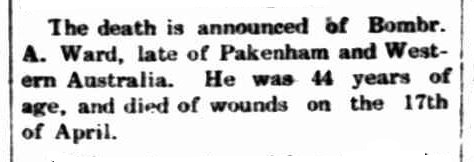
Pakenham Gazette May 10 1918


Ward, Arthur  (SN 20154)  Arthur Ward was two months off the age of 42 when he enlisted at Blackboy Hill in Western Australia, on November 19, 1915. He was born at Ballarat and his occupation was a miner and his next of kin was his sister in law, Ellen Hawes of Cowwarr. As the article in the Pakenham Gazette, above, states he died of wounds on April 17, 1918. He had received a gun shot wound the previous day in the shoulder that penetrated the spine, fighting in France. I wonder how long he had been away from Pakenham. Arthur's mother, Eliza Fraser and her second husband, operated a hotel in Pakenham from 1881 to 1890, you can read about Eliza, the Hotel and the rest of the family, here.


This is St Patrick's Catholic Church at Pakenham, built in 1872. It would have been a familiar sight to all the men listed on this Honour Roll. The School opened in 1888.
Photo from North of the Line: a pictorial record, published by the Berwick Pakenham Historical Society.

Sunday, September 11, 2016

Lambis Engelzos and the lost soldiers of Fromelles

Yesterday I attended the Korumburra Historical Society 50th anniversary celebration where Lambis Engelzos, AM, was the guest speaker. Lambis was one of a team of  amateur (in the sense of being unpaid, nothing to do with the excellent standard of their work) historians who discovered the mass grave site of 250 Australian soldiers who were 'missing' after the Battle of Fromelles in 1916. It's  a fascinating story and Lambis is a fantastic speaker.  You can read about the discovery and the subsequent reburial of the these soldiers in the Pheasant Wood Military Cemetery here and about his quest here.

Anyway, amongst the many interesting things that Lambis said was that there were around 60,000 soldiers who died whilst serving in the AIF but around the same number died in the 15 years after the War, due no doubt to the trauma (both physical and mental) that they suffered during the War. Many of the returned soldiers are lying in unmarked graves in cemeteries around Australia and like the Fromelles soldiers they also deserve recognition.  This made me wonder about my own great uncles and where they are buried - I'll have to find out*. I'm not saying that we should all go out and place  elaborate head stone on these graves, but it did make me think about how we are honoring and recognizing these returned soldiers (and the returned military personnel from later wars)

Lambis spoke at the Koo-Wee-Rup Swamp Historical Society last year, so this is the second time that I have heard him speak and if you ever get the opportunity then go along and hear him. Tim Whitford, was part of the same team as Lambis, who discovered the Fromelles grave site - I have also heard him talk, at the Warragul RSL,  and he is equally interesting,  as his great uncle, Private Harry Willis, from Alberton was amongst the missing soldiers. Harry was indentified by DNA supplied by his niece, Marjory Whitford, who is Tim's aunty. In fact, 150 of the 'missing' soldiers have been positively indentified through DNA and other means. You can read about  Harry Willis here  and listen to podcast of a talk Tim did at the State Library of Victoria during Family History Feast in 2013.


Aerial photograph showing the site of the mass grave beside Pheasant Wood, the northern end of the village of Fromelles, and the site of the Fromelles (Pheasant Wood) Military Cemetery. The mass burial site, its access roads and facilities are shown to the right (eastern side) off the central road leaving Fromelles (the D22). The location of the cemetery site, its access road and carpark are marked on the left (western side) of the D22. [Australian Army]  From http://www.ww1westernfront.gov.au/fromelles/pheasant-wood.php#

*I have found out where they are buried and one of them Alf Weatherhead, who died in May 1976, is for some reason buried at Kangaroo Ground Cemetery even though we have no family connection to the area. His grave is unmarked so that's our project, to get a headstone on his grave, so I'll keep you posted. (19/9/2016)

Thursday, August 25, 2016

Carter Brothers of Bunyip


The Age August 4, 1915

In this post, in our series of Brother who enlisted, we are looking at the Carter Brothers of Bunyip. You can read about the Cullen Brothers of Cockatoo here and the Maher Brothers of Pakenham, here.

William, Alfred and Frederick were the sons of William and Annie Carter (nee Saunders)  of Maidstone House in Bunyip. The Brothers came from Maidstone in  Kent in England, hence the name of their property in Bunyip. William had already died when the brothers enlisted as their next of kin was their mother. Annie died in 1924 aged 61 in Carlton. I believe there were at least two other children, George who died in 1962 aged 60 and the grandly named Victoria Georgina Augusta who was only 22 when she died in 1919 in South Melbourne.

Bunyip Free Press September 9 1915


Carter, Alfred Nathaniel (SN 2467)  Alfred enlisted on July 20 1915 at the age of 26. He was Driver. Alfred sustained  a Gun Shot  Wound to his right arm, which made him permanently unfit for service and thus he Returned to Australia  December 20, 1917 and was Discharged in July 1918. Alfred died on May 14, 1921 at the age of 32 and is buried in the Bunyip Cemetery.

Carter, Frederick Arthur (SN 1397)  Frederick, who was a baker,  enlisted at the age of 20 on July 28 1915. He did his training, was sent overseas to Egypt  and Returned to Australia on May 21, 1916 for discharge due to 'defective vision in right eye'  In the 1919 Electoral Roll, Frederick is living in Carlton, but not sure of what happened to him after that.

Carter, William (SN 2266) William enlisted on July 17 1915  - he was a 28 year old Labourer. William Died of Wounds received while fighting in France on August 6, 1916. William is listed on the Bunyip War Memorial.

Wednesday, August 3, 2016

The Cullen boys of Cockatoo Creek

This is another post on brothers who enlisted, in the last post we looked at the Maher Brothers of Pakenham and we have also looked at the Carter Brothers of Bunyip, here, and in this post we will look at the four Cullen Brothers of Cockatoo Creek, as the town of Cockatoo used to be called. Interestingly, one of the enlistment papers has the address as Cockatoo Creek, Gembrook line, obviously referring to the 'Puffing Billy'  Railway line. The Cullen Brothers are the sons of Francis Patrick Cullen and Mary Jane Whitehead who married in New South Wales in 1883. They had seven children (there may be more)  the first three listed were born in Sydney, Francis (born 1884) Arthur Byrne (1886), Frederick (1888), Kathleen Mary (1890), Emily Margaret (1891) William Beechworth (1894) and Alfred Charles (1899). Mary Jane died in 1950, aged 91 and Francis died in 1942 aged 84.

The Argus May 26, 1915


Here are the four brothers, including their Service Number (SN) so you can look up their full service record in the National Archives of Australia, www.naa.gov.au

Cullen, Alfred Charles (SN 2629)     Alfred first enlisted on September 6, 1915 and said he was 18 years old, but this was untrue. There is  a letter in his file from his father saying that his signature must have been forged as he didn't give permission and his son was only 16 years, ten months old. So Alfred was discharged less than two months later on October 31 for 'being a minor and enlisting without parents consent', He enlisted again as Christopher Patrick Cullen on March 11, 1916 aged 18. His occupation was listed as grocer. It appears that he was  bit of  a 'lad', and was charged with Desertion in November 1917, after having been reported as missing, but found guilty of being absent without leave, sentenced to ten years gaol, which was later commuted to two years and then suspended.  Christopher Returned to Australia July 5, 1919. His real name was actually Alfred Charles Cullen and there is a note in his file saying that in 1922 he signed a Statuary Declaration saying that he wasn't really Christopher. Alfred died in 1969.


National Archives of Australia www.naa.gov.au 
First Australian Imperial Force Personnel Dossiers, 1914-1920


Cullen, Arthur Burns   (SN 1347 or 842) Arthur seems to have two Service Numbers and  is listed as having the same Service Number as his brother Frederick. Arthur enlisted on September 21, 1914 aged 25. His occupation was labourer. Arthur Returned to Australia on  December 3, 1918.

Cullen, Frederick  (SN 1347)   Frederick enlisted on the same day as his brother, William, November 11, 1914. He was a 26 year old Saw Mill hand. He was wounded in action - bullet wound to forehead, - and Returned to Australia in September 1915, but then obviously returned to serve overseas and he was  Killed in Action in Belgium on October 19, 1917. 


The Argus November 14, 1917


Cullen, William Beechworth (SN 1348) William enlisted on November 11, 1914 aged 21. His Occupation was sawyer. William Returned to Australia on  March 11, 1916 and discharged on medical grounds as he was suffering from nephritis (inflammation of the kidneys) William died in 1957.